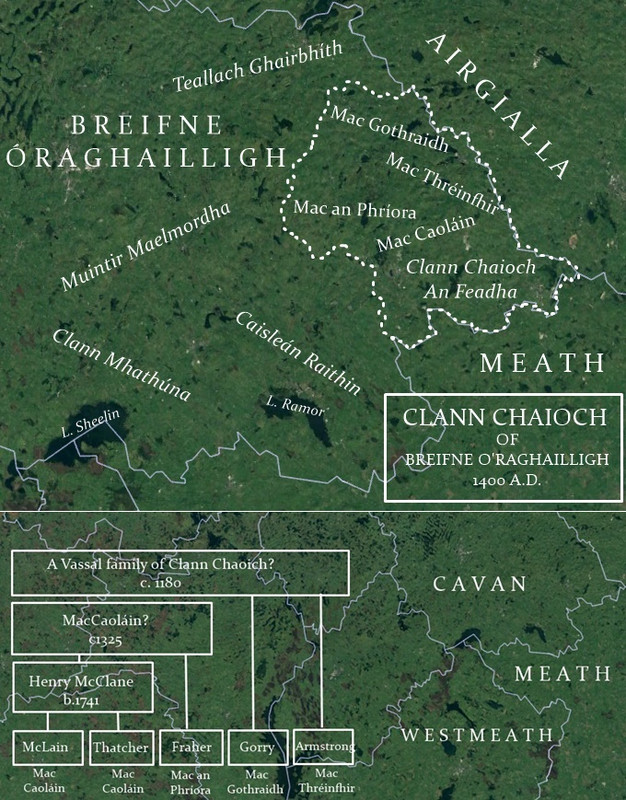
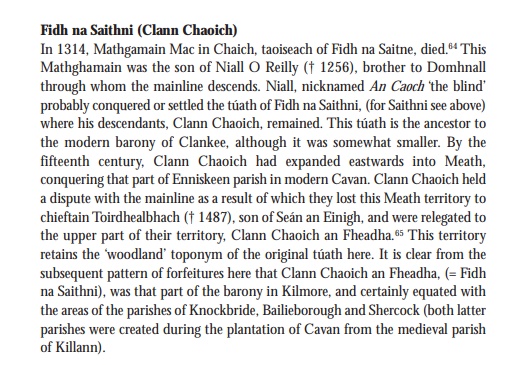
Updated and finalized map of the MacCaolain surname cluster adding in the few older records, especially after finding a townland name of
Coill Caolain in very close proximity to the 1558 fiant of a "M'Kelane" in Balruntagh. I was also careful to omit parishes where there were only McClean variants not not Clane/Kellane/Killane etc (because MacCaolain and MacGillaEain met or overlapped at some point, possibly NW of Lickbla).
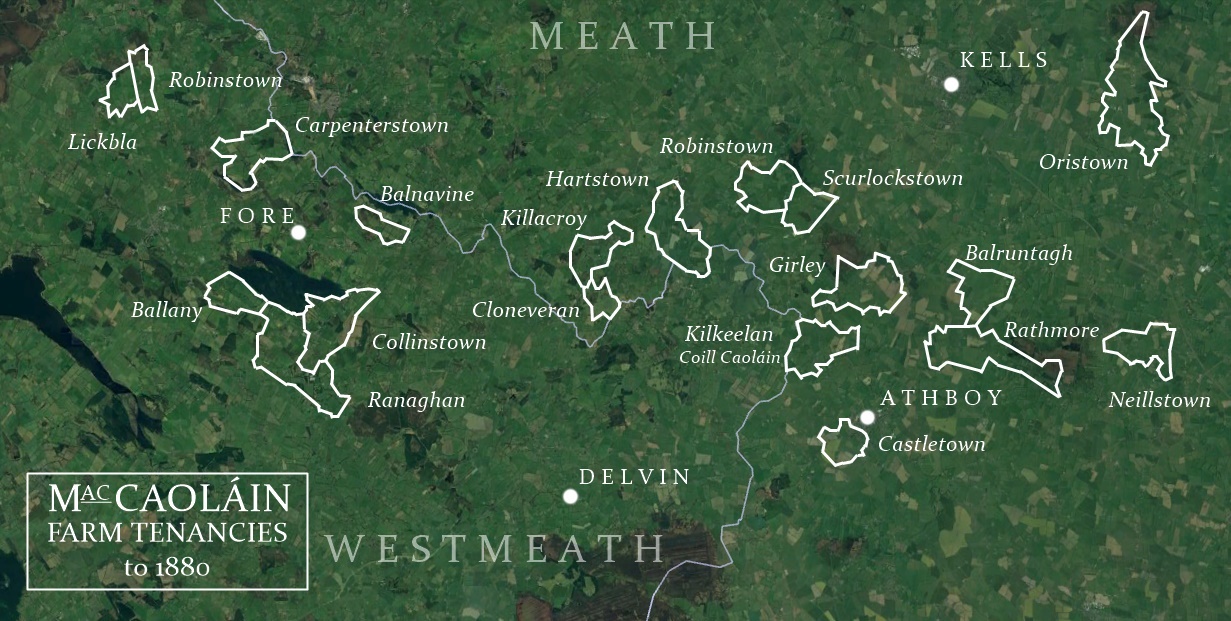
The core of this cluster definitely seems to be around Kilkeelan, almost all of the townlands being held by two of the Plunketts from the 15th through 17th centuries.
Killacroy, Cloneveran, Hartstown, Robinstown--
Plunkett, Earl of Fingall; The Manor of Killallon
Rathmore, Balruntagh, Girley, Scurlockstown--
Plunkett of Rathmore; The Manor of Rathmore, parts of Girley & Burry
My ancestors were in Collinstown/Ranaghan but I have a hunch they may have obtained farms here through maternal relatives in the early 18th century. The given-names somewhat match given names in records of townlands held by the Plunketts of Rathmore, but not at all the farms around Killallon. With the Fiant of Teige M'Kelane in Balruntagh in 1558, and "Clanes" appearing in records in Rathmore through the 1860s, it seems this family was firmly connected to Rathmore parish.
On the face of it with the Breifne connection, one would think this family came here during the gaelic resurgence, but the fact that there is a townland bearing the name Caolain in an area that was subjugated and so heavily anglicized, and became part of a manor under the English manorial system around 1180, I would think the connection may be older. The Normans were successful in the area of Athboy in resisting the need for new Irish tenants from elsewhere for quite a long time, as there is substantial evidence for the area being so heavily planted. However they tolerated and somewhat valued the tenancies of families settled in the area from before the invasion and called them "Betaghs" (food providers).
Revisiting the earliest records of Kilkeelan in 1418, a "Wyllam O'Cwyllane of Kylchewlane" led a jury of six men who were freeholders in deciding a property dispute regarding the bog of Balmartin/Martinstown between the Lords of Athboy and Rathmore. I can take away from this that he spoke English and may have held some local status, maybe a town burgess with a trade or a freeholder. Also there is a 1416 pardon of a "Willam Okallan, chaplain" in Athboy town, but whether this is the same person is unknown. Is O'Caolain an offshoot of MacCaolain? Possibly, or William was simply stating that he was a descedant of Caolain and maintaining that he belonged on the land he was farming.
Some coincidences pointing to an older settlement besides the townland name: Kilkeelan & Rathmore were in the confines of Breifne c1100-1171, also noted as Mag Tlachtga, (the plains of Tlachtga) in 12th century land charters. This area was originally part of the tribes of Gailenge & Luigne that the Ui Ruairc conquered by 1100 and likely started planting Breifne families on the new southern fringe of his territory. Also in the charters referenced that were written in the book of Kells, Godfraidh Ui Raghallaigh was noted as the Lord of Muintir Maelmordha and King of the Gailenge, indicating his and Muintir Maelmordha's interests may lie Maigh Tlachtga and Maigh Gailenge, which for a time would have technically been "East Breifne". Godfraidh is the ancestor of the Clann Chaoich an Feadha who occupied the tuath of Fidh na Saithni in the early 14th century (Clankee barony, Co. Cavan) much longer after surnames had developed. Could Godfraigh Ui Raghallaigh's kin and adherents have originally been some elsewhere in Breifne c1200 and displaced by the Norman incursion resulting in pushing another direction for their own lands and leaving some families behind? After all, the other FT130287 names of Gorry, Friar, and Armstrong are present here.
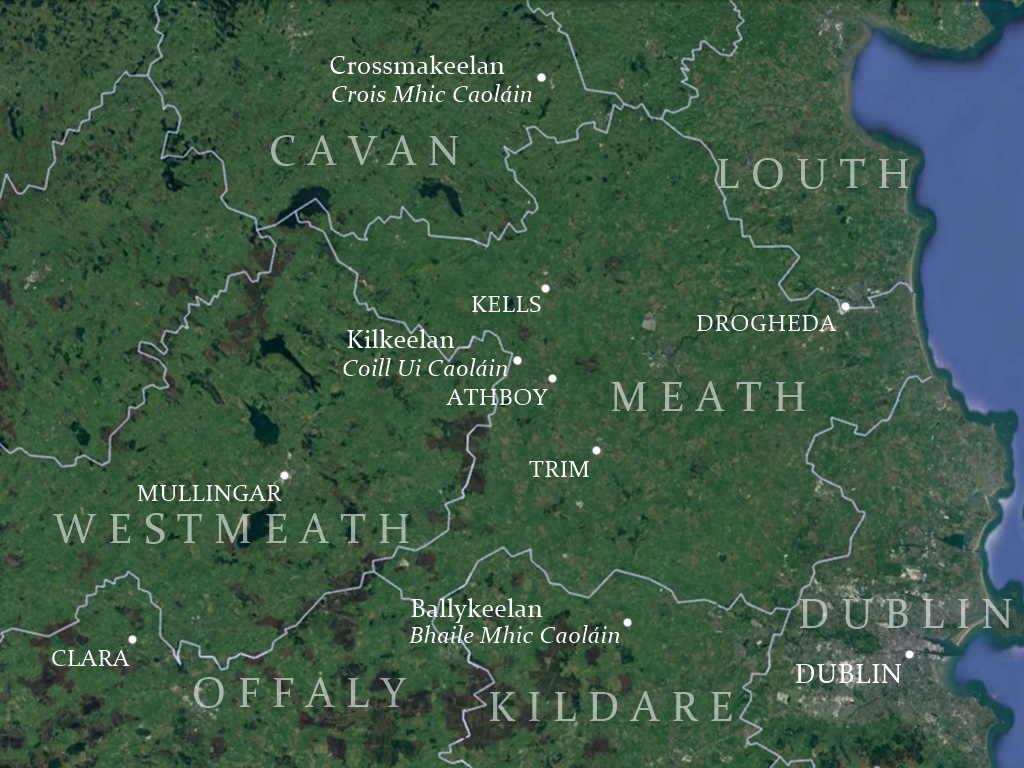
In regards to the other townlands bearing the surname, Ballykeelan in Kildare is first recorded in the Red Book of Ormonde in 1304 ("Waltero de Balymakelane") but Crossmakeelan could be plantation-era, as it references "crossroads" and doesn't appear on the 1609 Bodley maps as that part of the parish is mountainous.
Taking any type of analysis from the most popular anglicization of "Keelan" is very problematic, because it overlapped with O'Ceilachain (an Airgialla sept, also noted to be Keelan) and O'Cathalain (a Meath sept, which turned into Callan and Callane) and today, Keelan/Callan exist most numerously in the Meath/Monaghan/Louth border area. Woulfe noted that Ó CAOLÁIN "seemed to be a Meath family" but he must not have been able to come to any firm conclusions. Mapping out different names on johngrenham, it definitely seems that "Keelan" existed roughly within the boundaries of the Pale but "(Mac)Keel-ayn" existed outside that area, in both Breifne and West Meath which just happened to be linguistically influenced by Connacht.
Although "Westmeath" was officially shired in 1542 from an area where the King's laws could not be enforced, there are references to "West Meath" as early as the 14th century. The old medieval unofficial boundary would have been west of Kells/Athboy/Trim, Westmeath would have included almost all of "Plunkett's Country" where the bulk of this surname cluster lies.