FT130287. Finally moving in the right direction.

This forum is for discussion about the Uí Briúin specifically.
ChrisMcLain132906
Suí Senchada
Posts: 136
Joined: Sat, 2020-Apr-18 3:51 pm
Location: Bushkill, Pennsylvania, US

FT130287. Finally moving in the right direction.

Post by ChrisMcLain132906 »

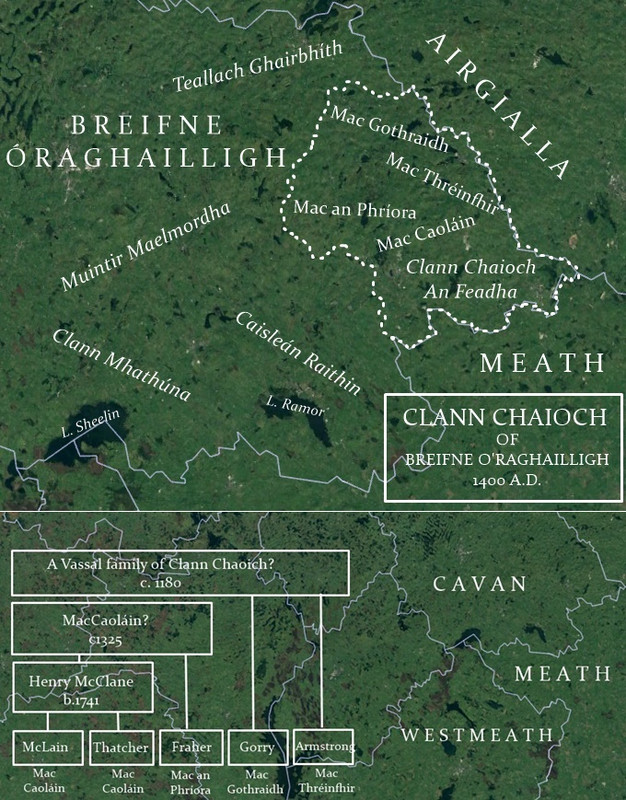
It seems that finally figuring out what "McLain" was (Mac Caolain) has me moving in the right direction as far as A5902>FT130287. Given the amount of contenders for these surnames just in Southern Breifne>Meath it has been a lot of trial and error. Once I found townlands related to "Mac" or "Ui" Caolain, it seems to narrow down the rest of the possiblities for Gorry, Fraher, and the unconfirmed Armstrong. Armstrong seems to be tightly related to Gorry and likely has a more recent ancestor, but as they have not responded to my emails and offers to purchase BigY for them, they are either uninterested or have a dead email address. "Fraher" has been particularly difficult but I found the name is really "Mac an Phriora" which was of popular use by the O'Reillys. It is scattered mostly Granard to Kells as Frayer, Frary, Friary, Frar, but I wasn't completely satisfied with that. I found the variant "Froher" in Bailieborough which seems to jive with the rest of the current analysis as well as a cluster of Friars in Knockbride, 1854.

Image

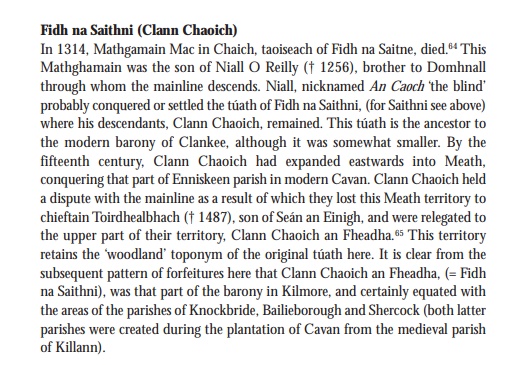
The ancestral farming populations of these families all cluster in Clankee barony, Co. Cavan. Named for "Clann Chaoich an Feadha" (Clan Chaoich of the Lengths or of the wood), a branch of the Ui Raghailligh descended of Gothraigh Ui Raghailligh (late 12th c. King of Muintir Maelmordha & Maigh Gailenga) whose descendant Niall "An Chaoich" (the one-eyed) settled in this territory with his kin and his adherents and also spawned the surname Mac An Chaoich.

What's interesting to me is that the name Mac Gothraigh (Gorry) is said to be associated with Breifne Ui Raghailligh and this man's descendants, however there is yet to be any BY3338+ Gorrys as well as any BY3338+ downstreams of any of these names. Could FT130287 be a foster son or adherent of Gothraigh Ui Raghailligh? The TMRCA of this cluster seems to be in the neighborhood of that possiblity. Gothraigh/Godfrey/Gothrith Ui Raghailligh lead Muintir Maelmordha 1127-1161.
FTDNA Kit 132906 McLain
A5902>FT130287 Muintir Guaire
User avatar
Webmaster
Site Admin
Posts: 1574
Joined: Wed, 2019-Jun-26 2:47 pm

Re: FT130287. Finally moving in the right direction.

Post by Webmaster »

Chris,

Superb work as always. The Mac Cáeláin sept.

And adding my old Gaelic 2 cents worth, the word was cáech which has a genitive case of caích. So, Niall inda Caích, Niall the One-Eyed Man or Niall the One-Eyed. "An Feadha" does get more interesting as feadha does appear it could derive from ed, fet, or fid. So, Cland Caích inda Feda, the Cland of the One-Eyed Man of the Wood?

And finally, yes, I think we are seeing certain families affiliated with one branch actually descended from a different branch; such as Cenél nEógain families actually being genetically Cenél Conaill and vice versa. There is a lot of untangling to do.
Image
ChrisMcLain132906
Suí Senchada
Posts: 136
Joined: Sat, 2020-Apr-18 3:51 pm
Location: Bushkill, Pennsylvania, US

Re: FT130287. Finally moving in the right direction.

Post by ChrisMcLain132906 »

Thanks very much David! The "Feadha" addition definitely confused me a little bit, and it appears the "Clann Chaoich" as a defined sept and nickname could have come a century after the place was already inhabited by Breifne. It was originally part of "Maigh Gailenga" in the early 12th century, a place where Gothraith Ui Raghailligh certainly had interest as he was noted as "King of Muintir Maelmordha & Magh Gaileng" in 1150. It may have originally been a tuath of the Airgialla and forefeited by them as Breifne expanded. Paul Cottar's work in "Early subdivisions of Breifne:

Image
FTDNA Kit 132906 McLain
A5902>FT130287 Muintir Guaire
User avatar
Webmaster
Site Admin
Posts: 1574
Joined: Wed, 2019-Jun-26 2:47 pm

Re: FT130287. Finally moving in the right direction.

Post by Webmaster »

Chris,

My pleasure.

It appears there was a lot going on in the Midlands in the 1100s AD, relating to church matters.
AFM1155.12
Tighearnan Ua Ruairc took Donnchadh Ua Cearbhaill, lord of Oirghialla, prisoner, after he had gone to meet him, to Ceanannus [Kells], with a small force; and he incarcerated him on Loch Sileann, where he was detained for a month and a fortnight, but he was ransomed, through the miracles of God, and of Patrick, and of the saints in general, by Godfrey Ua Raghallaigh, who slew the party who were keeping him; and Donnchadh assumed the lordship of Oirghialla again.
https://www.mcmahonsofmonaghan.org/ocarroll_kings.htm
Unfortunately, I could not easily find a detailed definition of the Saithni, who appear to have been a Midlands people.
AFM1165.3 - Sitric Ua Ruairc, Tanist of Breifne, was killed by Ua Ciardha and the Cairbri. A great depredation was committed by Ruaidhri Ua Conchobhair, and the people of all the province of Connaught, upon the Cairbri, in revenge of Sitric. Another depredation by the same, upon the men of Breagha, the Saithni, and the Ui-Colgain; and they plundered the whole country.
https://freepages.rootsweb.com/~ruairc/ ... annals.htm
Image
ChrisMcLain132906
Suí Senchada
Posts: 136
Joined: Sat, 2020-Apr-18 3:51 pm
Location: Bushkill, Pennsylvania, US

Re: FT130287. Finally moving in the right direction.

Post by ChrisMcLain132906 »

The O'Rourkes must have been real juggernauts, it seems they have constant mention in that timeframe with territorial expansion. If I remember right, the 1167 meeting at Atha Buidhe Tlachtga with O'Rourke, O'Connor & MacMurrough, "Fir Breifne" numbered 4,000+ fighting men. I was able to find some references to the Saithne/Saithni. They look to have a few different splintered tribes, but as Fidh na Saithni was part of "Maigh Gailenga", these look like they may be the correct people, fighting off both the Gailenga, Ui Briuin and Southern Ui Niall.

U1018.3 Maelán son of Éicnech ua Lorcán, king of Gailenga and all Tuatha Luigne, was killed by the Saithni.

U1019.1 Ailéne son of Oiséne, king of Mugdorna, and Oiséne ua Cathasaig, king of na Saithne, were killed by the Gailenga.

M1153, Domhnall Ua Cathasaigh, tigherna na Saithne, was slain by Maelseachlainn, son of Murchadh Ua Maeleachlainn.

M1160, Flaithbheartach Ua Cathasaigh, lord of Saithne, lamp of the chivalry and prowess of Meath, died.

M1170, A predatory incursion was made by Tighearnan Ua Ruairc into Gaileanga and Saithne, and he carried off many cows.


Also I think i'm fairly comfortable now with surname edits on the cladogram at this point. I'm going to keep trying to contact Armstrong so I can hopefully solidify this with another Clann Chaoich name.
FTDNA Kit 132906 McLain
A5902>FT130287 Muintir Guaire
User avatar
Webmaster
Site Admin
Posts: 1574
Joined: Wed, 2019-Jun-26 2:47 pm

Re: FT130287. Finally moving in the right direction.

Post by Webmaster »

I finally found this:
This warrior afterwards won large possessions in Leth-Cuinn; for Connla and Cormac Galengach were the sons of Tadg, son of Kian, son of Olild Olum, and from him have sprung the O'Haras, O'Gares, O'Caseys (of Breagh, in Meath), and the O'Connors Keenaught (i. e. the O'Connors of Ulster). The following are the territories that were possessed by his posterity, namely: the Galenga, both east and west; the Kiannacta, both south and north; and the Luighui, both east and west.

Kinanacta, south. This territory extended from the River Liffey to near Drunnskin, in the county of Louth (comprehending the barony of Ferrard, or Arda Kianacta, in that county). Daleek, in Meath, is mentioned as in it. O'Cathasaigh, or O'Casey, of Saithni, in Magh Breagh, was one of its principal chiefs. He was dispossessed shortly after the English invasion, by Hugo de Lacy, This tribe must be distinguished from the O'Cathasaigh, or O'Caseys, of Coillti Mabinecha, whose territory lay on the borders of the counties of Cork and Limerick, near the town of Mitchelstoun. The Kianacta Breagh did not include Tara within their bounds. The northern Kianacta, the tribeland of O'Connor of Glengiven, has been already pointed out; so have the Luighni.

The importance of the services rendered by Tadg to king Cormac, are sufficiently attested by the largeness and fertility of the territory given to him as a reward for his valor; as is the bravery of his descendants by the number and extent of the territories won by them in Ulster and Connaught. The posterity of Kian did not, however, all migrate to these new districts; the chief part of his descendants ruled the Elian territory down to a late period. There is an ancient historic tale still extant, called the Cath Crinna, which minutely describes the battle of Crinna. "Some of its details are legendary, but it is true as to its main facts."—O'D.

[ The History Of Ireland, Geoffrey Keating, 1857, p.327 ]
So the Saithni were descendants of Ailill Ollam. That took a bit to track down. :roll:
Image
ChrisMcLain132906
Suí Senchada
Posts: 136
Joined: Sat, 2020-Apr-18 3:51 pm
Location: Bushkill, Pennsylvania, US

Re: FT130287. Finally moving in the right direction.

Post by ChrisMcLain132906 »

Fascinating! that's another book I just added to my list :lol:
FTDNA Kit 132906 McLain
A5902>FT130287 Muintir Guaire
ChrisMcLain132906
Suí Senchada
Posts: 136
Joined: Sat, 2020-Apr-18 3:51 pm
Location: Bushkill, Pennsylvania, US

Re: FT130287. Finally moving in the right direction.

Post by ChrisMcLain132906 »

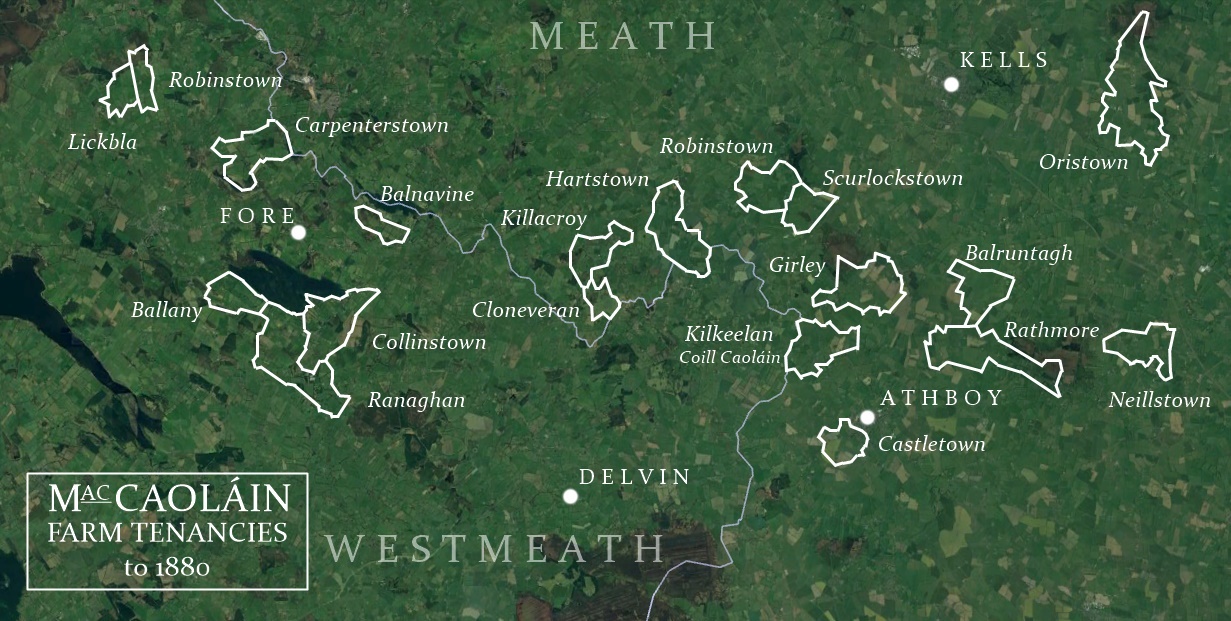
Updated and finalized map of the MacCaolain surname cluster adding in the few older records, especially after finding a townland name of Coill Caolain in very close proximity to the 1558 fiant of a "M'Kelane" in Balruntagh. I was also careful to omit parishes where there were only McClean variants not not Clane/Kellane/Killane etc (because MacCaolain and MacGillaEain met or overlapped at some point, possibly NW of Lickbla).
Image

The core of this cluster definitely seems to be around Kilkeelan, almost all of the townlands being held by two of the Plunketts from the 15th through 17th centuries.
Killacroy, Cloneveran, Hartstown, Robinstown-- Plunkett, Earl of Fingall; The Manor of Killallon
Rathmore, Balruntagh, Girley, Scurlockstown-- Plunkett of Rathmore; The Manor of Rathmore, parts of Girley & Burry

My ancestors were in Collinstown/Ranaghan but I have a hunch they may have obtained farms here through maternal relatives in the early 18th century. The given-names somewhat match given names in records of townlands held by the Plunketts of Rathmore, but not at all the farms around Killallon. With the Fiant of Teige M'Kelane in Balruntagh in 1558, and "Clanes" appearing in records in Rathmore through the 1860s, it seems this family was firmly connected to Rathmore parish.

On the face of it with the Breifne connection, one would think this family came here during the gaelic resurgence, but the fact that there is a townland bearing the name Caolain in an area that was subjugated and so heavily anglicized, and became part of a manor under the English manorial system around 1180, I would think the connection may be older. The Normans were successful in the area of Athboy in resisting the need for new Irish tenants from elsewhere for quite a long time, as there is substantial evidence for the area being so heavily planted. However they tolerated and somewhat valued the tenancies of families settled in the area from before the invasion and called them "Betaghs" (food providers).

Revisiting the earliest records of Kilkeelan in 1418, a "Wyllam O'Cwyllane of Kylchewlane" led a jury of six men who were freeholders in deciding a property dispute regarding the bog of Balmartin/Martinstown between the Lords of Athboy and Rathmore. I can take away from this that he spoke English and may have held some local status, maybe a town burgess with a trade or a freeholder. Also there is a 1416 pardon of a "Willam Okallan, chaplain" in Athboy town, but whether this is the same person is unknown. Is O'Caolain an offshoot of MacCaolain? Possibly, or William was simply stating that he was a descedant of Caolain and maintaining that he belonged on the land he was farming.

Some coincidences pointing to an older settlement besides the townland name: Kilkeelan & Rathmore were in the confines of Breifne c1100-1171, also noted as Mag Tlachtga, (the plains of Tlachtga) in 12th century land charters. This area was originally part of the tribes of Gailenge & Luigne that the Ui Ruairc conquered by 1100 and likely started planting Breifne families on the new southern fringe of his territory. Also in the charters referenced that were written in the book of Kells, Godfraidh Ui Raghallaigh was noted as the Lord of Muintir Maelmordha and King of the Gailenge, indicating his and Muintir Maelmordha's interests may lie Maigh Tlachtga and Maigh Gailenge, which for a time would have technically been "East Breifne". Godfraidh is the ancestor of the Clann Chaoich an Feadha who occupied the tuath of Fidh na Saithni in the early 14th century (Clankee barony, Co. Cavan) much longer after surnames had developed. Could Godfraigh Ui Raghallaigh's kin and adherents have originally been some elsewhere in Breifne c1200 and displaced by the Norman incursion resulting in pushing another direction for their own lands and leaving some families behind? After all, the other FT130287 names of Gorry, Friar, and Armstrong are present here.
Image
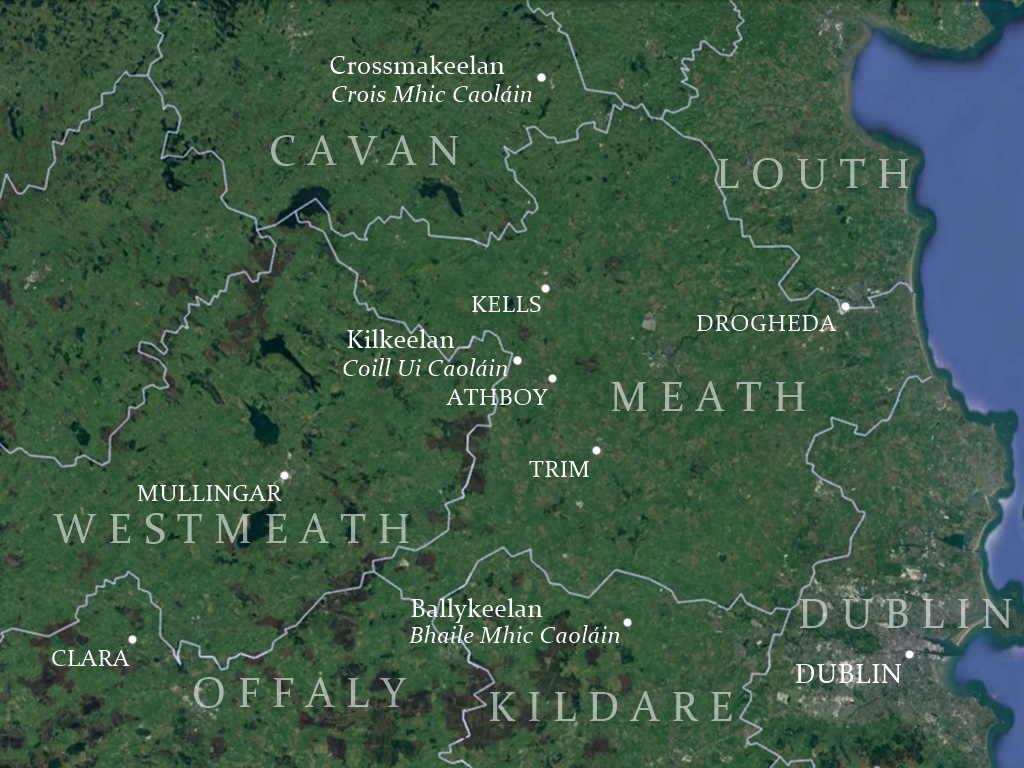
In regards to the other townlands bearing the surname, Ballykeelan in Kildare is first recorded in the Red Book of Ormonde in 1304 ("Waltero de Balymakelane") but Crossmakeelan could be plantation-era, as it references "crossroads" and doesn't appear on the 1609 Bodley maps as that part of the parish is mountainous.

Taking any type of analysis from the most popular anglicization of "Keelan" is very problematic, because it overlapped with O'Ceilachain (an Airgialla sept, also noted to be Keelan) and O'Cathalain (a Meath sept, which turned into Callan and Callane) and today, Keelan/Callan exist most numerously in the Meath/Monaghan/Louth border area. Woulfe noted that Ó CAOLÁIN "seemed to be a Meath family" but he must not have been able to come to any firm conclusions. Mapping out different names on johngrenham, it definitely seems that "Keelan" existed roughly within the boundaries of the Pale but "(Mac)Keel-ayn" existed outside that area, in both Breifne and West Meath which just happened to be linguistically influenced by Connacht.

Although "Westmeath" was officially shired in 1542 from an area where the King's laws could not be enforced, there are references to "West Meath" as early as the 14th century. The old medieval unofficial boundary would have been west of Kells/Athboy/Trim, Westmeath would have included almost all of "Plunkett's Country" where the bulk of this surname cluster lies.
Last edited by ChrisMcLain132906 on Tue, 2022-Jun-28 8:58 pm, edited 1 time in total.
FTDNA Kit 132906 McLain
A5902>FT130287 Muintir Guaire
User avatar
Webmaster
Site Admin
Posts: 1574
Joined: Wed, 2019-Jun-26 2:47 pm

Re: FT130287. Finally moving in the right direction.

Post by Webmaster »

Chris,

Wow! What a long journey from McClain gallowglasses.
Image
Post Reply