
FT130287. Finally moving in the right direction.
-
ChrisMcLain132906
- Suí Senchada
- Posts: 136
- Joined: Sat, 2020-Apr-18 3:51 pm
- Location: Bushkill, Pennsylvania, US
Re: FT130287. Finally moving in the right direction.
Thanks David! Makes me wonder what percent of the "McClean" population is really something else!
FTDNA Kit 132906 McLain
A5902>FT130287 Muintir Guaire
A5902>FT130287 Muintir Guaire
-
ChrisMcLain132906
- Suí Senchada
- Posts: 136
- Joined: Sat, 2020-Apr-18 3:51 pm
- Location: Bushkill, Pennsylvania, US
Re: FT130287. Finally moving in the right direction.
I had a brief conversation via email with Dr. Ó Crualaoich, the chief placename officer for the agency that runs logainm.ie, who specializes in Meath. I asked him if I could pick his brain for a moment and laid out the possibility of Kilkeelan (Coill Ui Caolain; Athboy p., Lune b.) possibly being a pre-Invasion townland name and connected to the two other townlands that bear the surname Mhic Caolain, specifically to see if my theory held water on this surname developing near Kilkeelan on the southern boundary of Breifne c. 12th century (aka Maigh Tlachtga) or elsewhere, and this family's possibly dispersing because of the Norman invasion. He does confirm that it's probably a pre-1171 townland name. Although I don't 100% agree with his response that the townlands are unrelated just because of the surname prefix mentioned (because I've come across quite a lot of instances of prefix changes, almost to the point where I think there may have been a time that Mac and Ó could have been interchangeable or meant the same thing) he also points out that it may not be my thinking of an Irish dialect that created "MAC-keel-AYN" rather than mac-KEEL-ayn, but a later English one.
Chris, a chara,
As the place-name Kilkeelan is first attested in the early 15th century I can only say that it had to be coined in the 14th at the latest and probably prior to that. The fact that Irish were not banished wholesale from the Pale means it certainly could have been coined after the initial surge of Anglo-Norman settlement here, but probably not. I think I mentioned before that it seems likely to be from Coill Uí Chaoláin "the wood of Ó Caoláin", given the presence of a person with that surname here in the 15th century, rather that Coill Chaoláin "Caolán's wood" in which Caolán is a personal name. However, it is extremely important to note that this Ó Caoláin as suggested in Coill Uí Chaoláin is not the same name as that found in Crois Mhic Caoláin in which the qualifier Mac Caoláin could be either a surname or patronymic. This is also true in the case of Baile Mhic Caoláin in Kildare.
As far as anglicisations are concerned, the '-lane' found in 'Kylchewlane' (1420c) and other early historical forms of Kilkeelan, was not at that time pronounced as 'lane' /leːn/ as in the English of today, but this -ane was an attempt to represent the long /aː/ or /ɑː/ of Irish as represented by á in Irish orthography. Indeed, this is the reason why Seán was so often represented by Shane in documents into the 16th and 17th centuries. There was, however, a subsequent vowel-shift in English which led to long a /aː/ developing to long /eː/. Thus we hear the name Shane today not as /ʃɑːn/ but as /ʃeːn/. So I'd suggest that any development of the anglicised name McKeelan (Mac Caoláin) to McLean was a late development, which was facilitated by this vowel shift -- it certainly does not reflect the pronunciation of Mac Caoláin in the Irish of Meath or Oirialla/Oriel.
I'm afraid that I don't have time to tease out the various points you make below, but I will emphasis that Ó Caoláin as reflected in Coill Uí Chaoláin and Mac Caoláin as found in Crois Mhic Caoláin need not be related at all, and both may simply have been formed on the base of the personal name Caolán.
Le dea-mhéin, Conchubhar Ó Crualaoich.
This prompted me to learn a little more about what the english language did with the long a, and found there were two phases of "The Great Vowel Shift" in middle to modern English. Wikipedia uses the word "MATE" and has recordings of what this sounded like in 1400 ("MAHT"), 1500 ("MEHT"), and 1600 ("MAYT"). Fascinating. So the anglicization may be more of a timeframe-specific issue in English, i.e. M'ke'LEHN > M'ke'LAYN c.1550.
Chris, a chara,
As the place-name Kilkeelan is first attested in the early 15th century I can only say that it had to be coined in the 14th at the latest and probably prior to that. The fact that Irish were not banished wholesale from the Pale means it certainly could have been coined after the initial surge of Anglo-Norman settlement here, but probably not. I think I mentioned before that it seems likely to be from Coill Uí Chaoláin "the wood of Ó Caoláin", given the presence of a person with that surname here in the 15th century, rather that Coill Chaoláin "Caolán's wood" in which Caolán is a personal name. However, it is extremely important to note that this Ó Caoláin as suggested in Coill Uí Chaoláin is not the same name as that found in Crois Mhic Caoláin in which the qualifier Mac Caoláin could be either a surname or patronymic. This is also true in the case of Baile Mhic Caoláin in Kildare.
As far as anglicisations are concerned, the '-lane' found in 'Kylchewlane' (1420c) and other early historical forms of Kilkeelan, was not at that time pronounced as 'lane' /leːn/ as in the English of today, but this -ane was an attempt to represent the long /aː/ or /ɑː/ of Irish as represented by á in Irish orthography. Indeed, this is the reason why Seán was so often represented by Shane in documents into the 16th and 17th centuries. There was, however, a subsequent vowel-shift in English which led to long a /aː/ developing to long /eː/. Thus we hear the name Shane today not as /ʃɑːn/ but as /ʃeːn/. So I'd suggest that any development of the anglicised name McKeelan (Mac Caoláin) to McLean was a late development, which was facilitated by this vowel shift -- it certainly does not reflect the pronunciation of Mac Caoláin in the Irish of Meath or Oirialla/Oriel.
I'm afraid that I don't have time to tease out the various points you make below, but I will emphasis that Ó Caoláin as reflected in Coill Uí Chaoláin and Mac Caoláin as found in Crois Mhic Caoláin need not be related at all, and both may simply have been formed on the base of the personal name Caolán.
Le dea-mhéin, Conchubhar Ó Crualaoich.
This prompted me to learn a little more about what the english language did with the long a, and found there were two phases of "The Great Vowel Shift" in middle to modern English. Wikipedia uses the word "MATE" and has recordings of what this sounded like in 1400 ("MAHT"), 1500 ("MEHT"), and 1600 ("MAYT"). Fascinating. So the anglicization may be more of a timeframe-specific issue in English, i.e. M'ke'LEHN > M'ke'LAYN c.1550.
FTDNA Kit 132906 McLain
A5902>FT130287 Muintir Guaire
A5902>FT130287 Muintir Guaire
-
Webmaster

- Site Admin
- Posts: 1587
- Joined: Wed, 2019-Jun-26 2:47 pm
Re: FT130287. Finally moving in the right direction.
Chris,
I have come across this certainty in native Irishmen of how Gaelic surnames were Anglicized, starting at least as early as John O’Donovan in the mid 1800s AD. But they don't seem to understand that there were "extreme Anglicizations" of Gaelic surnames, of which we have come across several. Of course, we are also dealing with dialectical differences among Americans, Australians, New Zealanders, etc. as well. Nonetheless, it seems to be clear that Gaelic surnames even in Ireland occasionally were Anglicized in ways the Irish themselves did not expect.
Also, any read through Rev. Woulfe's Irish Surnames will show that Mac and Ó were used interchangeably among some families; and as Rev. Woulfe puts it, "as an alias".
I have come across this certainty in native Irishmen of how Gaelic surnames were Anglicized, starting at least as early as John O’Donovan in the mid 1800s AD. But they don't seem to understand that there were "extreme Anglicizations" of Gaelic surnames, of which we have come across several. Of course, we are also dealing with dialectical differences among Americans, Australians, New Zealanders, etc. as well. Nonetheless, it seems to be clear that Gaelic surnames even in Ireland occasionally were Anglicized in ways the Irish themselves did not expect.
Also, any read through Rev. Woulfe's Irish Surnames will show that Mac and Ó were used interchangeably among some families; and as Rev. Woulfe puts it, "as an alias".

-
ChrisMcLain132906
- Suí Senchada
- Posts: 136
- Joined: Sat, 2020-Apr-18 3:51 pm
- Location: Bushkill, Pennsylvania, US
Re: FT130287. Finally moving in the right direction.
Some new developments and theories with Mac Caolain after turning up a lot of information worthy of noting.
I had figured for a while that the modern "Keelan" anglicization, as it was also noted to be a variant of the Oriel sept Ó Céileacháin had become so very conflated with Ó Caoláin (Breifne-Meath), that it wasn't worth really analyzing the original population via 1901 census because it would be impossible. But finding some odd coincidences with data that the scholars gathered made me want to look into it. Woulfe in his second edition of Irish names in 1923, adds the variant Keallain to his entry for Ó Caoláin so he likely came across the same things I did as it pertains that that vowel swap in the long-A syllable.
However as I feel I overturned just about everything, the evidence for an Ó-prefix to this surname really seems insignificant to the amount of references to a Mac-prefix. Aside from the records plotted below, the only other time I've definitively found this name with an Ó-prefix is a 1410 chancery roll entry for a Beaghan O'Kyllane, s. of Philip who d. near Trim, Co. Meath, and his land was confiscated by a local Anglo-Norman lord.
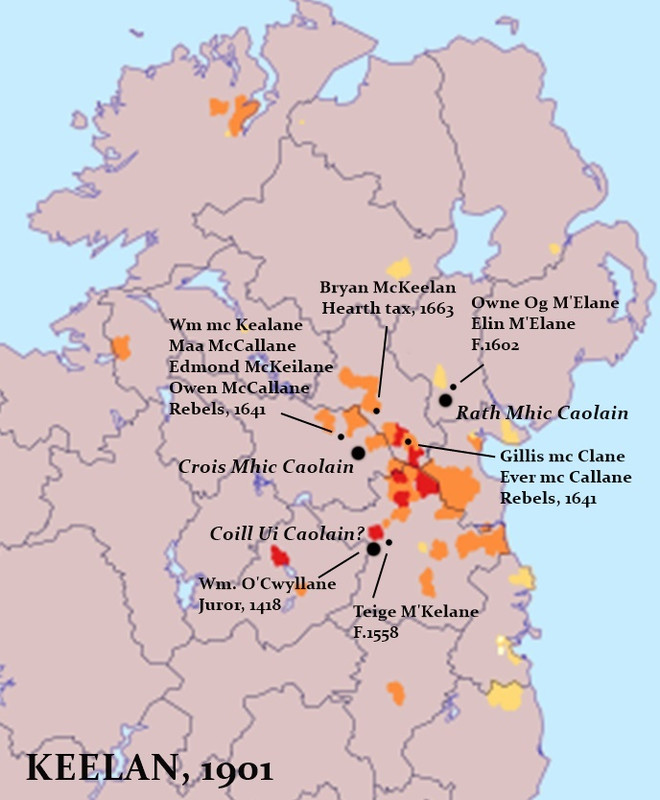
The Wm O'Cwyllane in Kilkeelan, Co. Meath, although he appears with an Ó-prefix in 1418, is adjacent to the Fiant of Teige M'Kelane in Balruntagh, and it could be that this surname in it's entirety was originally Mac Caoláin, with an alias arising of Ó Caoláin very scattered. So Kilkeelan (Coill Ui Caolain) may really be Coill Mhic Caolain. The townland Rathkeelan (Rath Mhic Caolain) near Crossmaglen, Co. Armagh could support the 1602 pardoning of the two kerns named M'Elane ("of the Fews"), as Mac Caoláins. I did find that the townland Ballykeelan ("Ballymakelan") in Co. Kildare that I had mentioned in an earlier post, was really very likely Baile Mhic Fhaelain as it lie within the O'Fhaelain's lands pre-invasion. A Mac-alias of this name would anglicize Mac'eelan.
The population density of KEELAN seems to be centered in Ardagh parish, Co. Meath, which borders Cavan, Monaghan, and Louth. It is Drumlin-country and would have been under the sway of Ui Ruairc pre-invasion, as Ui Ruairc did set up a stronghold near present-day Slane on the River Boyne (It seems the north side of the Boyne was firmly in Breifne hands for most of it's run to Drogheda before 1171). However, this area, along with the tuath of Fidh na Saithne which was occupied by the Clann Chaoich O'Reillys (Clankee by.) c.1300 was once firmly under the control of the Airghialla. So the origin of this surname is questionable, as it could already have been in this area.
This brings me to my next point of interest: MacLysaght wrote "KEELAN: Woulfe gives Ó Caoláin, treating it as an almost obsolete Meath name. It is, I suggest, an abbreviation of Keelahan,Kealaghan: Ó Céileacháin, an Oriel sept, who were chiefs of the Ui Breassaill, whose name has often been changed to Callaghan by attraction; it occurs with prefix Mac in Westmeath."
Well this certainly piqued my interest, as Keleghan 133269 not only shares rare markers with me, but the geographic coincidences are uncanny. A farming population of Keleghans occur in the Westmeath parish which borders Kilkeelan, Co. Meath and he also has two Braswell matches within BY38401 which we have been unable to explain. David has pointed out the flaws in BigY and that there are several portions of the Y-Chromosome not being tested.
Broken genealogies would be the only way to explain it, but it wouldn't be unbelievable to think that BY38401 could be Airghialla names, and that FT130287, which looks to have some relation to Clann Chaoich, also have an Airghialla branch.
This is proving very interesting.
I had figured for a while that the modern "Keelan" anglicization, as it was also noted to be a variant of the Oriel sept Ó Céileacháin had become so very conflated with Ó Caoláin (Breifne-Meath), that it wasn't worth really analyzing the original population via 1901 census because it would be impossible. But finding some odd coincidences with data that the scholars gathered made me want to look into it. Woulfe in his second edition of Irish names in 1923, adds the variant Keallain to his entry for Ó Caoláin so he likely came across the same things I did as it pertains that that vowel swap in the long-A syllable.
However as I feel I overturned just about everything, the evidence for an Ó-prefix to this surname really seems insignificant to the amount of references to a Mac-prefix. Aside from the records plotted below, the only other time I've definitively found this name with an Ó-prefix is a 1410 chancery roll entry for a Beaghan O'Kyllane, s. of Philip who d. near Trim, Co. Meath, and his land was confiscated by a local Anglo-Norman lord.
The Wm O'Cwyllane in Kilkeelan, Co. Meath, although he appears with an Ó-prefix in 1418, is adjacent to the Fiant of Teige M'Kelane in Balruntagh, and it could be that this surname in it's entirety was originally Mac Caoláin, with an alias arising of Ó Caoláin very scattered. So Kilkeelan (Coill Ui Caolain) may really be Coill Mhic Caolain. The townland Rathkeelan (Rath Mhic Caolain) near Crossmaglen, Co. Armagh could support the 1602 pardoning of the two kerns named M'Elane ("of the Fews"), as Mac Caoláins. I did find that the townland Ballykeelan ("Ballymakelan") in Co. Kildare that I had mentioned in an earlier post, was really very likely Baile Mhic Fhaelain as it lie within the O'Fhaelain's lands pre-invasion. A Mac-alias of this name would anglicize Mac'eelan.
The population density of KEELAN seems to be centered in Ardagh parish, Co. Meath, which borders Cavan, Monaghan, and Louth. It is Drumlin-country and would have been under the sway of Ui Ruairc pre-invasion, as Ui Ruairc did set up a stronghold near present-day Slane on the River Boyne (It seems the north side of the Boyne was firmly in Breifne hands for most of it's run to Drogheda before 1171). However, this area, along with the tuath of Fidh na Saithne which was occupied by the Clann Chaoich O'Reillys (Clankee by.) c.1300 was once firmly under the control of the Airghialla. So the origin of this surname is questionable, as it could already have been in this area.
This brings me to my next point of interest: MacLysaght wrote "KEELAN: Woulfe gives Ó Caoláin, treating it as an almost obsolete Meath name. It is, I suggest, an abbreviation of Keelahan,Kealaghan: Ó Céileacháin, an Oriel sept, who were chiefs of the Ui Breassaill, whose name has often been changed to Callaghan by attraction; it occurs with prefix Mac in Westmeath."
Well this certainly piqued my interest, as Keleghan 133269 not only shares rare markers with me, but the geographic coincidences are uncanny. A farming population of Keleghans occur in the Westmeath parish which borders Kilkeelan, Co. Meath and he also has two Braswell matches within BY38401 which we have been unable to explain. David has pointed out the flaws in BigY and that there are several portions of the Y-Chromosome not being tested.
Broken genealogies would be the only way to explain it, but it wouldn't be unbelievable to think that BY38401 could be Airghialla names, and that FT130287, which looks to have some relation to Clann Chaoich, also have an Airghialla branch.
This is proving very interesting.
FTDNA Kit 132906 McLain
A5902>FT130287 Muintir Guaire
A5902>FT130287 Muintir Guaire
-
Webmaster
- Site Admin
- Posts: 1587
- Joined: Wed, 2019-Jun-26 2:47 pm
Re: FT130287. Finally moving in the right direction.
Chris,
You always find the most interesting info. BTW, in case you were unaware, the Cland Colla/Airgíalla seem to be located in the R1b-Z3000 clade and discussed in detail at http://peterspioneers.com/colla.htm. You may see it on The Big Tree at https://www.ytree.net/DisplayTree.php?blockID=68. There is also the "Airgíalla" Mac Tréuin Fir family which shows up in the R1b-FGC6545 clade along with the Uí Maini O’Kelly family, at https://www.ytree.net/DisplayTree.php?blockID=815. You may spot some other surnames of interest in these clades.
They fit in with the R1b-DF104 clade as:

But as we are well aware of, there were allegiance changes, SCEs, etc. that could have caused non-bloodline cland organization.
BTW, there were some recent McGovern upgrades:
viewtopic.php?f=7&p=1217#p1217
You always find the most interesting info. BTW, in case you were unaware, the Cland Colla/Airgíalla seem to be located in the R1b-Z3000 clade and discussed in detail at http://peterspioneers.com/colla.htm. You may see it on The Big Tree at https://www.ytree.net/DisplayTree.php?blockID=68. There is also the "Airgíalla" Mac Tréuin Fir family which shows up in the R1b-FGC6545 clade along with the Uí Maini O’Kelly family, at https://www.ytree.net/DisplayTree.php?blockID=815. You may spot some other surnames of interest in these clades.
They fit in with the R1b-DF104 clade as:
But as we are well aware of, there were allegiance changes, SCEs, etc. that could have caused non-bloodline cland organization.
BTW, there were some recent McGovern upgrades:
viewtopic.php?f=7&p=1217#p1217
-
ChrisMcLain132906
- Suí Senchada
- Posts: 136
- Joined: Sat, 2020-Apr-18 3:51 pm
- Location: Bushkill, Pennsylvania, US
Re: FT130287. Finally moving in the right direction.
Fascinating! I never knew where they fit in to the grand scheme of things and had figured them for Ui Nialls.
I'm definitely betting on both FT130287 and BY38401 possibly being rife with SCEs. There definitely seems to be a number of townland names on both sides of the Cavan/Monaghan border to come to the conclusion that these surnames were probably well-established early on here (the unconfirmed Armstrong included). Also in trying to figure out the "Fraher" mystery, the anglicizations also point to the Cavan/Monaghan border.
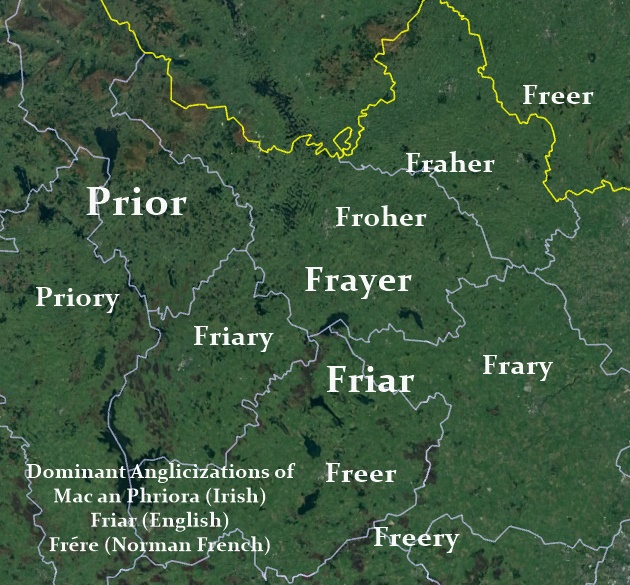
Gorry could really be the only true Breifne surname of the bunch. Although (Mc)Gorry is numerous in Clann Chaoich, the townland of Drumgorry (Drom Godfraigh) is on the western edge of Tullygarvey close to Belturbet (which was the Breifne Ui Raghailligh capital c1300 prior to Cavan town, and also just prior to the inhabiting of Fidh na Saithni by the Clann Chaoich Ui Raghaillighs). This probably points to FT130287 probably being associated with Muintir Maelmordha a millennium ago.
I'm definitely betting on both FT130287 and BY38401 possibly being rife with SCEs. There definitely seems to be a number of townland names on both sides of the Cavan/Monaghan border to come to the conclusion that these surnames were probably well-established early on here (the unconfirmed Armstrong included). Also in trying to figure out the "Fraher" mystery, the anglicizations also point to the Cavan/Monaghan border.
Gorry could really be the only true Breifne surname of the bunch. Although (Mc)Gorry is numerous in Clann Chaoich, the townland of Drumgorry (Drom Godfraigh) is on the western edge of Tullygarvey close to Belturbet (which was the Breifne Ui Raghailligh capital c1300 prior to Cavan town, and also just prior to the inhabiting of Fidh na Saithni by the Clann Chaoich Ui Raghaillighs). This probably points to FT130287 probably being associated with Muintir Maelmordha a millennium ago.
FTDNA Kit 132906 McLain
A5902>FT130287 Muintir Guaire
A5902>FT130287 Muintir Guaire
-
Webmaster
- Site Admin
- Posts: 1587
- Joined: Wed, 2019-Jun-26 2:47 pm
Re: FT130287. Finally moving in the right direction.
Chris,
Before settling on the idea of SCEs. please keep in mind what we are seeing with the Uí Maini: Dál Cuinn descendants being incorporated into non-Dál Cuinn genealogies. That means keeping an eye out for traditionally Cland Colla/Airgíalla surnames never turning up in the R1b-Z3000 clade, but rather somewhere under R1b-DF104.
Before settling on the idea of SCEs. please keep in mind what we are seeing with the Uí Maini: Dál Cuinn descendants being incorporated into non-Dál Cuinn genealogies. That means keeping an eye out for traditionally Cland Colla/Airgíalla surnames never turning up in the R1b-Z3000 clade, but rather somewhere under R1b-DF104.
-
Mark Monroe
- Dos Senchada
- Posts: 50
- Joined: Tue, 2020-Mar-17 1:19 am
Re: FT130287. Finally moving in the right direction.
WOW! Chris and David, you guys amaze me! This thread has me in suspense that one day the key to my door might magically appear! I swear I don't know how you find this info. Do I need to say how appreciative I am of your posts? Keep it up!
-
ChrisMcLain132906
- Suí Senchada
- Posts: 136
- Joined: Sat, 2020-Apr-18 3:51 pm
- Location: Bushkill, Pennsylvania, US
Re: FT130287. Finally moving in the right direction.
Great info David, thank you! I'm going to keep that in mind moving forward. I also just read that the King of Airgialla (Donnchad Ua Cearbhaill, 1130-1168) was a half-brother of Tighernain Ua Ruairc (d1172). This seems to be an interesting point in time for the ebb and flow of all these territory boundaries, I wonder if it plays into these YDNA developments at all. MacLysaght's theory definitely plays into the earlier analysis I was doing around Westmeath records where I found (Mc)Clane & Kellane appear everywhere that Keleghan does in varying numbers, leading me to the probability of MacCeallachain after your found this surname that Woulfe noted "Rare; Westmeath". If Keelan/Keelane was an abbreviated Keelaghan, and Keleghan was also Keelaghan, I could see one coming to this conclusion, he must have found some compelling patterns and similarities.
This also opens the door for more Fraher possibilities, as Carragher (Mac Fhearchair) was an Armagh-Monaghan name. Although I only found O'Fearchair in west/central Connacht so it moved down the list of possibilities, the few scattered Fraher/Froher around the Cavan/Monaghan border could be an O- alias of Mac Fhearchair that just overlapped Mac an Phriora.
Mark, I'm really rooting for you to find the missing puzzle pieces. I really think you are a Mac Conruabha and there was an anglicization "by way of attraction" in your family's case, just like O'Maolseachlainn>O'Melaghlin>McLoughlin. Being that there were plenty of Scottish planters coming into Cavan, it's definintely likely, specifically Bailieborough where it seems this cluster of Monroes are. It would seem that this is part of the MacEnroe farming population with an alias/anglicization.
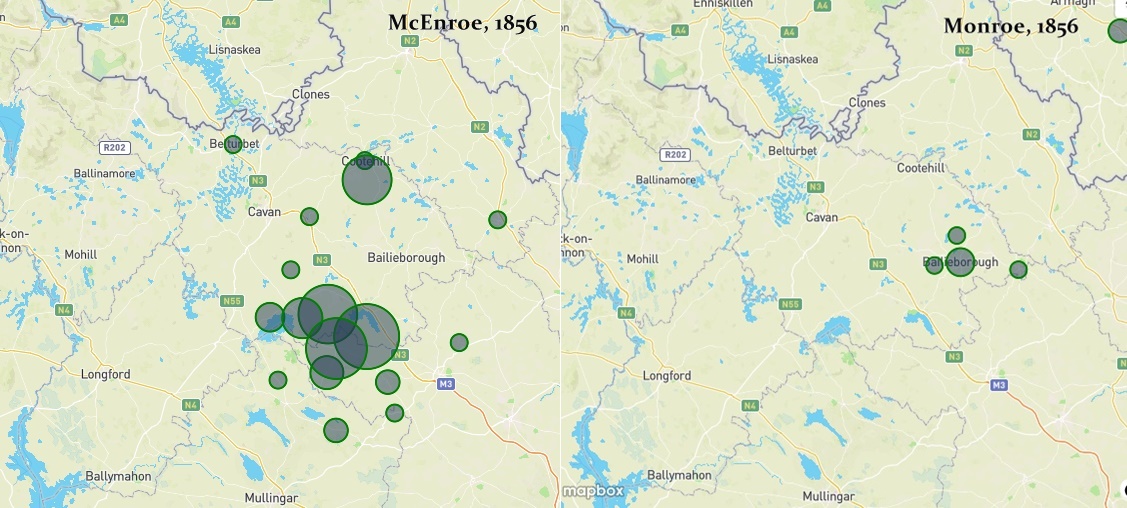
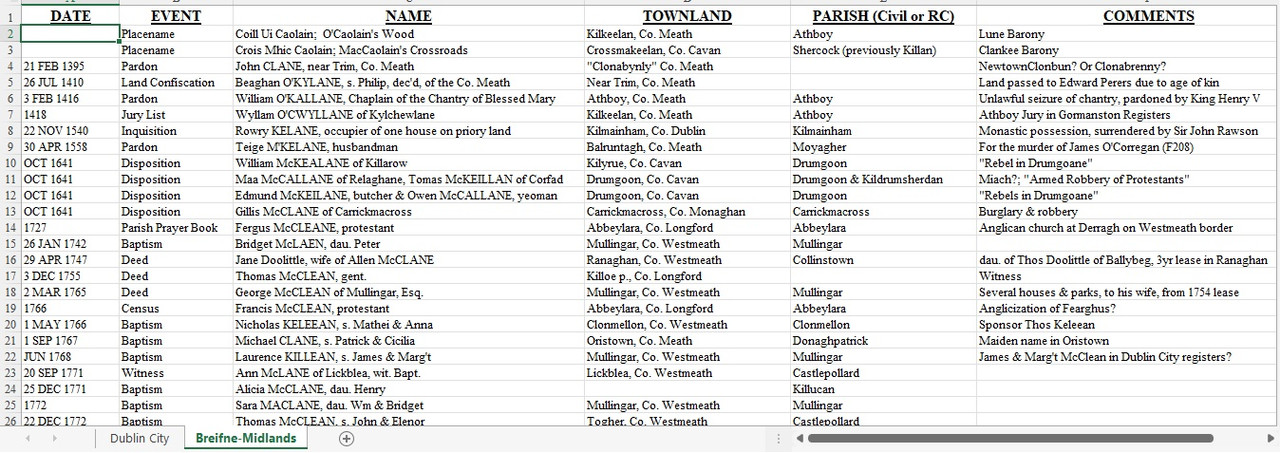
Once you're at your papertrail brick wall, it really needs a different approach, and that is digging up absolutely everything on a regional level. I would do Cavan/Meath in your case. I began compiling everything into an excel spreadsheet chronologically, and plotting on a map everything I could (as you can tell! visualizing this stuff helps me a lot more than staring at endless lines of names, dates and places). It also helped me understand the geography much better and the history of various baronies/tuaiths. Dont neglect the big towns though, because there were some tough decades where Dublin city had a cost of living half of that in Cavan & Meath, prompting a huge temporary inflow of rural folks, particularly tradesmen. You could find your ancestors as more or less "urban refugees" during tough times, which may reveal a decade of existing parish registers or directory entries. Mullingar was a fairly big town and has some records going back to the 1760s, and was a dawn-to-dusk walk from Eastern Cavan.
You may end up seeing familiar names or at least naming systems moving about.
This also opens the door for more Fraher possibilities, as Carragher (Mac Fhearchair) was an Armagh-Monaghan name. Although I only found O'Fearchair in west/central Connacht so it moved down the list of possibilities, the few scattered Fraher/Froher around the Cavan/Monaghan border could be an O- alias of Mac Fhearchair that just overlapped Mac an Phriora.
Mark, I'm really rooting for you to find the missing puzzle pieces. I really think you are a Mac Conruabha and there was an anglicization "by way of attraction" in your family's case, just like O'Maolseachlainn>O'Melaghlin>McLoughlin. Being that there were plenty of Scottish planters coming into Cavan, it's definintely likely, specifically Bailieborough where it seems this cluster of Monroes are. It would seem that this is part of the MacEnroe farming population with an alias/anglicization.
Once you're at your papertrail brick wall, it really needs a different approach, and that is digging up absolutely everything on a regional level. I would do Cavan/Meath in your case. I began compiling everything into an excel spreadsheet chronologically, and plotting on a map everything I could (as you can tell!
visualizing this stuff helps me a lot more than staring at endless lines of names, dates and places). It also helped me understand the geography much better and the history of various baronies/tuaiths. Dont neglect the big towns though, because there were some tough decades where Dublin city had a cost of living half of that in Cavan & Meath, prompting a huge temporary inflow of rural folks, particularly tradesmen. You could find your ancestors as more or less "urban refugees" during tough times, which may reveal a decade of existing parish registers or directory entries. Mullingar was a fairly big town and has some records going back to the 1760s, and was a dawn-to-dusk walk from Eastern Cavan.You may end up seeing familiar names or at least naming systems moving about.
FTDNA Kit 132906 McLain
A5902>FT130287 Muintir Guaire
A5902>FT130287 Muintir Guaire
-
ChrisMcLain132906
- Suí Senchada
- Posts: 136
- Joined: Sat, 2020-Apr-18 3:51 pm
- Location: Bushkill, Pennsylvania, US
Re: FT130287. Finally moving in the right direction.
Population density & dominant variants, on the theory this is one surname. Pre-1700 records show Mac-prefix is dominant, while O-prefix is in Armagh. 1602 Armagh fiant with "M'Elane" kerns in The Fews, also contains "O'Keelychan" yeomen. Woulfe notes O'Ceileachain were "Chiefs of Ui Breasaill"; backed up by 11th c. annals noting several lords of the name; "Ui Breasaill"/Clanbrassill was roughtly located in Oneilland b., Co. Armagh; If this is one family, the Mac-alias may have occurred very early. The abbreviation of "Ceil'ain" may have occurred many times & places. (Mc)KeelANE population specfically lies between Keelan population cluster of Ardagh, Co. Meath, scattered southwest to a large McCLANE population around Fore/Delvin/Athboy. Which at least links "McKelane" to Keelan. "Keleghan/Keelaghan/Kilaghan" seems to spread in same direction with similar concentrations in Delvin, Co. Westmeath. This may be what MacLysaght found.
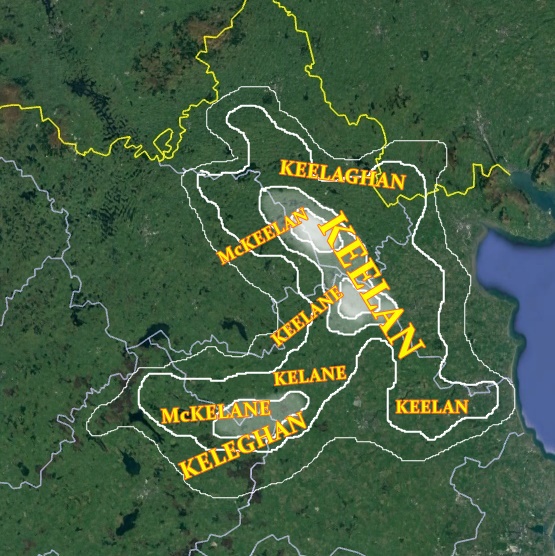
Looks like I need to hunt down Keelaghans and Keelans and send them kits.
Looks like I need to hunt down Keelaghans and Keelans and send them kits.
FTDNA Kit 132906 McLain
A5902>FT130287 Muintir Guaire
A5902>FT130287 Muintir Guaire