FT130287. Finally moving in the right direction.

This forum is for discussion about the Uí Briúin specifically.
ChrisMcLain132906
Suí Senchada
Posts: 136
Joined: Sat, 2020-Apr-18 3:51 pm
Location: Bushkill, Pennsylvania, US

Re: FT130287. Finally moving in the right direction.

Post by ChrisMcLain132906 »

I'm becoming fairly certain now that there is definitely a connection to 133269 Keleghan.
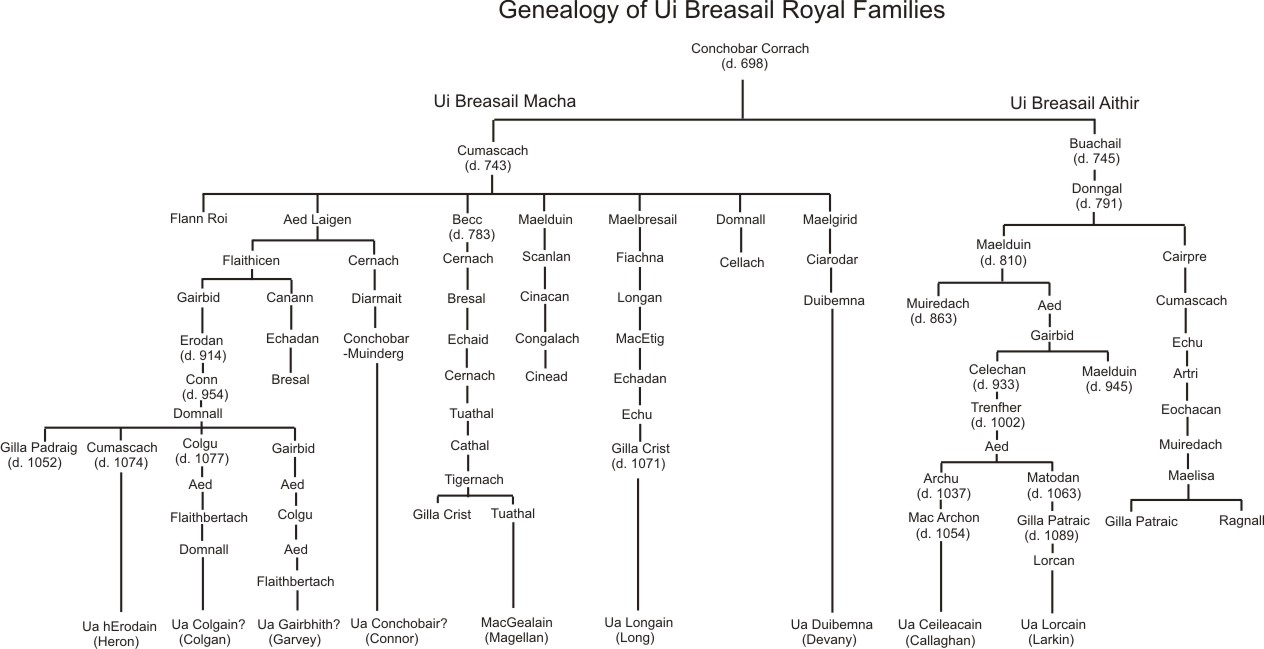
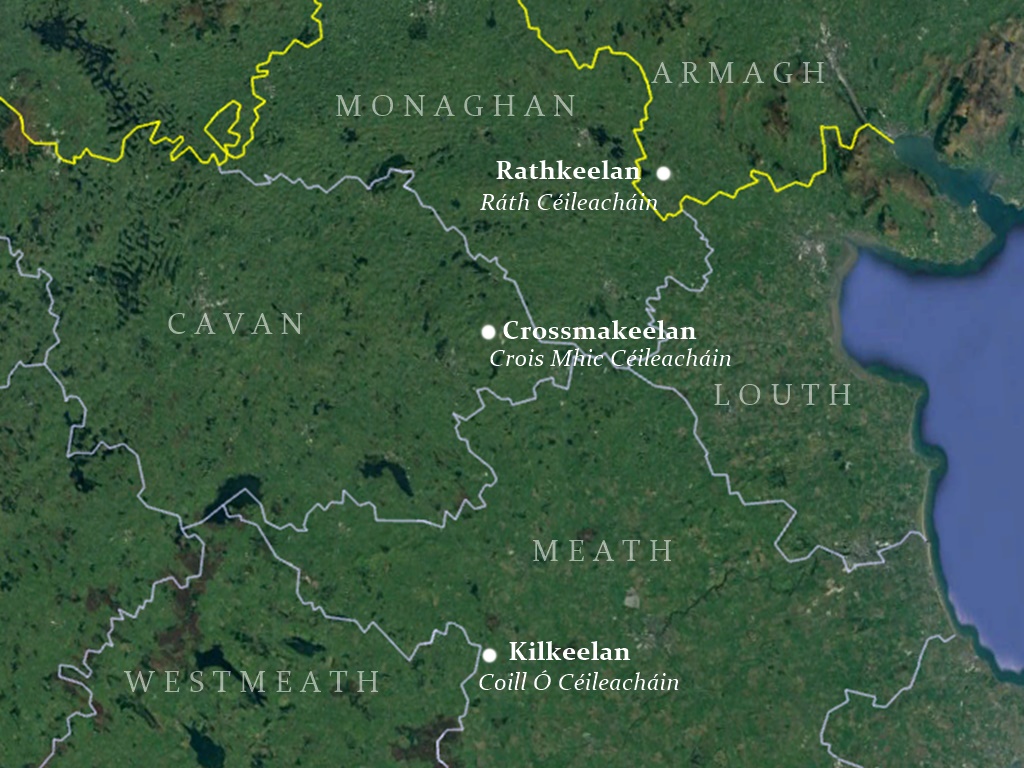
Based on all the research I've been doing, the three "Keelan" townlands (one referencing an individual, and two referencing a surname), in my opinion have been mistaken for the given name "Caolain", and it is in actuality the abbreviation of Ceileachain (either Ceil'ain or Ceilea'n). The "Keelan" surname itself was most numerous along the Monaghan/Cavan border and the Monaghan/Meath border. Close to a millennium ago, all of these areas (even the Cavan side and Meath side) were in the territory of the Airgialla.
Image

Rathkeelan, near Crossmaglen, Co. Armagh, near which in 1659, Seamus Pender wrote "O'Kealloghane, 6 families of the name" in his census; also backed up by the 1602 Fiant of Torlagh McHenry O'Neil's tenants, may really be the homeland of this surname. As the O'Ceileachain spent over a century as Chiefs of the Ui Breasaill Airthir (Eastern Armagh), and yet there are no townlands referencing their original tuaith. It is in this area where "Keelaghan" is said to mostly changed to "Callaghan", and specifically around Crossmaglen, Creggan parish in 1854 were 31 Callaghan housholds, far more dense than any Keelaghan/Keleghan/Callaghan cluster in South Ulster/Northern Midlands. Rathkeelan may in fact be Rath Ceileachain ("The Fortress of Ceileachain"). The 1836 Ordnance Survey map shows an ancient ringfort in the townland on a low hilltop near the Blaney Road. Could this ditched enclosure that is still viewable on Google Earth be the homestead of our eponymous ancestor? Although "Clanbrassill", ie the the territory of the Ui Breasaill Airthir in later records was quite synonymous with Orior and Oneilland baronies, it's likely that The Fews (where Rathkeelan is located, just west of Orior barony) was also included at one time or another.

Crossmakeelan, although it lies in the County Cavan, was in the tuaith of Fidh na Saithne which the O'Reillys took from Airgialla circa 1300. I believe the surname Mhic Ceileachain or Mhic Ceilea'n may have already been present here. There is less information about this townland name, as it doesn't appear on the 1609 Bodley maps, and was probably still unforfeited at the time.

Kilkeelan Co. Meath, being in an area that was heavily anglicized by Anglo-Norman settlement since the late 12th century offers a little more insight. A 1408 jury list in Athboy mentions "Wylliam O'Cwyllane of Kilchewlane". This indicates to me he was a free tenant, and it's very likely that this townland took it's name prior to the 1171 Norman invasion. If this is true, it could be that this surname spread from Armagh to Westmeath within it's first 250 years (as Ceileachain himself was noted to have died in 933) and lost it's internal fricative very early, as this "Keelan" abbreviation was already numerous. Although "Wylliam O'Cwyllane" has an O-prefix on his name, the bulk of the records in the Athboy area suggest the Mac-prefix was dominant. It could be that Wylliam was just simply stating he was a descendant of "Ceilea'n".

MacLysaght wrote that the name "gained a Mac prefix in Westmeath" but I've uncovered that the Mac-prefix probably pre-dated this family's movement to Westmeath, which is also backed up by the townland name of Crossmakeelan in Cavan and a 1663 Monaghan hearth tax record of Bryan McKeelan of Ardragh. Given that this family was among the nobility of Airgialla for at least 4 generations and kings having up to ten sons was quite the norm, there could have been numerous "Sons of Ceileachain" and "Descendants of Ceileachain" spawning both surnames at the same time and we aren't looking at any prefix aliases, but diffferent branches of Ceileachain's many sons and grandsons. And it seems "Keelan" is far more numerous than Keelaghan-variants, and if the Mac-prefix was just as widepsread it also may answer the question of who the 1602 pardoned kerns by the name of "McElane" are, who appear alongside the "O'Kellychan".

I've taken to rootschat and ancestry.com to locate Keelans from the most dense areas of this population cluster to offer to send them a Y-test. Hopefully I get some responses and we can build this genetic tree and either prove or disprove that these surnames area really all one.

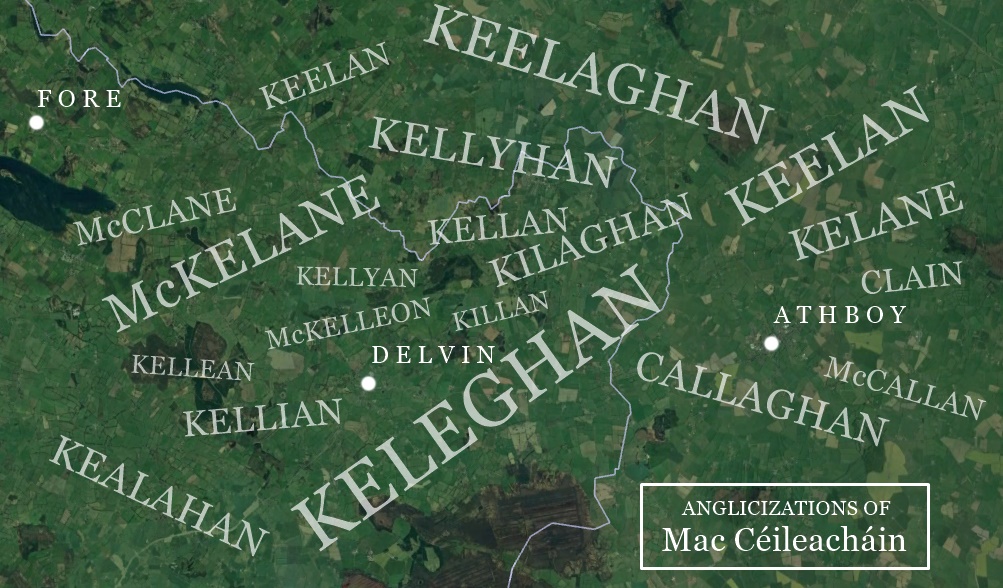
Focusing just on the area around Delvin barony, Co. Westmeath reveals a ton of mutations of this name.
Image
I had left several odd ones out in my research just to err on the side of caution, ie mostly the Kelleon (which also coincided with M'Cleon) because I though it could be related to Killeen which was very numerous in Westmeath (O'Cillin). But once I found "Kellyhan" here and thought about how the surname lost it's internal fricative, "Kelly'an" variants started to make complete sense. This occurs very close to my MDKA near Drumcree and one can see how just emphasizing certain syllables could turned it to McClane (MAC-kel-EE-ahn).
FTDNA Kit 132906 McLain
A5902>FT130287 Muintir Guaire
User avatar
Webmaster
Site Admin
Posts: 1574
Joined: Wed, 2019-Jun-26 2:47 pm

Re: FT130287. Finally moving in the right direction.

Post by Webmaster »

Chris,

Truly astounding work! :o

So, do we change the surname on the DCG Cladogram? Just let me know which kit numbers should be changed, and I will be delighted to do so.
Image
ChrisMcLain132906
Suí Senchada
Posts: 136
Joined: Sat, 2020-Apr-18 3:51 pm
Location: Bushkill, Pennsylvania, US

Re: FT130287. Finally moving in the right direction.

Post by ChrisMcLain132906 »

Thanks David! I think it's probably enough info to go ahead and make the changes. Also now that these people were Breifne>Airgialla, I think we can go back to your original estimation for Fraher of O'Fearchair as a rare O-alias of Mac Fhearchair because I believe the Mac prefix would probably have the silent "fh", as CARRAGHER, who were numerous around the S.Armagh/Monaghan border, as MacLysaght writes...
fairly numerous: Oriel (S Ulster) etc. Ir. Mac Fhearchair. The early Irish personal name Ferchar meant, perhaps, "friendly". It occurs as Farquhar (Scotland) and Forker (Ulster). MIF.

132906 Mac Céileacháin
IN25704 Mac Céileacháin
793777 Mac Fearchair
160997 Mac Gothraidh

I've put out a ton of messages to Keelans on ancestry, and also quite a good number of folks on FTDNA trying to get them into the group, as even though STRs are quite the mirage, among my own match dashboard, Keleghan's dashboard, and two Keelaghan's dashboard, I've found a few LONG and DeVANEY individuals, which would prove pretty interesting being that these are supposedly Ui Breasaill Macha families

Image

There are also A5902+ Gartlans (at least one I believe) and this may end up as a 3rd branch spawning Airgialla names if he ever does BigY
FTDNA Kit 132906 McLain
A5902>FT130287 Muintir Guaire
User avatar
Webmaster
Site Admin
Posts: 1574
Joined: Wed, 2019-Jun-26 2:47 pm

Re: FT130287. Finally moving in the right direction.

Post by Webmaster »

Chris,

We kind of have an interesting dilemma on the origination of the Céil(l)each name. My Irish Names book only has Cellachán, the diminutive of Cellach, from whence we get the O’Kelly surname. The eDIL website has both céilech AND céillech. the latter of which references céillid(e) and célech. So, we have:
  1. Céilech = "who had many companions" or "obedient".
  2. Céillech = céillid(e) = "sensible, intelligent, reasonable".
  3. Céillech = célech = "obedient".
The first and third are most likely synonyms, or one is a derivative of the other, with the meaning of "obedient"; with the second, for a name, most likely meaning "sensible, intelligent, reasonable". Céillech and céillid(e) then must be synonyms or one is a derivative of the other. I tend to go with meanings that have a loftier sense, human nature being what it is; especially in the situation of parents naming their children. Also, a lot of the Anglicizations have a double "L". That being the case, I suppose the names should be:
  1. Mac Céillecháin
  2. Mac Ferchair
  3. Mac Goffrada [nominative case Goffraid, likely genitive case Goffrada, following the pattern of Amalgaid/Amalgada]
But if you have better suggestions, please fire away.

And yes, we do have one R1b-A5902+ Gartland. Which surname are you thinking that derives from: the Cenél nEógain Mac Gartnáin or the generic Mac Gartlan from the Norman Viking Gernún/Gerlún/Gerlann?
Image
ChrisMcLain132906
Suí Senchada
Posts: 136
Joined: Sat, 2020-Apr-18 3:51 pm
Location: Bushkill, Pennsylvania, US

Re: FT130287. Finally moving in the right direction.

Post by ChrisMcLain132906 »

Thanks David, I would definitely go with Ceillechain. This actually brings up a question I meant to ask you but you had just answered it :lol: - as it seems the Ó Céileachair had some confusion on the basis of their root given-name, Woulfe wrote "companion-dear; spouse-loving", but other sources had ceileach: "wise, prudent", so I couldn't tell which was which as it looked to me to be the same word, but one being derivative of the other definitely makes sense.

Just looking at the anglicizations of specifically "Gartlan", its overwhelmingly around Carrickmacross near the Louth border, meanwhile (Mc)Gartland does spread up into Dungannon. So basing it on just the modern population it would probably seem like a gaelicization from the Norman settlement in Louth.
FTDNA Kit 132906 McLain
A5902>FT130287 Muintir Guaire
User avatar
Webmaster
Site Admin
Posts: 1574
Joined: Wed, 2019-Jun-26 2:47 pm

Re: FT130287. Finally moving in the right direction.

Post by Webmaster »

Chris,

My pleasure. I may be completely wrong, but I surmise that Ó Céileachair was the result of a scribal typo of mistaking the ending "N" in Céillecháin for an "R", easy enough to do in the typical Gaelic handwritten font (check out those exemplar links for the characters). It COULD come from céile, "servant, bondsman, vassal, subject/fellow, companion/husband/rarely wife", + car, "loving, fond of"; but none of those possible meanings has much impact. So I am going to stick with my typo hypothesis. Also, the double "L" makes the most sense. So Mac Céillecháin it is.

If originating from a Norman Viking settlement, then Mac Gartlan it is.

What about the other McLean/McLain/McClain/etc.? Any ideas?
Image
ChrisMcLain132906
Suí Senchada
Posts: 136
Joined: Sat, 2020-Apr-18 3:51 pm
Location: Bushkill, Pennsylvania, US

Re: FT130287. Finally moving in the right direction.

Post by ChrisMcLain132906 »

I firmly believe that IN58736 McClean (Drumgoa, Killeshandra, Co. Cavan) as well as 215536 (who hasn't done BigY yet), are definitely Mac Gilla Eain; as both seem to very likely be a branch of Mac An Maighistir or a closely related sept. IN58736's population cluster looks to be of Ui Ruairc's galloglach (Carrigallen-Killeshandra; Ulster Annals 1486 note Ruaidhri & Alan, sons of Gilla Eain, "who went with Ui Ruairc" slain in Mac Raghnaill's Country). Meanwhile 215536 who is probably related to him c1500 (my best guess since he hasn't upgraded yet), but came from the Mourne Mountains in Down, where there was a documented mercenary family of "McClean of South Clannaboye" in 1599, possibly employed by Magennis. It looks like an A5902+ individual was absorbed into a battalion of Mac Gilla Eain somewhere around Killeshandra, a descendant of whom was a freelance gallowglass and served another or multiple tuaiths, eventually settling in Clandeboye.

I'm also in the process of getting a 3rd McLain to BigY. The account of 156031 McLain (who I first got in touch with in 2009, but he passed away quite a while ago) was reactivated by his nephew who got in touch with me and is going to upgrade. 156031 is more closely related to Thatcher. Im really hoping this additional kit may bring more early SNPs to light and make connections.
FTDNA Kit 132906 McLain
A5902>FT130287 Muintir Guaire
User avatar
Webmaster
Site Admin
Posts: 1574
Joined: Wed, 2019-Jun-26 2:47 pm

Re: FT130287. Finally moving in the right direction.

Post by Webmaster »

Chris,

It has been my experience with several kits of deceased men, that if they are older than ~5 years, they are too degraded to be useful. The 25 year lifespan for kits was wishful thinking, apparently. Hopefully the nephew is a paternal relationship so he can be the alternate tester; or that there is another paternal cousin or something.

I will make sure those other kits remain Mac Gilla Eáin then. Although, did you decide between that and Mac Ailín / Mac Cailín? Rev. Woulfe prefers the latter two forms for the Gallóglach.
Image
ChrisMcLain132906
Suí Senchada
Posts: 136
Joined: Sat, 2020-Apr-18 3:51 pm
Location: Bushkill, Pennsylvania, US

Re: FT130287. Finally moving in the right direction.

Post by ChrisMcLain132906 »

That's a real bummer but I'll keep my finger's crossed. I tested in '08 and had several upgrades before BigY in '19 but I may just be the minority of people that never needed to send another sample in. He's a maternal relative of Paul McLain but I think he has contact with other McLains in his area that can test. As for the MacAilin/Cailin, it was just a possible theory of mine in Westmeath which I was seeing held water or not (due to the amount of Campbells/Allans/Callens around), but those two other McCleans I believe are solidly Mac Gilla Eain.
FTDNA Kit 132906 McLain
A5902>FT130287 Muintir Guaire
User avatar
Webmaster
Site Admin
Posts: 1574
Joined: Wed, 2019-Jun-26 2:47 pm

Re: FT130287. Finally moving in the right direction.

Post by Webmaster »

Chris,

About the Mac Ailín / Mac Cailín surname, Rev. Woulfe seems pretty sure these were the Gallóglach, while the Mac Gilla Eáin were later Plantation settlers.
Mac Ailín—IV—M'Aline, M'Alline, MacAllion, MacAllen, MacAllon, MacEllin, MacEllen, etc.; 'son of Ailín'; the name of a branch of the Campbells of Scotland, some of whom were brought over by the O'Donnells as fighting-men, about the middle of the 16th century, and settled in Tirconnell. This surname easily got confused with Mac Cailín, which see.
Mac Giolla Eáin—IV—MacAlean, MacClean, MacClane, MacLean, MacLaine, MacLane, &c.; 'son of Giolla Eáin' (servant of St. John); the name of a numerous and powerful clan in the western Highlands of Scotland, whose patrimony from a remote period was the island of Mull. Some of this race settled in the 17th century in the North of Ireland.
What did your research turn up? Which group did the other 2 gentlemen descend from?
Image
Post Reply