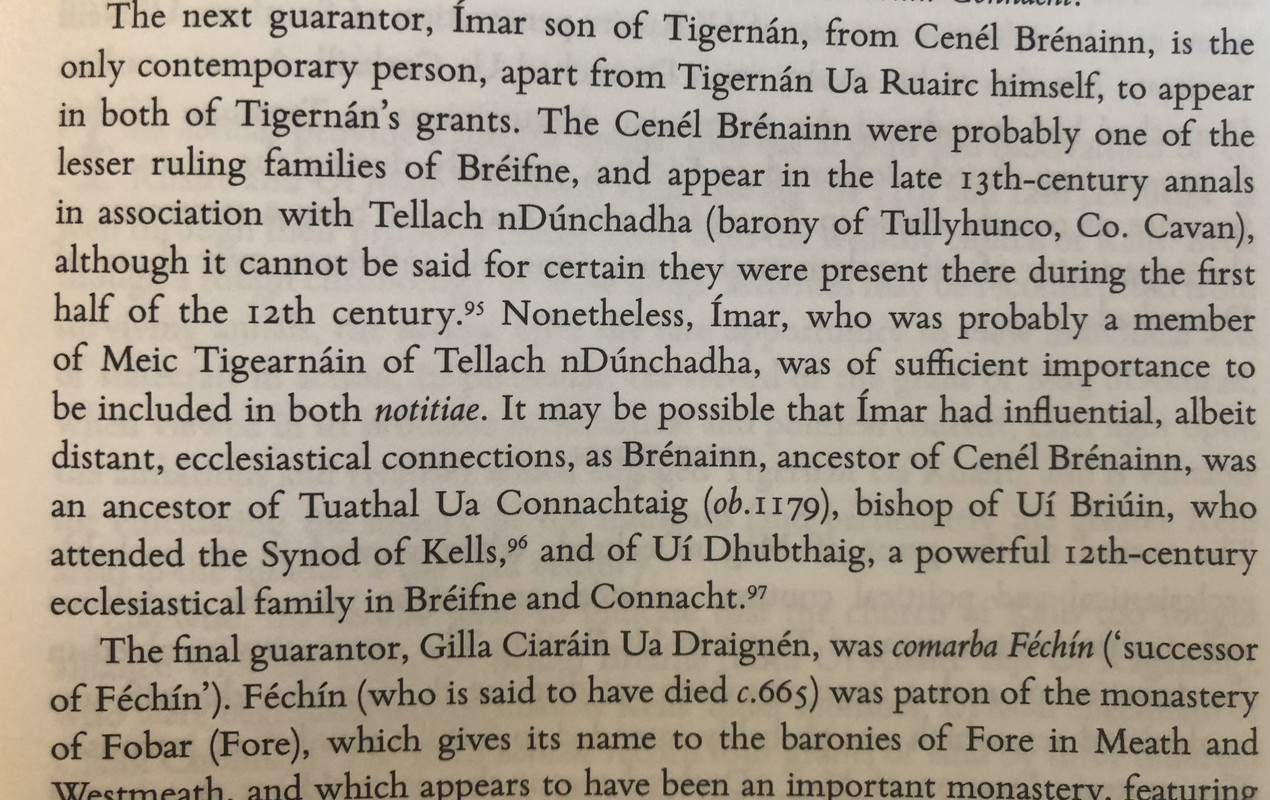
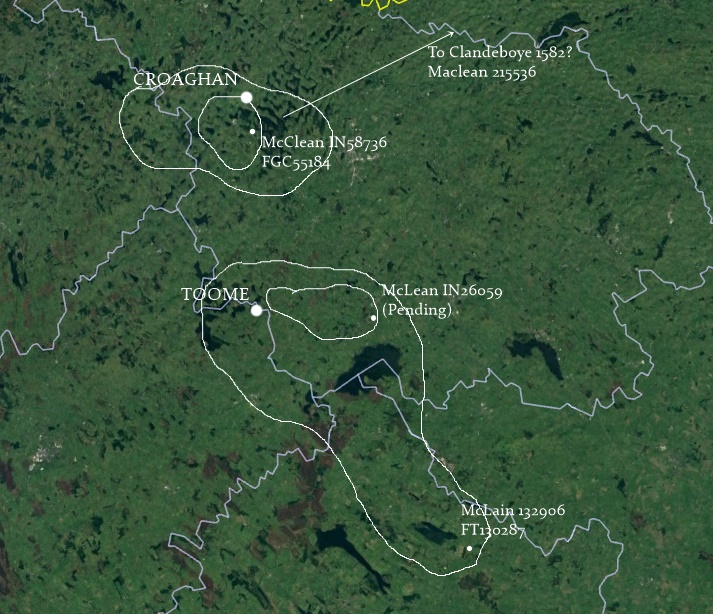
Thanks very much David! I definitely agree with your conclusion there in ref to "Brenaind", as the data suggests that the A5902+ man probably lived c900 and likely in Breifne. It's definitely a little murky, as I found the Teallach Dunchadha first used the term
Cenel Brenainn possibly in attempt to claim themselves to be an elder branch to the Teallach Eachdhach. In my mind, as these were two separate distinct tuaths, I would think "why would one branch claim more legitimacy to an ancestor than the other?" but aside from vying for potential chieftainship of Breifne, or some elevated status, it could be that there was originally one A5902+ tuaith where two or more fledgling septs were vying for supremacy in the century or so prior to Tighernain Mor Ui Ruairc's massive expansion c1050-1170. In this timeframe, he was actively colonizing Mide, Annaly & Airgialla with
Fir Breifne. Maybe it was Paul MacCottar's work that I'm thinking of where he said that it seemed (via placenames) that "Inner Breifne" (either or all of Tullyhaw, Tullyhunco, Loughtee) seemed to possibly be the Ui Ruairc stronghold prior to expansion. Surname clusters under
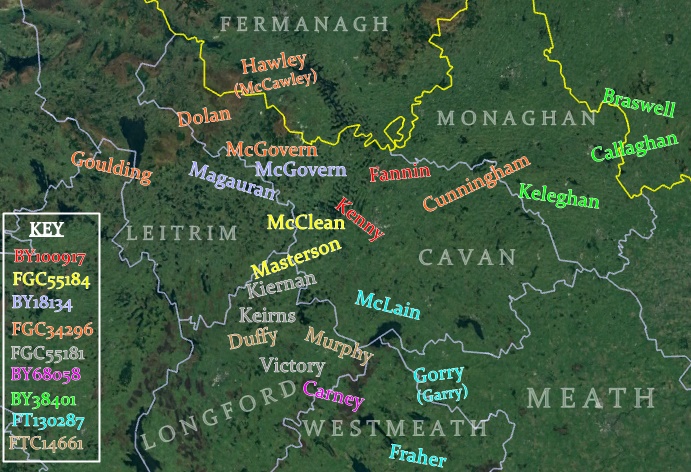
FGC59200 Teallach Eachdach seem to have the greatest geographical spread, including the perplexing Airgialla surnames, maybe there's something to this.
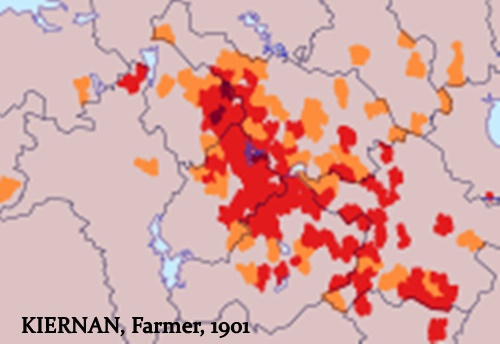
In other news, although attempts at verifying "Ceilleachain" have yet to pan out, I was able to sleuth out another McLean (of Tullyboy, Co. Cavan) who may be more distantly related and send him a kit. Whether he ends up related to me, or of FGC55814, or is even Scottish, it's a real toss-up. I was able to determine that my particular kindred was most dense around Lisduff & Tullyboy, Co. Cavan post-1600 and either originated there or migrated there from West Meath. This distribution reflects a family of anglican smiths, carpenters and masons most numerous around Ballymachugh parish. And that this surname probably distributed as it did c1570-1650 when the Nugents of Delvin had possessed all of Fore barony along with a growing proportion of Granard & Clanmahon baronies, which which they held in their entirety by 1598 under Elizabeth I until the Cromwellian confiscations.
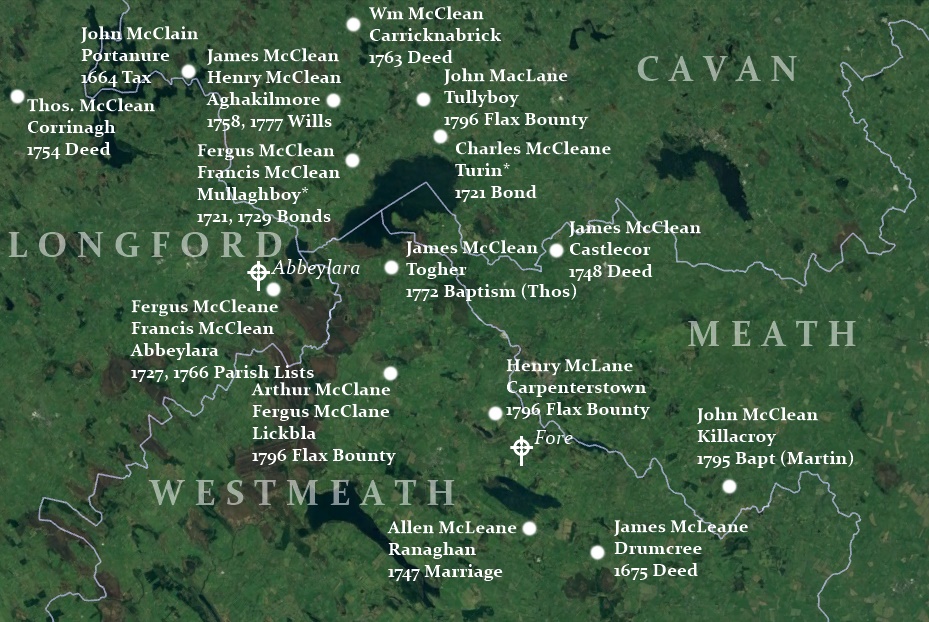
(Records prior to 1800)
Multiple McClean Families...
It would seem there were multiple "McClean" kindreds in Breifne, or surnames that anglicized this way, at least one of which were late 16th century redshanks
(as opposed to earlier gallowglass, which little to no references really support; the "Redshank era" was c1450-1650), I found that between 1569 and 1584, upwards of 4,000 Maclean redshanks landed in Lough Foyle in three waves and were in buonnaght with Turlough Luineach O'Neil, who was also the largest purveyor of redshanks in Ireland. The Macleans were kinsmen of the O'Neil predecessor (Shane O'Neil, who m. Cath Maclean, dau. Sir Lachlan Mor Maclean). Turlough Luineach O'Neil on multiple occasions came to an agreement with the Elizabethan govt and dismissed large forces of mercenaries. He consistently sent forces of mercenaries to his allies like O'Rourke, because O'Neil was at war with O'Reilly c1570-84 due to O'Reilly's cooperation with the government
(in essence it seems like O'Neil was fighting a proxy war with O'Reilly via supplying the O'Rourke with large forces of redshanks) In 1581 it was noted O'Neil sent O'Rourke "600 Scottes" (poss the Carrigallen-Killeshandra McCleans?). In the timeframe of this event, O'Neill had 3,000 redshanks billeted in his country, over 2,000 of which were Macleans. In 1582, he dismisses more redshanks who were noted in Hayes-McCoy's book to "have intention to go to Clandeboye and settle". Alone this isn't much but in 1599 a Maclean population was recorded in "Clannaboye & The Dufferin", indicating these people made good on their intention. It would also explain the FGC55184 McClean in Killeshandra being closely related to the McClean from the Mourne Mountains, but the timeframe is narrow for a 1581 group of mercenaries to absorb the native population and then migrate to Clandeboye the following fighting season. I would theorize that these many settlements were in communication with eachother, possibly resupplied eachother, and that there was already a large family of Macleans in Breifne in 1581 (
ref AU 1486 "Alan & Ruaidhri Maclean slain when O'Rourke & MacCabe went to MacRannell's country)
The redshank kindreds could have fought as little as one season before transitioning to farming or craftsmanship, as it was not a hereditary occupation like gallowglass. There were initially, until the 1540s, transient and returned to Scotland, until the mass overpopulation and poverty in the isles. A redshank captain in one fighting season would have accumulated enough wealth to practically be on par of a country gentleman of the time.
Something else interesting is that in 1580-81, Nugent of Delvin had allied himself with James Eustace and was "out" in the Baltinglass rebellion (Battle of Glenmalure, allied with Fiach mac Hugh O Byrne); William Nugent came to Turlough Luineach O'Neil in April 1581 asking for aid, however history does not note if this help came through although O'Neil pledged "foot and horse for Nugent and Eustace" which would have more than likely been in the form of Scots (70% of which were Macleans) , as it was his established tactic. Soon afterwards, Nugent was in Scotland in the court of James V, and another fleet of Macleans landed in Lough Foyle. This gained the attention of many of Elizabeth I's spies in Ulster, and "The Nugent Intrigue" is well-documented in Elizabethan correspondence in the early 1580s with references to both O'Neil & Sir Lachlan Mor Maclean, but nothing was ever proven. It's quite interesting. In 1597 when Nugent was granted extensive lands in Granrd b, Co. Longford & Clanmahon b., Co. Cavan after his expenses and debts for decades of fighting O'Farrell & O'Reilly, he wrote to Elizabeth of his intent to "billet troops" in this area as a new bulwark to protect the Pale (could Macleans have still been under his employ?)
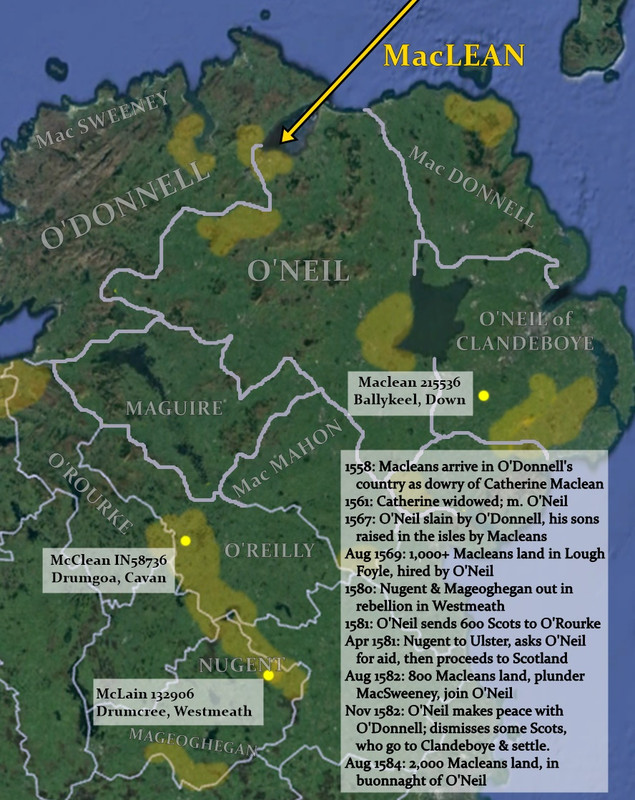
(Surname clusters with correlation to records of mercenary employment)
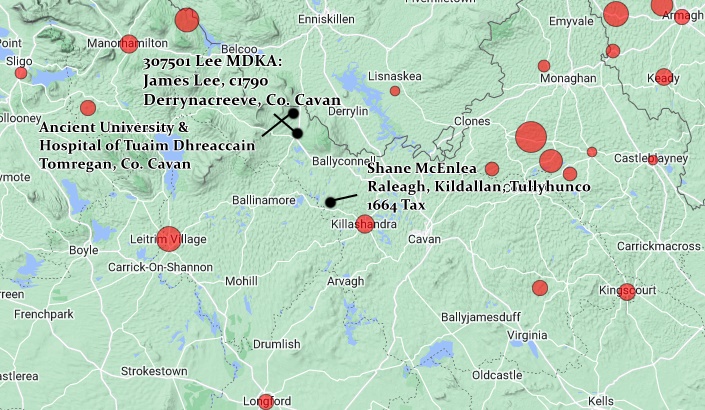
Also, Lee has about 2 weeks left before his BigY is done, I'm predicting he may be a new branch of BigY but that's just based on his "Mirage" of markers