A5902+ Group Update

This forum is for discussion about the Uí Briúin specifically.
ChrisMcLain132906
Suí Senchada
Posts: 136
Joined: Sat, 2020-Apr-18 3:51 pm
Location: Bushkill, Pennsylvania, US

Re: A5902+ Group Update

Post by ChrisMcLain132906 »

Thanks David, that's pretty fascinating! I havent delved much into the very early (Conn of the Hundred Battles-era) connections but that's very interesting about the DF27 specifically from that area on the mainland. About to go off topic myself :lol: - There was also a large Neanderthal population holdout around the Iberian peninsula that lasted quite a long time after the rest of the population died out, and its a strange concidence to me that
-it was a celtic stronghold prior to the migration into the british isles
-the celtic people seem to have a higher percentage of neanderthal traits (fair skin, blue eyes, red hair, stout, cold-adaptations to name a few)
-Genome-wise I carry close to 5% neanderthal, while the average individual of 100% N. European ancestry has 1%, so Ive wondered if during the Bronze age, the celtic people that were pushed to the western coast of Europe had absorbed whatever people that earlier had absorbed the Neanderthals. Maybe it's just an oddity with me as opposed to the whole Irish diaspora.

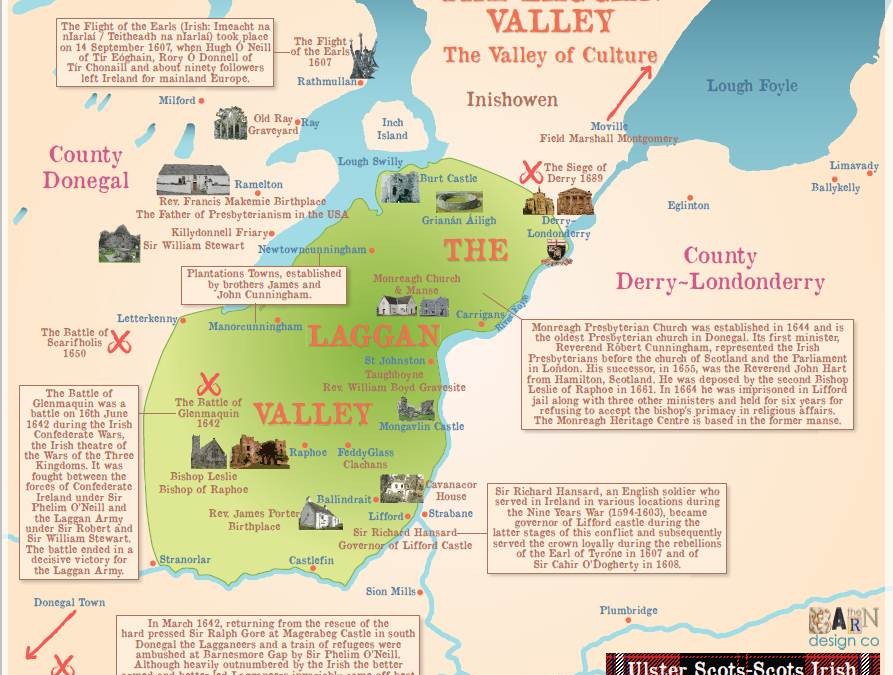
Back to the Laggan lol- I didn't realize there was a second "Laggan", but in terms of the redshanks, it was the valley around the River Foyle. The galleys full of mercenaries would either pull up to Carrigans on the O'Donnell side, or an opposite eastern bank for O'Neil. The redshank population here seems to have been made a part of the plantation scheme, it seems particularly for Maclean & Campbell- their chieftains during the redshank era were Presbyterians educated in Edinburgh and married into lowland gentry families; they probably pressed the reformed faith in the isles c. 1550s-1600. It seems the redshanks descendants made up a bulk of the Settler Army in the 1640s who were fighting Irish confederates, and were also besieged in the first Siege of Londonderry 1643-44. The redshanks were certainly an interesting and flexible group of people who were essentially loyal to no one and advanced their own interests.
Image

In terms of Clandeboye, I meant the O'Neill lordship in East Ulster. "Macleans of Clandeboye & the Dufferin" were referenced in 1599.
FTDNA Kit 132906 McLain
A5902>FT130287 Muintir Guaire
User avatar
Webmaster
Site Admin
Posts: 1574
Joined: Wed, 2019-Jun-26 2:47 pm

Re: A5902+ Group Update

Post by Webmaster »

Chris,

Bad on us for going off topic. :lol:

As the Meatloaf song goes, “Two out of three ain't bad.” The classic Gaelic phenotype was fair skin, blue eyes, and BLACK hair. The red hair allegedly came in with the Vikings and probably from the I1 clade. As a complete aside, it is interesting to note that I is very close to J genetically, which is associated with middle eastern people, particularly the Jewish people, of whom the Biblical Old Testament makes note of red hair in some individuals. :o

While the Milesian origin story says they came from the Iberian peninsula, probably from around A Coruña, Galicia, Spain, as I alluded to, the Laud 610 genealogy says the Dál Cuinn came from a SECOND, much later invasion. It is my belief these proto Dál Cuinn came from the La Tène culture of continental Europe circa the 2nd or 1st century BC. There are some interesting fortification styles, such as the Doon of Drumsna, that do not appear elsewhere in Ireland, that is, not a native innovation, that are very similar to fortification styles found in the La Tène region.

I also speculate that the Dál Cuinn brought iron working into the bronze culture of Ireland at the time. Again, this goes back to the distorted stories of the Tuatha Dé (Danaan) who had "magic". There is an interesting nexus of events in the 2nd to 1st centuries BC in Ireland that swirl around Queen Medb of Connacht, with whom the Doon of Drumsna is associated, the Tuatha Dé (Danaan), the story of the findemna, from whom the Dál Cuinn purportedly descend, etc. I think most of this is distorted stories about the invasion of the proto Dál Cuinn. This is all speculation, but the pieces do seem to form an interesting mosaic. As the Laud 610 genealogy says, “Thus they [the proto Dál Cuinn] took lordship from then on, and thus it will be always, (that it is) by force they take lordship.”
Image
ChrisMcLain132906
Suí Senchada
Posts: 136
Joined: Sat, 2020-Apr-18 3:51 pm
Location: Bushkill, Pennsylvania, US

Re: A5902+ Group Update

Post by ChrisMcLain132906 »

Wow, that is a really compelling analysis and makes complete sense. Now I need to get into the other cycles of Irish mythology, I really enjoyed the Fenian cycle.

Image On amazon if anyone is interested
FTDNA Kit 132906 McLain
A5902>FT130287 Muintir Guaire
ChrisMcLain132906
Suí Senchada
Posts: 136
Joined: Sat, 2020-Apr-18 3:51 pm
Location: Bushkill, Pennsylvania, US

Re: A5902+ Group Update

Post by ChrisMcLain132906 »

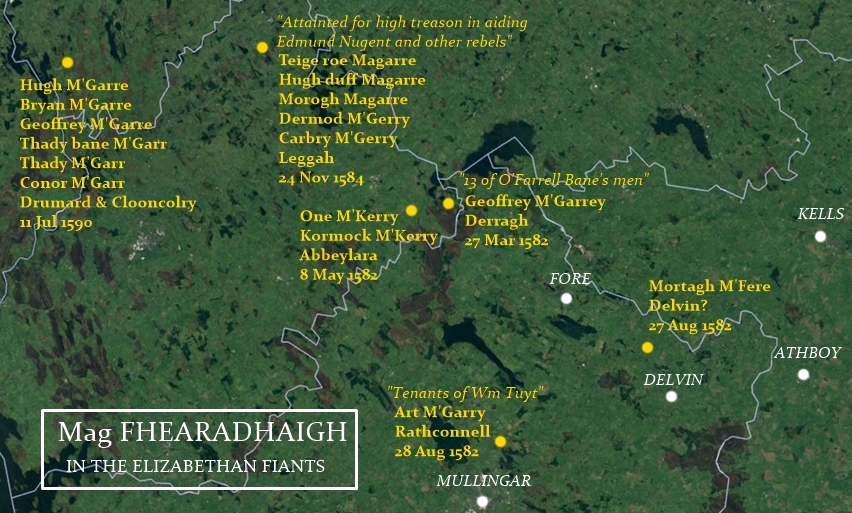
Investigating the events surrounding Maclean mercenaries coming into Nugent's country (The Baltinglass Rebellion of 1580-82; Wm Nugent obtaining mercenaries from Turlough Luineach O'Neil) in the Fiants, and the name which I believe spawned both "Gorry" & "Fraher" is not only thoroughly in the area of the later McClean-variant surname cluster, but it seems this family turned out in the 2nd Desmond Rebellion/Baltinglass Rebellion.
By the 1580s, the Baron of Delvin controlled many parts of Granard barony in Longford and was gaining foothold in Clanmahon.

Image
Some things that pique my interest
-Abbeylara/Derragh. Derragh is the location of a ruined Anglican church, where one "Fergus McCleane, protestant" is first associated with in 1701. The given-name Fergus in the area is very very rare, and is only among the O'Farrells; There was a Fergus O'Farrell of Annaly during the Nine Years War.
-"Mortogh M'Fere" somewhere near Delvin; this is also the area where there was likely a "Farrahy>Faraher" mutation, spawning the small number of Farker/Forker/Farquhar near Athboy.

(Later records in 1659 c.: "Magarre", 6 families, Delvyn barony)

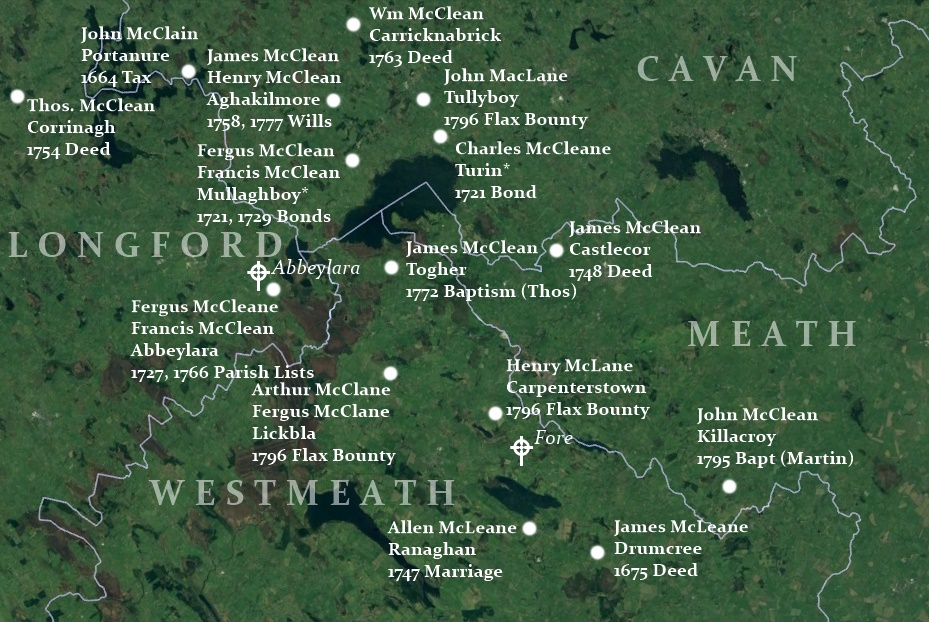
Besides the outlier family in Leitrim who appear with a lot of MacRannells, the surname is roughly in area where ive mapped out pre-1800 McClean records. The McCleans were most numerous in Ballymachugh parish, Co. Cavan, which was probably in Longford for a short time as it lies in Ardagh diocese and the tithes supported Abbeylara.

Image
FTDNA Kit 132906 McLain
A5902>FT130287 Muintir Guaire
ChrisMcLain132906
Suí Senchada
Posts: 136
Joined: Sat, 2020-Apr-18 3:51 pm
Location: Bushkill, Pennsylvania, US

Re: A5902+ Group Update

Post by ChrisMcLain132906 »

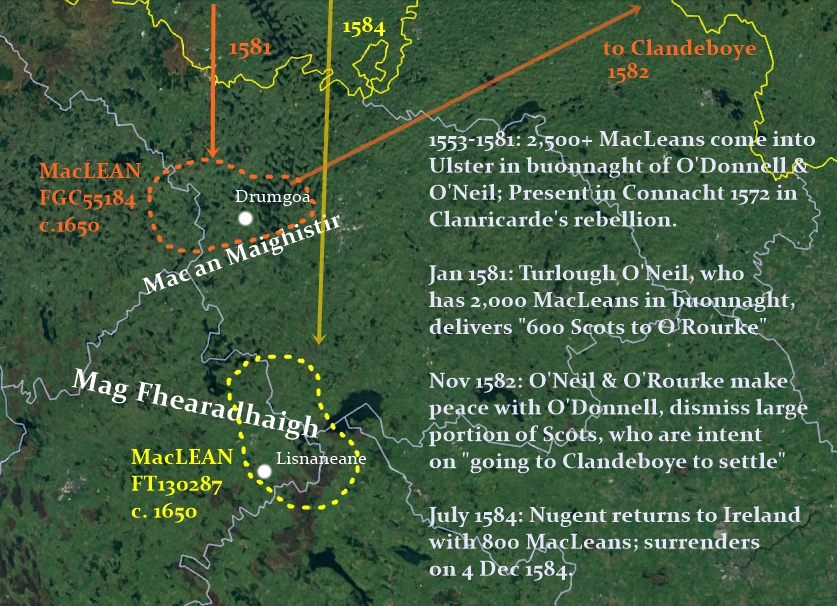
I was able to FINALLY find confirmation in a book I ordered from Dublin, that 800 Macleans who landed in Lough Foyle in July 1584, were under the employ of William Nugent, of Ross, Co. Meath. They skirmished with the Queen's forces in MacDonnell's country, met up with Maguire & O'Rourke, and came down through the Annaly towards the outer edges of the Pale. Nugent ended up surrendering on 4 Dec 1584 on promise of a pardon and restoration of his properties. It's now finally evident that Macleans became his tenants. This also explains what seems like two separate kindreds of A5902+ Macleans and 215536 Maclean's ancestral presence near the Mourne Mountains in County Down.
Image

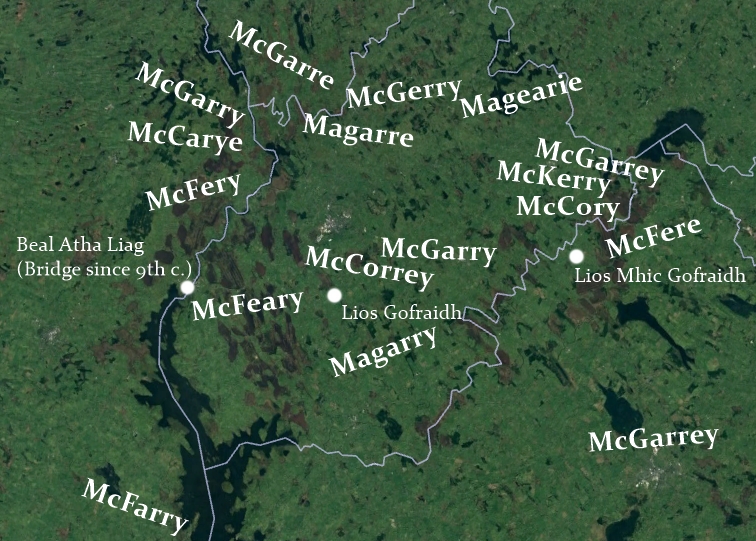
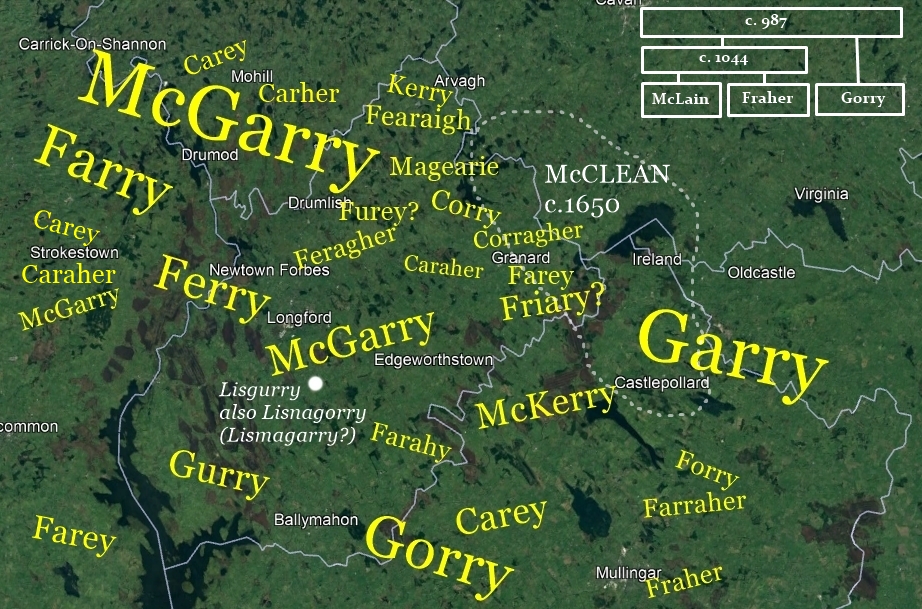
This brings me to what I believe "Gorry" and "Fraher" are really: Mag Fearadhaigh, which also had an O'prefix mostly in E. Connacht, and a linguistically incorrect Mac prefix scattered in W. Meath. This created O'Farry, O'Ferry, McFarry, McVerry, and McGarry. I believe there probably was a mutation among this family from Fearadghaigh to Fearadgh(er). I've found instances of O'Fearagh & O'Fearagha in close proximity to eachtother as well as Foragher & Coragher. The bulk of these people seem to be Roscommon-Longford, confirmed by 14 Fiants, and may have never been in "Breifne" proper, or perhaps for a very short period when O'Rourke was overlord of the Conmaicne & Cairpre Garbra.
This family seems most numerous in Mohill, and possibly crossed into there from Connacht. I sleuthed out a Y37 match to Gorry, who is a "Gurry", a variant that was very specific to southern Longford.
Image

But of course this is just based on my attempt at what these two names *may* have in common, and falls apart if Fraher is just an NPE. There is just as much evidence of Gorry & Gurry being Mac Gothradha; Lisgurry Co Longford is attributed to "Lios Gofraidh" (however with the butchering of names, a lot of these townland translations are up in the air) and adjoining this townland, one "Melaghlyn M'Correy of the Bawn, kern" was pardoned in 1585, so its evidence that this individual spawned a surname. There was also (very close to Abbeylara a Lismacaffrey in Streete parish, Co. Westmeath on the Longford border, ie "Lios Mhic Gofraidh". But where and why this name was mostly "M'Caffrey" and mostly "M'Gorry" I'm not sure. There is the thought in the back of my mind that Mac Gofraidh could have been pronounced Mac-a-Fragh and in some odd mutation become Fragha>Fraher. Woulfe wrote about Magarry, that it was sometimes "Mac a REE" and confused with Mac An Ri and anglicized to King

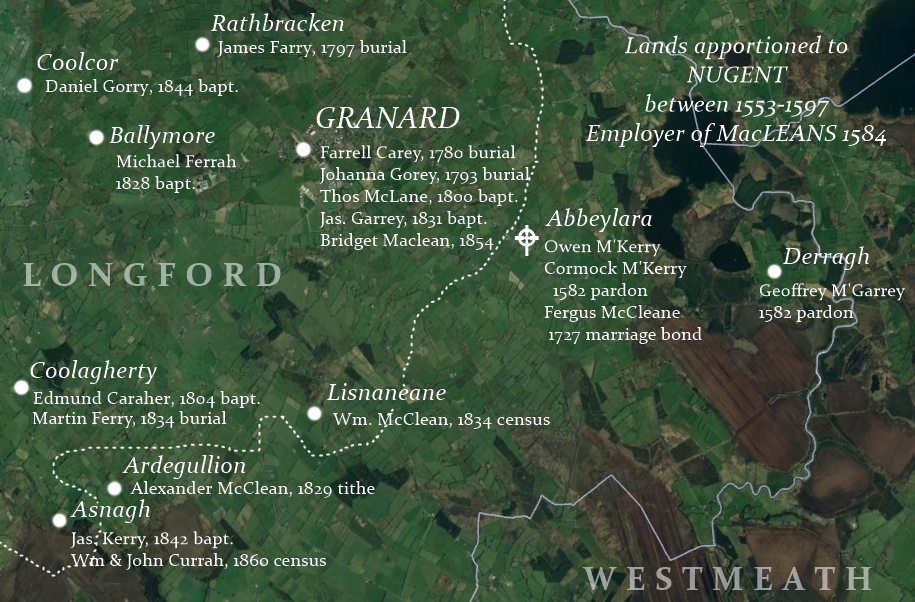
Now to my own area of interest... I was able to figure out that my leads of the previous year or so into Drumcree, ended up very likely being cousins of my ancestors with similar names who married into a family there and inherited some leases. When my ancestors emerged in Dublin city parish records c1715, they were in St Peter's parish on the estate of Lord Aungier, Earl of Longford, and were carpenters. Aungier established his suburb & St. Peters in 1685 and probably had his own craftsmen at his disposal to build it. The first Aungier took possession of the Manor of Granard in 1617, also where multiple records of McCleans emerge, one being an exchequer court bill with Fergus McClean (who appears in Abbeylara parish lists) & Aungier Gordon (a maternal descendant of Lord Aungier, who inherited a large portion of his estate) in 1701. Fergus McClean could have been in Lisnaneane, which passed from Lord Aungier to Aungier Gordon in 1705. Abbeylara was granted to Nugent in 1553, and later on the Baron Delvin in 1597 expressed to Elizabeth I his intent to billet troops on his border with O'Farrell's Country. This was before he was granted almost all of Clanmahon barony, Co. Cavan on O'Reilly's surrender, and also various more detached lands in Killoe, Longford. So in 1584-97, this would have been the border where Nugent wanted infantry or at the very least militant tenants.
Image
FTDNA Kit 132906 McLain
A5902>FT130287 Muintir Guaire
User avatar
Webmaster
Site Admin
Posts: 1574
Joined: Wed, 2019-Jun-26 2:47 pm

Re: A5902+ Group Update

Post by Webmaster »

Chris,

Ummmmm...Just wow! Fantastic research and analysis.

Something not directly related to your post, but of related interest, is what we are finding out about the R1b-FGC5939 clade. For the past several years there has been a major disconnect between the Y-DNA and the genealogies when it comes to the Uí Briúin Aí. Initially, the genealogy of the 3 sons of Fergus, Dau Tengae Umae, Fergnóe, and Eóchád Tírmchárnae, just was not holding up.

The descendants of Dau Tengae Umae, the nominal Uí Briúin Seóla, appear to be in the R1b-BY11725 subclade of R1b-A260, while the descendants of Fergnóe, the Uí Briúin Bréifne, appear to be split in the R1b-BY3338 and R1b-A5902 subclades of R1b-A260. But the dominant family of the Uí Briúin Aí, the O’Conors, and the Cland Cathail have been falling in the R1b-Y166841 clade that is parallel to R1b-A260. They are recorded as being descendants of Eóchád Tírmchárnae, but this is genetically impossible.

The R1b-FGC5939 subclade of R1b-A260 initially appeared to be vassal families of the Uí Briúin Seóla Muinter Murcháda, but with no identifiable progenitor. Then Mac Dermott men began showing up in R1b-FGC5939, along with some other related families. This led us to surmise that R1b-FGC5939 are the descendants of Eóchád Tírmchárnae, while the Uí Briúin Aí descend from a pre R1b-A260 split as outlined in an obscure genealogy.

However, recent R1b-FGC5939+ test results from men whose surnames are in the Uí Briúin Aí, Síl Muiredaig genealogies are forcing another look at the origin of the Uí Briúin Aí. It is now beginning to appear that R1b-FGC5939 are not only the descendants of Eóchád Tírmchárnae, but include the majority of the Síl Muiredaig, with a plethora of other, non Síl Muiredaig families too. It now looks like the O’Conors, and possibly the Cland Cathail, were artificially jammed onto the Síl Muiredaig genealogies, or there was a major SCE after ~950 AD for the O’Conors. So now the question becomes, who gets the label of "Uí Briúin Aí"?

The point of all this is that the Y-DNA can hold some interesting surprises that diverge from the traditional genealogies; but that again, the core of the genealogies is holding up quite well. Also, the lesson is that just when we think we have gotten a handle on things, newer results can cause a major reset in thinking - something you have been having to do for the past few years. But time, patience, and dedication will get us there eventually; we just need to be flexible in our thinking along the way.
Image
ChrisMcLain132906
Suí Senchada
Posts: 136
Joined: Sat, 2020-Apr-18 3:51 pm
Location: Bushkill, Pennsylvania, US

Re: A5902+ Group Update

Post by ChrisMcLain132906 »

Thanks so much David, just my brain in it's non-stop attempt at trying to recognize patterns :lol:
That is quite a discovery, nice work making sense of all that. I've been thinking the Viking-age upheaval may have played a part because this all seems very early. Particularly in A5902, the timeframe is correct for A5902 DNA to be injected into the Ui Breasaill Airthir line in Airgialla (O Ceileachain, O Breasaill, O hEarchadh, with O Longain & O Devanny in their match dashboards but non BigY accts) maybe as early as the 10th century, but they weren't bordering territories at the time. O'Maolseachlainn power collapsed around 1050 and their influence in Mide drastically receded, fueling the Tighernan O'Ruairc expansion which would have brought A260/A5902 into direct constant contact with Airgialla around what became Clankee barony. The TMRCA for my line of FT130287 is 987ad, and it wouldnt shock me if these people had been in Annaly at the time.

(Surnames in Fiants with Points of interest)
Image
If Gah-ree became Gaw-ree, it would dispel these Irish placenames as incorrect but there could have easily been multiple families of similar names here. However the absolutely low numbers of Mac Gofraidh variants would certainly confirm my lack of DNA matches, hahaha.
FTDNA Kit 132906 McLain
A5902>FT130287 Muintir Guaire
ChrisMcLain132906
Suí Senchada
Posts: 136
Joined: Sat, 2020-Apr-18 3:51 pm
Location: Bushkill, Pennsylvania, US

Re: A5902+ Group Update

Post by ChrisMcLain132906 »

Well it seems trying to disprove myself has turned up some things a little bit more compelling in the 10th century timeframe. I was able to find a McGarry in the Longford DNA group who is certainly not Breifne, so Mag Fhearraigh/Mag Fhearadghaigh may not be the origin.
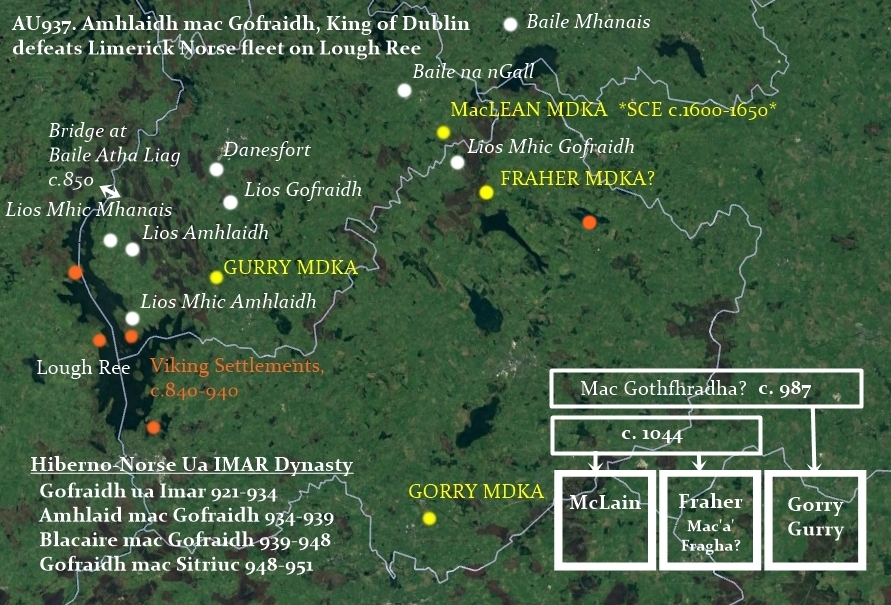
Looking for other townland names like Lisgurry/Lismacaffrey that denote a patronym as well as a surname, both turned up similar Norse given-names in the same region as known Viking age settlements around Lough Ree. This certainly supports Mac Gofraidh/Gothfradha/Gothraidh.
"Danesfort" would be a specific reference to the "black foreigners" ie the Danes of the 2nd Viking age who were led by the Ua Imar dynasty (who are probably descended of Imar the Boneless, King of Dublin 850s). Lisawly could reference the Amhlaiobh mac Gofraidh of this dynasty who was associated with Lough Ree in 937.
The hybrid culture of Norse-gaels as well as the rampant kidnapping of children by raiders would certainly be a contender for FT130287. Plundering of settlements from western banks of Lough Ree wold have very likely reached the "A5902 Homeland" in Central Roscommon. In fact this may make more sense than trying to link this clade with a strictly-Breifnean origin, which so far has just left me scratching my head and over-reaching in a lot of theories. Certainly the given names reflected in these townlands would have been immensely popular during the mid to late 10th century among gaelic people who fell under Norse leadership. The "Gofraidh O Raghallaigh" of the late 12th century and McGorrys in Clan Chaoich just being several of many unrelated coincidences. Now that I've figured out the McCleans were in Granard parish, and my contender for Fraher's ancestors (a John Fraher in Mayne, Co. Westmeath in 1779) both being extremely close to Lismacaffrey, I definitely can't overlook it.
Image
FTDNA Kit 132906 McLain
A5902>FT130287 Muintir Guaire
User avatar
Webmaster
Site Admin
Posts: 1574
Joined: Wed, 2019-Jun-26 2:47 pm

Re: A5902+ Group Update

Post by Webmaster »

Chris,

Is that "Manais" given name a corruption of "Magnusa/Magnuis", all being in the genitive case? Magnus is certainly a Viking given name introduced into Ireland. Rev. Woulfe names at least 2 families of the surname.

Also, the Uí Briúin Bréifne "homeland" was actually Mag Seóla in Co. Galway.
With the inclusion of Máenach mac Báethíne, ancestors of all three major branches of the dynasty are mentioned in the annals as residing or fighting in the Maigh Seóla region in the 7th century. The district to the east of Lough Corrib and the River Corrib is referred to as "Magh Ua mBriuin" at least as late as 1149. This likely denotes the domain of the "king of Uí Briúin", a title borne primarily by men of the Uí Briúin Seóla. As Knox points out, these kings were distinguished at an early date from the Síol Muireadaigh of central Roscommon in the Book of Rights, suggesting that the lands of the Uí Briúin Seóla were the original "Hy Briuin".
https://en.wikipedia.org/wiki/Uí_Briúin
The evidence seems to be mounting that the R1b-BY20602 subclade of R1b-FGC5939 MAY be the Síl Muiredaig. We are seeing a pattern of surnames beginning to emerge that match the genealogies in breadth, although we only have a one sample depth in many cases. This is quite exciting, because the R1b-Y166841 clade which has the later O’Conor families has had a dearth of any other Síl Muiredaig surnames.

For years now, we have thought that R1b-BY18120, which is now a subclade of R1b-Y166841, was the Uí Briúin Aí clade. But with all the new data, including that of the O’Conor Don gentleman, the whole nature of the Uí Briúin Aí has been thrown up into the air. If R1b-BY20602 is the Síl Muiredaig clade, then who are the later R1b-Y166841+ O’Conors?

We found the genealogy by Peter O’Connell written in the mid to late 1700s AD from unknown sources, and espoused by H. T. Knox in the early 1900s, that says that Muiredach Máel had TWO sons: Fergus and Cathal. Cathal certainly explains the R1b-Y166841 clade while the R1b-A260 clade certainly fits the traditional genealogies of the sons of Fergus. But it makes a hash of the Uí Briúin Aí genealogies to a degree.

I am beginning to wonder if we have a case of a major conflation error. There was Fergus son of Muiredach Máel who led to the Síl Muiredaig through his son Eóchád Tírmchárnae. Eóchád Tírmchárnae had a descendant named Fergus who was the father of Muiredach Muillethan, the putative eponymous namesake of the Síl Muiredaig. But we also have Cathal son of Muiredach Máel who MAY have been the progenitor of the later R1b-Y166841+ O’Conors.

We also have 2 different Ó Flannacáin families; one is R1b-Y166841+ like the later O’Conors, while the other is R1b-BY20602+. An Ó Flannacáin family is recorded as one of the chieftain families of the Cland Cathail sept of the Síl Muiredaig. So, we have two major branches under R1b-Y166841, one with an O’Conor family, including an O’Conor Don gentleman, and the other with an Ó Flannacáin family. This fits the Síl Muiredaig genealogy at a top level, but as I said previously, no other Síl Muiredaig surnames have been showing up. And let me stir the pot a little more by adding that we have one R1b-BY20602+ O’Conor gentleman.

Now we are seeing other Síl Muiredaig surnames in the R1b-BY20602 clade AND an Ó Flannacáin family. This fits the Síl Muiredaig genealogy better because of the breadth of surnames we are seeing. So now I am wondering if we have TWO different Síl Muiredaig and Cland Cathail tribes in the Uí Briúin dynasty. There is one set descending from Cathal son of Muiredach Máel which is the later O’Conor and Ó Flannacáin families; while the other set descends from Fergus son of Muiredach Máel and from which the 3 traditional septs of the Uí Briúin originated.

This is doing my head in at the moment. :shock: Will the real Síl Muiredaig and Cland Cathail please stand up? So don't feel you are alone out in left field with the R1b-A5902+ Uí Briúin Bréifne. Our whole damn family left us a genealogical mess. :lol:
Image
ChrisMcLain132906
Suí Senchada
Posts: 136
Joined: Sat, 2020-Apr-18 3:51 pm
Location: Bushkill, Pennsylvania, US

Re: A5902+ Group Update

Post by ChrisMcLain132906 »

Wow that is fascinating. I was under the impression that Duma Selga/Rathcroaghan was the Ui Briuin homeland only because of St Patrick's visit to the "halls of the sons of Brion", but had no other info to go on. I had figured that as Rathcroaghan became the Ui Briuin Ai inauguration site, they had pushed out Ui Briuin Breifne, spawning their movement into Cavan. I'm confident you'll put that puzzle together, I wish the rate of testing was where it was several years ago, there's also zero advertisement for this type of thing which is my major gripe with these companies :lol:
FTDNA Kit 132906 McLain
A5902>FT130287 Muintir Guaire
Post Reply