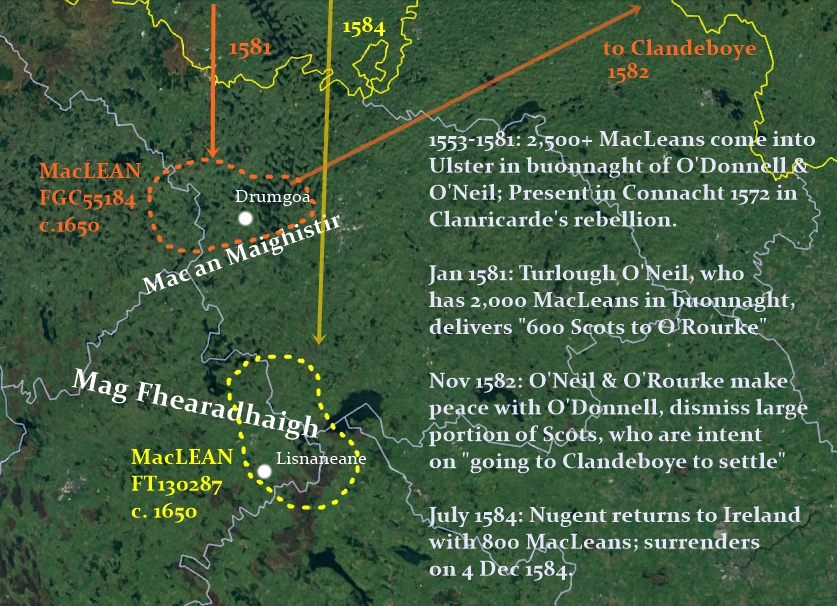
I was able to FINALLY find confirmation in a book I ordered from Dublin, that 800 Macleans who landed in Lough Foyle in July 1584, were under the employ of William Nugent, of Ross, Co. Meath. They skirmished with the Queen's forces in MacDonnell's country, met up with Maguire & O'Rourke, and came down through the Annaly towards the outer edges of the Pale. Nugent ended up surrendering on 4 Dec 1584 on promise of a pardon and restoration of his properties. It's now finally evident that Macleans became his tenants. This also explains what seems like two separate kindreds of A5902+ Macleans and 215536 Maclean's ancestral presence near the Mourne Mountains in County Down.
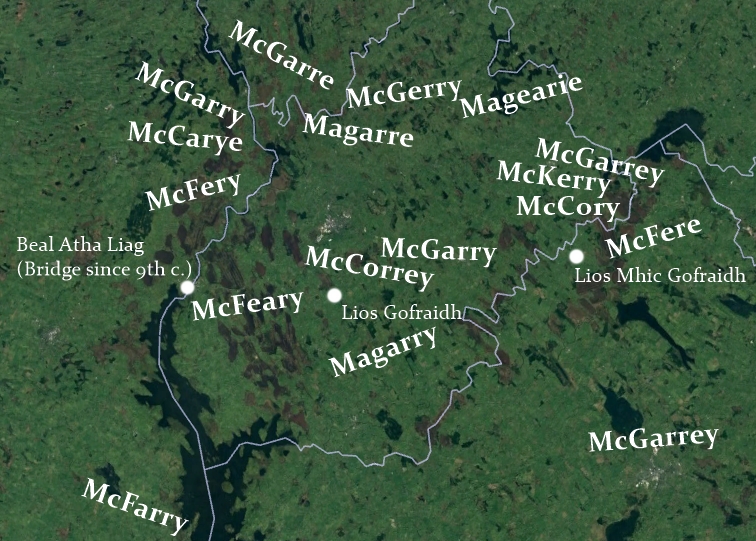
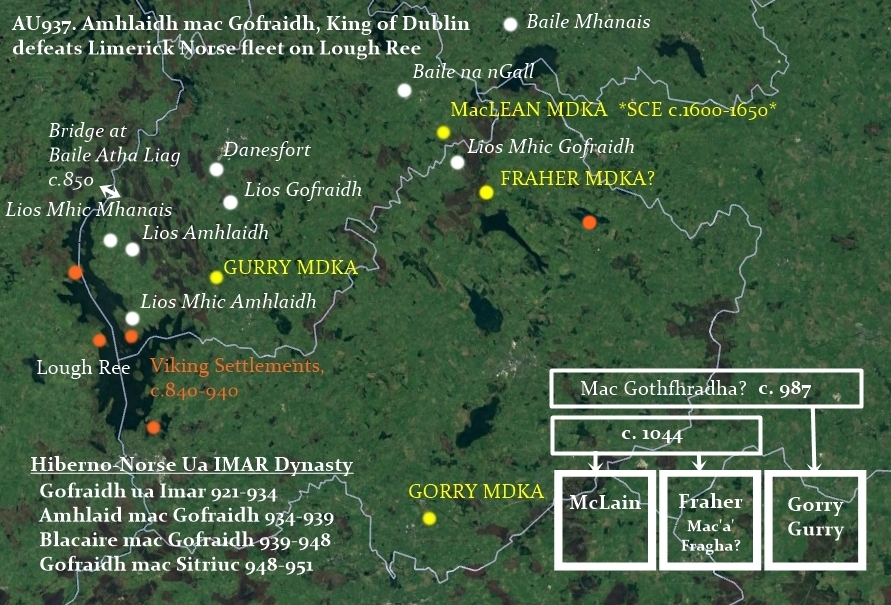
This brings me to what I believe "Gorry" and "Fraher" are really: Mag Fearadhaigh, which also had an O'prefix mostly in E. Connacht, and a linguistically incorrect Mac prefix scattered in W. Meath. This created O'Farry, O'Ferry, McFarry, McVerry, and McGarry. I believe there probably was a mutation among this family from Fearadghaigh to Fearadgh(er). I've found instances of O'Fearagh & O'Fearagha in close proximity to eachtother as well as Foragher & Coragher. The bulk of these people seem to be Roscommon-Longford, confirmed by 14 Fiants, and may have never been in "Breifne" proper, or perhaps for a very short period when O'Rourke was overlord of the Conmaicne & Cairpre Garbra.
This family seems most numerous in Mohill, and possibly crossed into there from Connacht. I sleuthed out a Y37 match to Gorry, who is a "Gurry", a variant that was very specific to southern Longford.
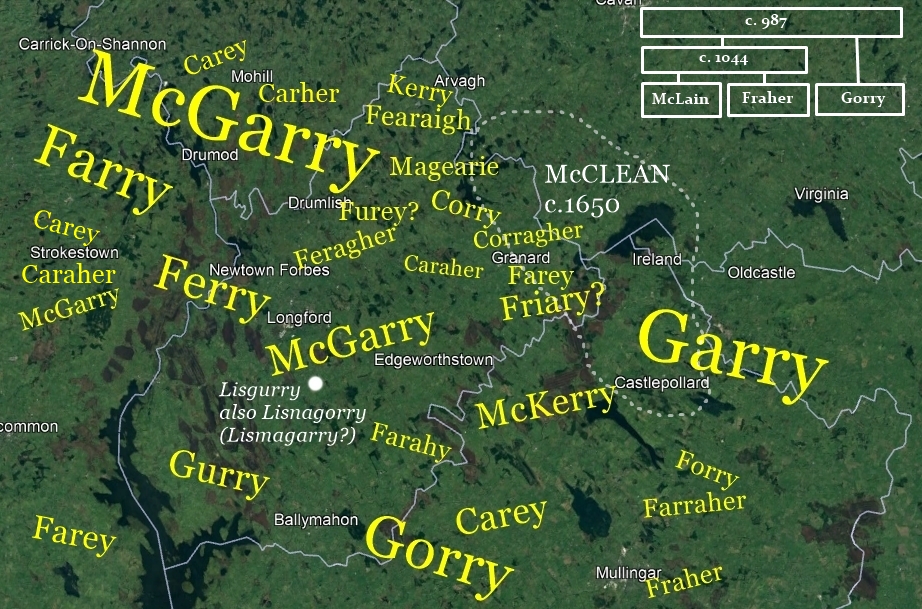
But of course this is just based on my attempt at what these two names *may* have in common, and falls apart if Fraher is just an NPE. There is just as much evidence of Gorry & Gurry being Mac Gothradha; Lisgurry Co Longford is attributed to "Lios Gofraidh" (however with the butchering of names, a lot of these townland translations are up in the air) and adjoining this townland, one "Melaghlyn M'Correy of the Bawn, kern" was pardoned in 1585, so its evidence that this individual spawned a surname. There was also (very close to Abbeylara a Lismacaffrey in Streete parish, Co. Westmeath on the Longford border, ie "Lios Mhic Gofraidh". But where and why this name was mostly "M'Caffrey" and mostly "M'Gorry" I'm not sure. There is the thought in the back of my mind that Mac Gofraidh could have been pronounced
Mac-a-
Fragh and in some odd mutation become Fragha>Fraher. Woulfe wrote about Magarry, that it was sometimes "Mac a REE" and confused with Mac An Ri and anglicized to King
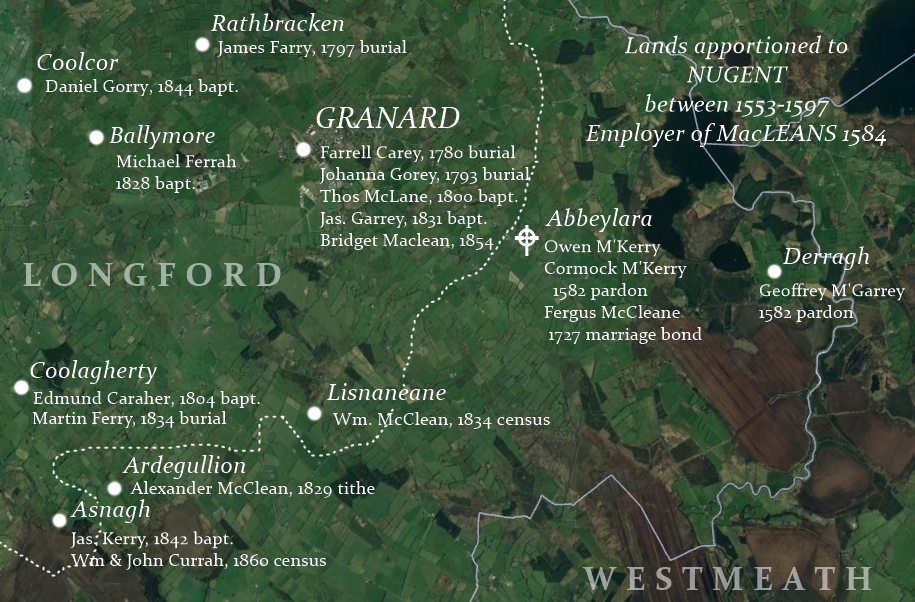
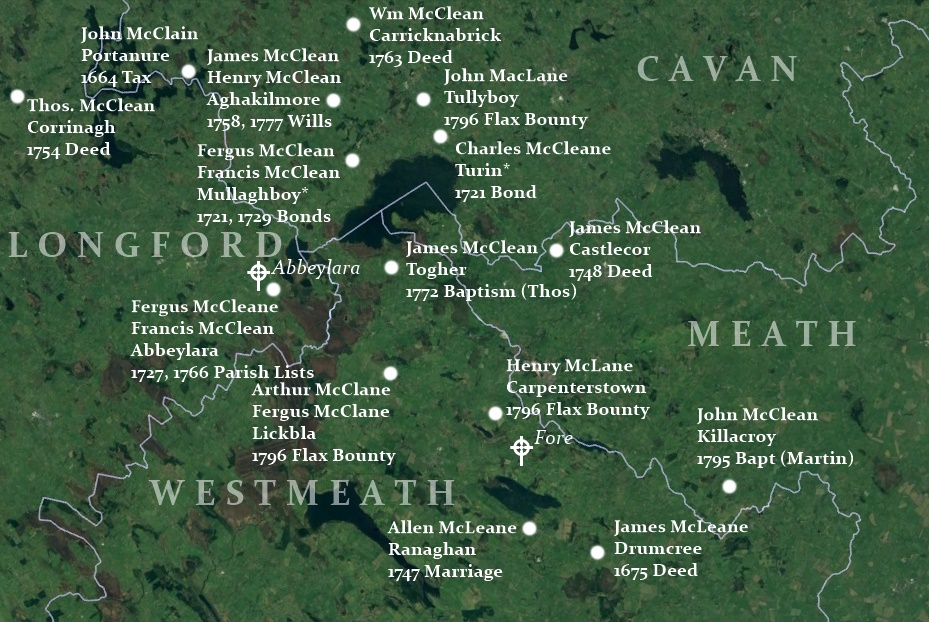
Now to my own area of interest... I was able to figure out that my leads of the previous year or so into Drumcree, ended up very likely being cousins of my ancestors with similar names who married into a family there and inherited some leases. When my ancestors emerged in Dublin city parish records c1715, they were in St Peter's parish on the estate of Lord Aungier, Earl of Longford, and were carpenters. Aungier established his suburb & St. Peters in 1685 and probably had his own craftsmen at his disposal to build it. The first Aungier took possession of the Manor of Granard in 1617, also where multiple records of McCleans emerge, one being an exchequer court bill with Fergus McClean (who appears in Abbeylara parish lists) & Aungier Gordon (a maternal descendant of Lord Aungier, who inherited a large portion of his estate) in 1701. Fergus McClean could have been in Lisnaneane, which passed from Lord Aungier to Aungier Gordon in 1705. Abbeylara was granted to Nugent in 1553, and later on the Baron Delvin in 1597 expressed to Elizabeth I his intent to billet troops on his border with O'Farrell's Country. This was before he was granted almost all of Clanmahon barony, Co. Cavan on O'Reilly's surrender, and also various more detached lands in Killoe, Longford. So in 1584-97, this would have been the border where Nugent wanted infantry or at the very least militant tenants.

 - There was also a large Neanderthal population holdout around the Iberian peninsula that lasted quite a long time after the rest of the population died out, and its a strange concidence to me that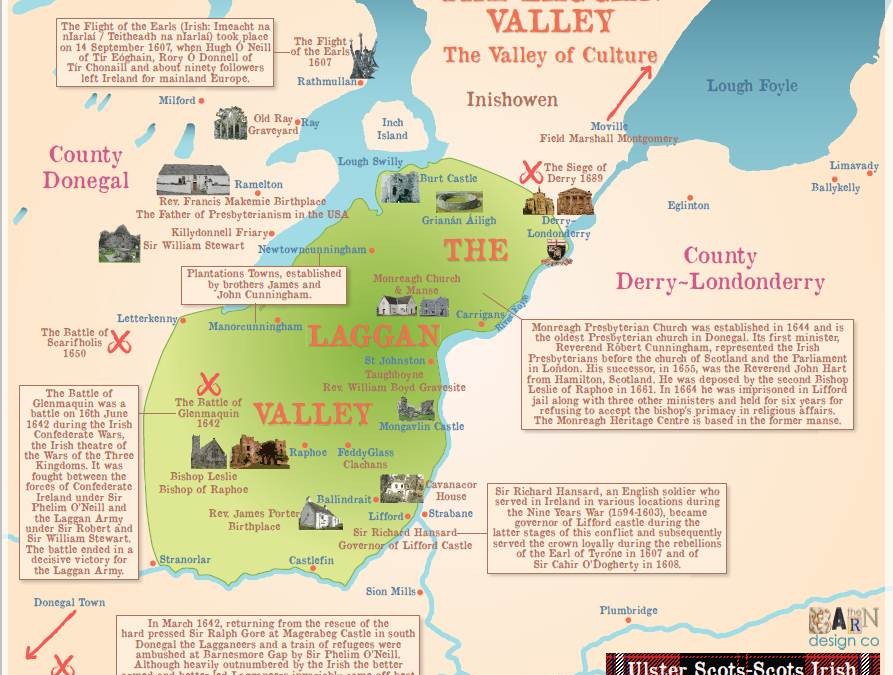


 On amazon if anyone is interested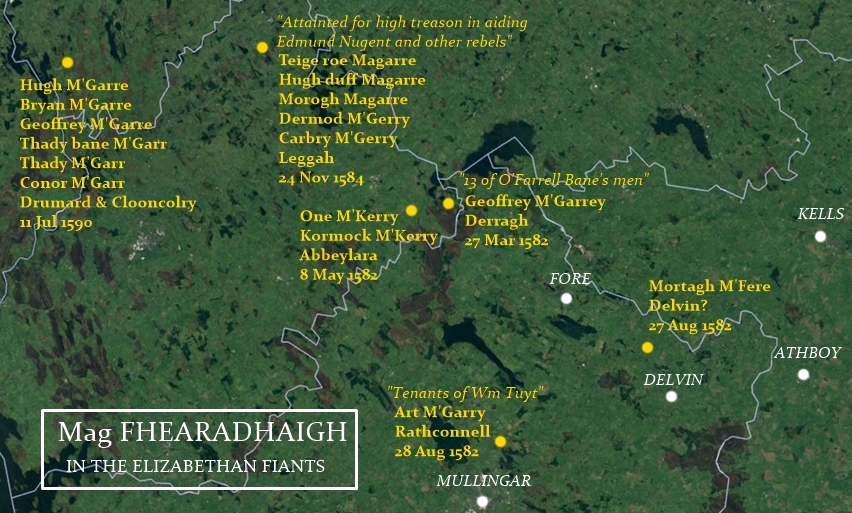
 Will the real Síl Muiredaig and Cland Cathail please stand up? So don't feel you are alone out in left field with the R1b-A5902+ Uí Briúin Bréifne. Our whole damn family left us a genealogical mess.