Page 3 of 6
Re: FT130287. Finally moving in the right direction.
Posted: Sun, 2022-Aug-21 5:17 am
by Richard Maclean
Interesting, Chris. Not sure if the following is helpful but Robert Bell (Book of Ulster Surnames) says O’Ceileachain mostly anglicised as Callaghan and that the name is amongst the forty most common names in Ireland. Most come from Cork. He says most of the Ulster Callaghan’s descend from the O’Ceileachain of Oriel who originally anglicised their name to (O’) Kelaghan, Kealaghan and (O’) Keelan. These Kelaghans had a stronghold at Liscallaghan near Fivemiletown in Co. Tyrone and their name derives from the Gaelic ‘ceile,’ meaning ‘companion.’
Re: FT130287. Finally moving in the right direction.
Posted: Sun, 2022-Aug-21 5:38 pm
by Webmaster
FYI,
It looks like O’Ceileachain/Ó Céilecháin may have derived from the diminutive form of
céilech, which is the adjective form of
céile; so
céilechán in the nominative case, and
céilecháin in the genitive case. And
céile had the meanings of:
- servant, bondsman, vassal, subject.
- fellow, companion.
- husband.
- etc.
while
céilech appears to have had the meaning of "obedient". So was this family possibly originally an Uí Briúin family under vassalage to one of the Airgíalla kings?
Re: FT130287. Finally moving in the right direction.
Posted: Mon, 2022-Aug-22 4:55 pm
by ChrisMcLain132906
Wow that definitely seems like it may be the case David. And thanks Richard, thats now a second source that identifies the Keelans as Keelaghans.
I found genealogies of this sept in the Book of Leinster, but may be a degree of conflation somewhere in attempt to link several septs of Ui Breasaill Airthir (O'Garvey; O'Ceilechain; O'Conchobhur) to a common ancestor. What interests me is the presence of "Trenfhir mac Ceilicain" when I've got a potential Armstrong. I see the Armstrong kit signs-in regularly but doesn't respond to emails, they may be not interested or a dead email unfortunately.
Genelach H. mBresail Airthir
Lorcan m. Gilli Padraic m. Madain m. Aedha m. Trenfhir m. Celicain m. Gairbid m. Aedha m. Maeliduin m. Donngaili m. Buachalla m. Concobair.
This "Conchobair" is Conchobhair Macha, whose death is recorded in 698 in the annals, and is said to descend from Breasal, a great-grandson of Colla Fo-Crith. This would probably put the theoretical Ceileachain living late 9th c AD and Lorcan mac Giolla Padraig getting closer to the 11th c.; The O'Ceilachains appear in the annals as chiefs of Clannbrassill in the 11th c:
1037. Archú ua Celecháin, tigherna Ua m-Bresail, was slain.
1038. Colman Cam ua Conghaile ri H.m-Bresail, slain by Matadan ua Ceilecan
1044. Niall ua Céilecáin, king of Uí Bresail, was blinded.
1047. Muirchertach, son of Madadhan, king of Uí-Bresail, was killed in Ard-Macha, by Madadhan Ua Celechain.
The obsolete territory name of Clannbrassill was modern day Oneilland b., Armagh, of which the Ui Breasaill Airthir were pushed out of by the Mac Cana (Dungannon Middle-Oneilland became "McCann's Country") c. 12th century, and the Mac Cana were later subjugated by the Ui Nialls. Maybe this is why the O'Ceileachain population seems to be situated on the western fringes of Airgialla.
Perhaps this Trenfhir individual had some fosterson/stepsons that were of a Breifne extraction.
Re: FT130287. Finally moving in the right direction.
Posted: Mon, 2022-Aug-22 11:03 pm
by Webmaster
Chris,
Like the Uí Maini, the Cland Colla/Airgíalla genealogies are also pretty corrupted in the early generations, but seem to be MUCH better in the later generations. From Dr. Bart Jaski's genealogical tables:
Muiredach Colla Dá Crích > Fiachróe Cassán > Bressal
which makes Bressal the grandson of Muiredach Colla Dá Crích; and as such should be R1b-Z3008+. This, of course, puts him at a far remove from the Dál Cuinn.
I did find this Uí Bressail Airthir genealogy online:
https://freepages.rootsweb.com/~dgarvey ... ealogy.htm.
Re: FT130287. Finally moving in the right direction.
Posted: Wed, 2022-Aug-24 1:15 pm
by ChrisMcLain132906
Wow that is good to know. So possibly it narrows down where this injection of Breifne DNA took place rather than a series of possible NPEs due to geography. Thank you David!
Re: FT130287. Finally moving in the right direction.
Posted: Tue, 2022-Aug-30 7:21 pm
by ChrisMcLain132906
FT130287 & BY38401 Surnames
Now that this Airgialla possibility has expanded research geographically, the Froher/Fraher on the Cavan/Monaghan border that i took for an odd anglicization of Mac An Phriora, may have been O'Fearchair after all like David first thought, in terms of an O-alias of a name that largely turned into "Carragher" in eastern Monaghan.
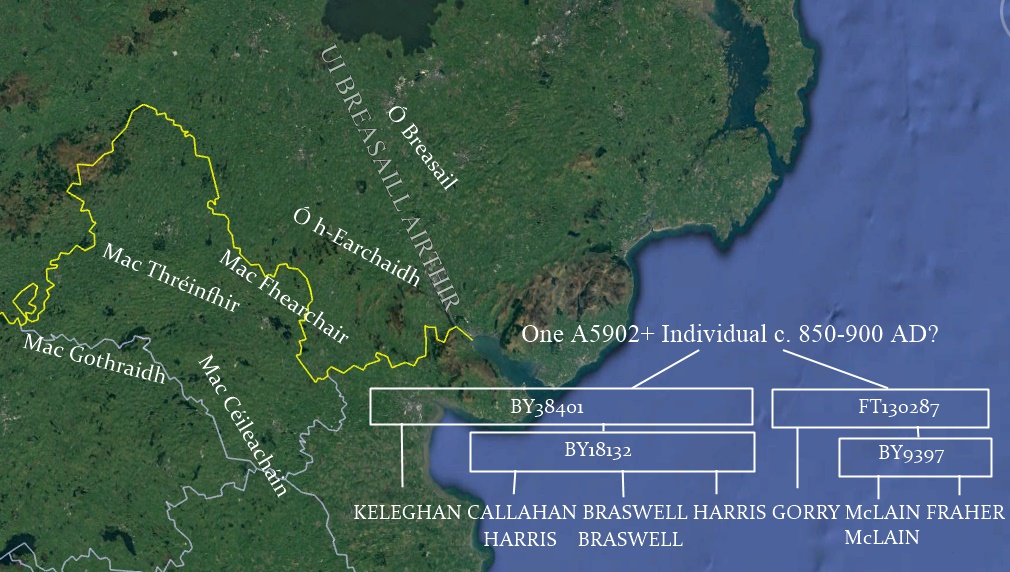
Mapped based on c.1901 populations of these surnames. Again it appears that the bulk of "Keelaghan/Keleghan/Keelan/Keelane" variants had a Mac prefix, but were far removed from their original tuaiths where the surname began, noted to be among the Ui Breasaill Airthir in the 10th century. In Fiant 6667 dated 24 JUN 1602, the pardoning of Torlagh McHenry O'Neil's tenants in the barony of the Fews, Co. Armagh, both
Ó Céileacháin,
Ó Céil'áin and a contender for
Mac Céil'áin appear:
Nele O Kellychan tenant
Brian O Kellychan yeoman
One O Kellychan tenant
Patr. O Kellychan tenant
One McShane O Kellychan tenant
One oge McElane kern
Elin McElane kern
James buy O Calane
Cormock O Kellechan
Another analysis of this surname, particularly of the (Mac)Keel-ANE variant in 19th c & later records (to make sure the pronunciantion was specifically -AYN), seems to solidify what Dr. Conchubhar O'Crualaoich told me, that it is an effect of a 15th-16th century english vowel switch. One could almost draw a line through northern Pale towns from Trim-Athboy-Navan-Ardee-Drogheda where the surname that commonly became (Mc) Clain/Clane/Clean occurred.
I've since taken over an old "Kelahan" DNA group that had no administrator and revamped it, invited the A5902 Callaghans/Keleghan, and took to ancestry trees trying to find Keelans to send kits to. There were a few Keelaghans/Kelaghans in the group from Monaghan who last signed in a decade ago and have dead email addresses unfortunately, but even just being able to access their kits shows several MacAdam & Carroll matches, both eastern Monaghan names (Diarmud Mac Cearbhall of Airgialla comes to mind as Tighernan Ui Ruairc's half brother). Hopefully I find out if this is really all one family.
Re: FT130287. Finally moving in the right direction.
Posted: Tue, 2022-Aug-30 7:50 pm
by Webmaster
Chris,
Amazing research, as always!
In terms of surname pronunciation/spelling changes, we have an interesting one now: Ó Croidheagain (Crane?). I cannot find a credible origin for Ó Croidheagain, unless possibly Ó Creitidegáin/Creitegáin, from
creitid. Apparently
creitid took on the later forms of
craitid and
croitid, as well as having the form of
creitem. So yes, some surnames went through major changes in the original Gaelic, much less being mangled by Anglicization.
Re: FT130287. Finally moving in the right direction.
Posted: Tue, 2022-Aug-30 10:27 pm
by ChrisMcLain132906
Thanks David! I just saw Tim's update on SOA from Crane. I was thinking, because I have Grehan's in my family that were midlands and supposedly Ó Gréacháin which was also numerous in Connacht. But I wasn't 100% sure because roughly in the same area was "Crehan". Ó Droighneáin gives the possibility of Mag Créacháin derived from créach (blind), and an O-prefix would definitely produce "Crane" surnames. Grehan & Crehan were also present in Sligo with Mr. Crane's MDKAs
Re: FT130287. Finally moving in the right direction.
Posted: Tue, 2022-Aug-30 11:20 pm
by Webmaster
FYI,
Créach is actually a metathesis of the adjective
cáech (
keek), "one-eyed".
Cáechán is a related noun, "one-eyed person". There is also the word
crech, " plunder, booty or plundering expedition", which appears to have a
crechán form. So Mac Créacháin could derive from either the metathesis of
Cáechán or from
Crechán. Mag Gréacháin most likely came from the affinity of the ending "G" in Mag and the silencing of the leading "C" in Créacháin. Even the Irish manged to confuse themselves with some words, especially in the transition from Old Irish to Middle Irish, where "A" was placed after "E" in many words. As if our research wasn't already hard enough.

Re: FT130287. Finally moving in the right direction.
Posted: Thu, 2022-Sep-01 12:56 pm
by ChrisMcLain132906
Seriously. I've been learning Irish for just about a year now and it's made me realize that for people who only spoke it without reading/writing it, the possible word mutations were endless. Maybe the english folks weren't 100% of the problem, hahaha.