Latest in the Ua Guaire/Ui Coileáin saga
Posted: Tue, 2025-Mar-25 4:13 pm
I've spent several months now finding a lot of consistencies and coincidences in a potential geographical location of the Ó Guaire & Ó Coileáin with corresponding evidence of an Ui Briuin presence in Leinster in an ecclesiastical capacity. I've also found that the Ui Failghe genealogies are largely fiction (as written by Noel O'Muraile who says Rus Failghe was a fictional person as well as Cathair Mor, and that Cathair Mor was possibly a deity). I set out perusing through the Southern Ui Niall SNPs only the find that the only defined group were the O'Molloy of Cenel Fiacach. Interestingly, among the BY198 Ui Maine a large cluster of Dunnes appear with a Connor from Laois. Are these the Dunnes of Ui Reagain? (Tenehinch b., Co. Laois). None of the Ui Failghe dynastic groups appear represented in the Blocktree as far as I can tell, certainly not under the southern Ui Niall.
In my quest for Ui Cuilinn... I found that the pre-famine population density of both surnames (Ó Guaire & Ó Coileáin) is numerous in one place, which is the ancient tuath of Fearann Ui Murchan, i.e. modern region of Clonbullogue Co. Offaly-Rathangan, Co. Kildare. Most of the locations I found were via baptismals and marriages. Many "Gorry" and "Cullen" families existed as tenant farmers in Clonbulloge-Rathangan but are absent in any sort of land records or leases, indicating their long presence here as impoverished under-tenants, which, although genealogically unfortunate in terms of records, also tells me their presence here is ancient as the unfree classes had little to no migratory ability. At least a half-dozen townlands in this area had both "Gorry" and "Cullen" tenants 1820-60 indicating a possible tie between the two beyond coincidence. "Mac Coileain" exists in this region in both church records, placenames and fiants which I've demonstrated in previous threads. It's been my opinion lately that "Ui Cuilinn" in AFM1032, of which Tadhg Ua Guaire was tigherna, was somewhere on the eastern fringes of Ui Failghe and that this population either became subodinate to, or were pushed into Ui Failghe. Also, it's been my opinion that Ballymote, which gives Guaire m. Dubhdacrich m. Brenainn may be either be referencing an earlier Guaire that did not spawn the surname, and there was a later Guaire on this line. And like most genealogies where prominent names repeat, this was a Guaire Ua Cuilen whose descendants became dominant in this kin group and appear in the AFM in the 10th/11th centuries.
A serious contender in my mind for a somewhat-specific location has been Feighcullen, Co. Kildare (Fiodh Cuilinn) which lies in the parish of the same name in the barony of Connell, which is on the border of the barony of Offaly East. That parish contains the townland of Clongorey (Cluain Guaire, or Cluain Ui Guaire). However Feighcullen has been determined to likely be "Wood of the Holly Trees" but I believe several factors have been overlooked in determining this placename, and it's much more likely that it was Cuilinn's Woods, Cuilinn being one of the many corruptions of the given name Cuilen/Cuilein, now in modern-Irish Coileáin. There are many Cullens in Feighcullen townland, and Gorrys in adjacent Drinnanstown, Drumsru, and Glenaree. Drumsru also has several "McColin", "McKelen", "McClon" tenants in baptismals. Also the closest "Fiodh" related placename is "Fiodh Gabhla" (or Gabhla's Woods), which was the ancient name of the oak forest around Clonbullogue, for which the Figile river takes it's name (a corruption of Fiodh Gabhla). As Fiodh Gabhla refers to a given name, it's likely that Fiodh Cuilinn does also.
The earliest records of the surname Ó Coileáin here is very early and occurs in the Justiciary Rolls in the reign of Edward I. Several locations are relatively unknown, however these are all listed as "Offaly" among a number of pleas recorded when the King's Justiciar was on-circuit at Kildare castle, Co. Kildare. The first entry is the only one that gives a specific location.
1297. Offaly.
When Adam, the serjeant of Conal, and Stephen Frere, serjeant there, came upon the tenament of John de la Hyde and Walter de Wellesely, and distrained for a debt of the King and of Will. de Vescy, and took 40 bests and brough them to the tenement of John de Punchardun; there came Geoffrey and Ricard, sons of John of Balydreinan, Walter le Carter, and Maur. le Scepherde, and deforced the serjeants and wounded Stephen. Nich. M'crinan, Tatheg Okellan (Tadgh Ó Coileáin), and his son, Walter Martin, and Roger Le Rede are common robbers and spies. Fled. Outlawed.
Punchardston is Punchersgrange in Feighcullen p., Balydreinan is Drennanstown in Cloncurry p. Listed later in 1297 at Kildare pleas, one "Gillecarrach m'Gillis M'Olan" (Giolla-carrach mac Geilis Mac Coileáin) "stole corn by night with a Maccotyn (Maccolyn?), a Martin, and a M'Dunne, and were all outlawed. In the same entry:
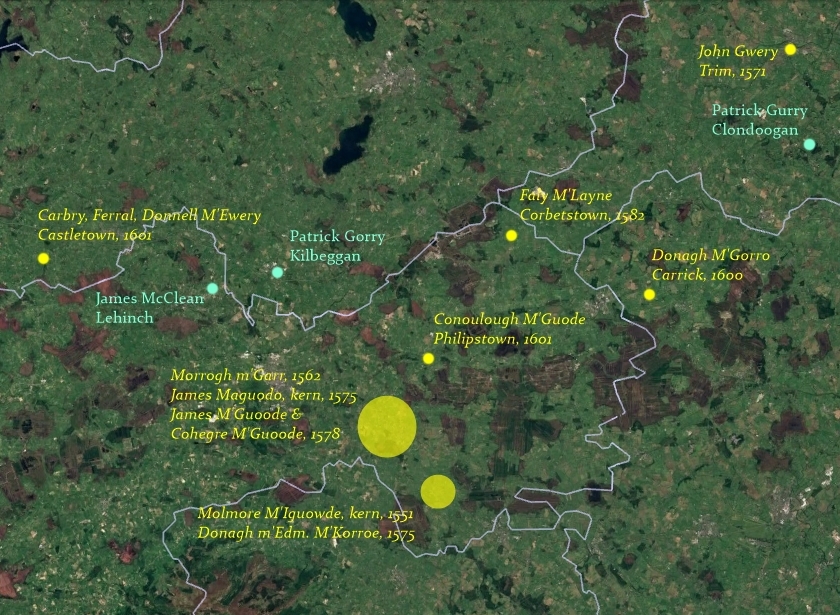
"Peter de Bermingham's serjeant and Nich. Molgeuery (Ó Maolguaire?) are receivers of Irish robbers." This may be a mistranscription of Mac Guaire. The Berminghams held Carbury barony, as well as "Tetmoy" which was anciently Tuath da Maigh in Offaly (now parts of Coolestown and Warrenstown baronies). However it would solidify the geography of a Fiant in 1600 where one "Donagh M'Gorro" (Donnchadha Mac Guaire?) was a tenant of Rich. Bermingham of Carrick, Co. Kildare very close to Edenderry, Co. Offaly; 28 April 1600
----
Research was a little stale after determining this, but a year ago when I was reading an entry in the Kildare Arcaeological society journal about the Sea of Kildare (as Clongorey was eccleasiastical land belonging to the monastery), and there was a Cairbre Ua Guaire "head of the church of Leinster" (undoubtedly Kildare) who died in the 960s (AFM), I was fascinated by a story relayed by the author (MacDevitt) which was told in the Fragmentary Annals.
"The annalists write of a battle in 722 where Fearghal, Ui Niall King of Ireland, with Aedh Laighen, King of Ui Maine invaded Leinster due to the refusal of the Laigin to continue the payment of the Borumean tribute. The invaders were defeated by the army of Leinstermen under King Murchadha mac Bran. The kings of both Ui Niall and Ui Maine were slain. The body of the Ui Maini king was recovered by his sons and his followers, carrying it over the country to ‘Lilcach’ “where Modichu, son of Amairgin, and Gall Craibhthech (i.e. the pious or religious foreigner) were.” The fugitives were, no doubt, encouraged to seek shelter at Lullymore by their trust in the piety of the foreigner; but we may be sure the mention of Modichu by the annalist had it’s own significance. Modicho was a brother of St. Finnbar, and we know him from the life of the latter that their father, Amairgin,w as sprung from the Hy Bruinn, the royal race of Connaught. There was good reason, therefore, to hope that the body of the dead king would receive honourable burial, and his sons protection at Lullymore through the influence of Modichu. The fugitives were kindly received, and remained for some time in the place, disguised as clerics. To show their gratitude, the annalist tells us, they employed their time in digging and erected the entrenchment around the church. Aedh Allen, son of Ui the slaine Ui Maini king accompanied them, lived to take his father’s place on the throne of and avenge his death at the Battle of Ballyshannon, County Kildare in 737; it was thus Aedh Allan sang:
“We did not find on earth a smoother place than Almhain,
We did not reach, after this, a more sacred place than Lilcach.”
The Fragmentary Annals adds "so that the friendship of the Úí Néill and Connachta is in that church from that time forth"
Lullymore was just north of Feighcullen. This was extremely interesting to me. It turns out that Saint Modichu was Ui Briuin Seola, and this all took place in the 8th century in the timeframe that the Ui Briuin kindreds were migrating out of Maigh Seola. Were there more Ui Briuin ecclesiastics associated with Lullymore? was it a known safe haven for disaffected or marginalized communities? Had it been part of a larger settlement and may have at one time been autonomous and located between Ui Failghe and Ui Faelain? It's proximity to Fiodh Cuilinn is certainly interesting. Fiodh Cuilinn was also an ecclesiastic settlement where one Saint Beoain established himself in either the 8th or 9th centuries, however he was known to be one of the Ui Faelain.
I've had this story in the back of my mind for quite a while but could never find anything more to associate with it. Recently I came across a pdf book called 'Irish septs and families" by an Australian named Larkin. He has for the O'Guaire... Two of these three I came to conclude myself, and it appears this guy has done his homework but gives zero sources. Ui Garrchon? I'm not sure who they were or why he would come to this conclusion. I took to the Ui Garrchon genealogies in Rawlinson B502 and found no Guaire, no Cuilinn. I wondered what he was saw that lead him to this but couldn't figure it out. It seems they were a branch of the Dal Messin Corb and an earlier people in Leinster, and very obscure. May be saw something I didn't that made him make this estimation and I left it at that.
Fast forward to the past week or so, I was reading a book called "Kildare: History & Society" and began a chapter about Saints Patrick, Brigid, and the Kings of Kildare 650-850 by Catherine Swift.
Swift goes into detail about who the Ui Garrchon were and where they were. She associates two churches, Lullymore and Dunmurraghill with the Dal Messin Corb prior to the domination of the Ui Dunlainge when the Dal Messin Corb were pushed into neighboring areas. She lays out a 10-mile stretch of north Kildare between Lullymore and Dunmurraghill as "Cenel Ucha" or Uachtar Fhine (for which the barony Oughterany, Co Kildare takes its name), this was a kindred of Dal Messin Corb, with whom the Ui Garrchon were associated or a branch of, as well as another fascinating fact...
An Ui Garrchon named Domnaill m. Flaithniad died in 783 at Cloncurry, and held the title ri Ui Failghe, noting his western connections. This Cloncurry was adjacent to Lullymore (and also adjacent to Fiodh Cuilinn). Swift writes that he was an interloper in the Ui Failghe kings who interrupted a succession of two sets of brothers ruling Ui Failghe. Did Larkin assocaite the Ua Guaire/Ua Cuilen with the Ui Garrchon because of their presence in Lullymore-Cloncurry-Feighcullen? Were they written into some genealogy of theirs? I have yet to check Ballymote. The fact that things keep leading me back to this area I believe is beyond coincidence. I recently found that there was a Saint Cilléne of Lilcach (Lullymore) whose feast day was March 12th, and just this morning I think I looked him up in the Martyrology of Gorman and he is listed as "cordial Cillene of Lilcach". I saw "Chualen mac Guaire" and though wow these two could be one and the same and possibly Ui Briuin, but it turns out that the Martyrology of Tallaght has Chualen mac Guaire as "of the race of Niall".
:
In one specific timeframe of 750-800 there is:
-The splintering of Ui Briuin out of Maigh Seola
-Ui Briuin ecclesastics sheltering Connachtmen in Lullymore
-Lullymore associated with Ui Garrchon
-An Ui Garrchon taking kingship of Ui Failghe
...possibly resulting in what looks like..
An Ui Briuin kindred in E. Offaly in the vicinity of Lullymore in the 10th century if not earlier.
In my quest for Ui Cuilinn... I found that the pre-famine population density of both surnames (Ó Guaire & Ó Coileáin) is numerous in one place, which is the ancient tuath of Fearann Ui Murchan, i.e. modern region of Clonbullogue Co. Offaly-Rathangan, Co. Kildare. Most of the locations I found were via baptismals and marriages. Many "Gorry" and "Cullen" families existed as tenant farmers in Clonbulloge-Rathangan but are absent in any sort of land records or leases, indicating their long presence here as impoverished under-tenants, which, although genealogically unfortunate in terms of records, also tells me their presence here is ancient as the unfree classes had little to no migratory ability. At least a half-dozen townlands in this area had both "Gorry" and "Cullen" tenants 1820-60 indicating a possible tie between the two beyond coincidence. "Mac Coileain" exists in this region in both church records, placenames and fiants which I've demonstrated in previous threads. It's been my opinion lately that "Ui Cuilinn" in AFM1032, of which Tadhg Ua Guaire was tigherna, was somewhere on the eastern fringes of Ui Failghe and that this population either became subodinate to, or were pushed into Ui Failghe. Also, it's been my opinion that Ballymote, which gives Guaire m. Dubhdacrich m. Brenainn may be either be referencing an earlier Guaire that did not spawn the surname, and there was a later Guaire on this line. And like most genealogies where prominent names repeat, this was a Guaire Ua Cuilen whose descendants became dominant in this kin group and appear in the AFM in the 10th/11th centuries.
A serious contender in my mind for a somewhat-specific location has been Feighcullen, Co. Kildare (Fiodh Cuilinn) which lies in the parish of the same name in the barony of Connell, which is on the border of the barony of Offaly East. That parish contains the townland of Clongorey (Cluain Guaire, or Cluain Ui Guaire). However Feighcullen has been determined to likely be "Wood of the Holly Trees" but I believe several factors have been overlooked in determining this placename, and it's much more likely that it was Cuilinn's Woods, Cuilinn being one of the many corruptions of the given name Cuilen/Cuilein, now in modern-Irish Coileáin. There are many Cullens in Feighcullen townland, and Gorrys in adjacent Drinnanstown, Drumsru, and Glenaree. Drumsru also has several "McColin", "McKelen", "McClon" tenants in baptismals. Also the closest "Fiodh" related placename is "Fiodh Gabhla" (or Gabhla's Woods), which was the ancient name of the oak forest around Clonbullogue, for which the Figile river takes it's name (a corruption of Fiodh Gabhla). As Fiodh Gabhla refers to a given name, it's likely that Fiodh Cuilinn does also.
The earliest records of the surname Ó Coileáin here is very early and occurs in the Justiciary Rolls in the reign of Edward I. Several locations are relatively unknown, however these are all listed as "Offaly" among a number of pleas recorded when the King's Justiciar was on-circuit at Kildare castle, Co. Kildare. The first entry is the only one that gives a specific location.
1297. Offaly.
When Adam, the serjeant of Conal, and Stephen Frere, serjeant there, came upon the tenament of John de la Hyde and Walter de Wellesely, and distrained for a debt of the King and of Will. de Vescy, and took 40 bests and brough them to the tenement of John de Punchardun; there came Geoffrey and Ricard, sons of John of Balydreinan, Walter le Carter, and Maur. le Scepherde, and deforced the serjeants and wounded Stephen. Nich. M'crinan, Tatheg Okellan (Tadgh Ó Coileáin), and his son, Walter Martin, and Roger Le Rede are common robbers and spies. Fled. Outlawed.
Punchardston is Punchersgrange in Feighcullen p., Balydreinan is Drennanstown in Cloncurry p. Listed later in 1297 at Kildare pleas, one "Gillecarrach m'Gillis M'Olan" (Giolla-carrach mac Geilis Mac Coileáin) "stole corn by night with a Maccotyn (Maccolyn?), a Martin, and a M'Dunne, and were all outlawed. In the same entry:
"Peter de Bermingham's serjeant and Nich. Molgeuery (Ó Maolguaire?) are receivers of Irish robbers." This may be a mistranscription of Mac Guaire. The Berminghams held Carbury barony, as well as "Tetmoy" which was anciently Tuath da Maigh in Offaly (now parts of Coolestown and Warrenstown baronies). However it would solidify the geography of a Fiant in 1600 where one "Donagh M'Gorro" (Donnchadha Mac Guaire?) was a tenant of Rich. Bermingham of Carrick, Co. Kildare very close to Edenderry, Co. Offaly; 28 April 1600
----
Research was a little stale after determining this, but a year ago when I was reading an entry in the Kildare Arcaeological society journal about the Sea of Kildare (as Clongorey was eccleasiastical land belonging to the monastery), and there was a Cairbre Ua Guaire "head of the church of Leinster" (undoubtedly Kildare) who died in the 960s (AFM), I was fascinated by a story relayed by the author (MacDevitt) which was told in the Fragmentary Annals.
"The annalists write of a battle in 722 where Fearghal, Ui Niall King of Ireland, with Aedh Laighen, King of Ui Maine invaded Leinster due to the refusal of the Laigin to continue the payment of the Borumean tribute. The invaders were defeated by the army of Leinstermen under King Murchadha mac Bran. The kings of both Ui Niall and Ui Maine were slain. The body of the Ui Maini king was recovered by his sons and his followers, carrying it over the country to ‘Lilcach’ “where Modichu, son of Amairgin, and Gall Craibhthech (i.e. the pious or religious foreigner) were.” The fugitives were, no doubt, encouraged to seek shelter at Lullymore by their trust in the piety of the foreigner; but we may be sure the mention of Modichu by the annalist had it’s own significance. Modicho was a brother of St. Finnbar, and we know him from the life of the latter that their father, Amairgin,w as sprung from the Hy Bruinn, the royal race of Connaught. There was good reason, therefore, to hope that the body of the dead king would receive honourable burial, and his sons protection at Lullymore through the influence of Modichu. The fugitives were kindly received, and remained for some time in the place, disguised as clerics. To show their gratitude, the annalist tells us, they employed their time in digging and erected the entrenchment around the church. Aedh Allen, son of Ui the slaine Ui Maini king accompanied them, lived to take his father’s place on the throne of and avenge his death at the Battle of Ballyshannon, County Kildare in 737; it was thus Aedh Allan sang:
“We did not find on earth a smoother place than Almhain,
We did not reach, after this, a more sacred place than Lilcach.”
The Fragmentary Annals adds "so that the friendship of the Úí Néill and Connachta is in that church from that time forth"
Lullymore was just north of Feighcullen. This was extremely interesting to me. It turns out that Saint Modichu was Ui Briuin Seola, and this all took place in the 8th century in the timeframe that the Ui Briuin kindreds were migrating out of Maigh Seola. Were there more Ui Briuin ecclesiastics associated with Lullymore? was it a known safe haven for disaffected or marginalized communities? Had it been part of a larger settlement and may have at one time been autonomous and located between Ui Failghe and Ui Faelain? It's proximity to Fiodh Cuilinn is certainly interesting. Fiodh Cuilinn was also an ecclesiastic settlement where one Saint Beoain established himself in either the 8th or 9th centuries, however he was known to be one of the Ui Faelain.
I've had this story in the back of my mind for quite a while but could never find anything more to associate with it. Recently I came across a pdf book called 'Irish septs and families" by an Australian named Larkin. He has for the O'Guaire... Two of these three I came to conclude myself, and it appears this guy has done his homework but gives zero sources. Ui Garrchon? I'm not sure who they were or why he would come to this conclusion. I took to the Ui Garrchon genealogies in Rawlinson B502 and found no Guaire, no Cuilinn. I wondered what he was saw that lead him to this but couldn't figure it out. It seems they were a branch of the Dal Messin Corb and an earlier people in Leinster, and very obscure. May be saw something I didn't that made him make this estimation and I left it at that.
Fast forward to the past week or so, I was reading a book called "Kildare: History & Society" and began a chapter about Saints Patrick, Brigid, and the Kings of Kildare 650-850 by Catherine Swift.
Swift goes into detail about who the Ui Garrchon were and where they were. She associates two churches, Lullymore and Dunmurraghill with the Dal Messin Corb prior to the domination of the Ui Dunlainge when the Dal Messin Corb were pushed into neighboring areas. She lays out a 10-mile stretch of north Kildare between Lullymore and Dunmurraghill as "Cenel Ucha" or Uachtar Fhine (for which the barony Oughterany, Co Kildare takes its name), this was a kindred of Dal Messin Corb, with whom the Ui Garrchon were associated or a branch of, as well as another fascinating fact...
An Ui Garrchon named Domnaill m. Flaithniad died in 783 at Cloncurry, and held the title ri Ui Failghe, noting his western connections. This Cloncurry was adjacent to Lullymore (and also adjacent to Fiodh Cuilinn). Swift writes that he was an interloper in the Ui Failghe kings who interrupted a succession of two sets of brothers ruling Ui Failghe. Did Larkin assocaite the Ua Guaire/Ua Cuilen with the Ui Garrchon because of their presence in Lullymore-Cloncurry-Feighcullen? Were they written into some genealogy of theirs? I have yet to check Ballymote. The fact that things keep leading me back to this area I believe is beyond coincidence. I recently found that there was a Saint Cilléne of Lilcach (Lullymore) whose feast day was March 12th, and just this morning I think I looked him up in the Martyrology of Gorman and he is listed as "cordial Cillene of Lilcach". I saw "Chualen mac Guaire" and though wow these two could be one and the same and possibly Ui Briuin, but it turns out that the Martyrology of Tallaght has Chualen mac Guaire as "of the race of Niall".
:
In one specific timeframe of 750-800 there is:
-The splintering of Ui Briuin out of Maigh Seola
-Ui Briuin ecclesastics sheltering Connachtmen in Lullymore
-Lullymore associated with Ui Garrchon
-An Ui Garrchon taking kingship of Ui Failghe
...possibly resulting in what looks like..
An Ui Briuin kindred in E. Offaly in the vicinity of Lullymore in the 10th century if not earlier.