

Dau Tengae Umae macc Fergusa is dated as being slain in 500 AD in the Battle of Segais (Curlew Mountains) by his son-in-law Muirchertach macc Ercca of the Uí Néill Noígíallaig, Cenél nEógain.
However, in doing my generational spreadsheet (very much a work-in-progress), I discovered that date is DEAD WRONG! There may have been a Battle of Segais in 500 AD, but that is NOT when Dau Tengae Umae macc Fergusa died. Apparently there was some kind of major conflation in the annals, but the Annals of Tigernach preserve both the error AND the correct date. It should be noted that the dates below are the raw dates from the Annals of Tigernach and should be adjusted according to Dr. Daniel P. Mc Carthy's synchronization methodology.
I must note that Mike Rowley has accepted the later death date for Dau Tengae Umae since 2022 AD, and he was right to do so. I followed the pack by accepting the 500 AD death date until the last couple of days.
After this we lose the happenings in Connacht for a while. But apparently Fúatu macc Áeda Flaitheman became King of Connacht after Áed macc Fógartaig died.https://celt.ucc.ie/published/T100002A.html
- AT500.1
The battle of Segais gained by Muireadach son of Erca over Duach of the Brazen Tongue [Tengae Umae], king of Connacht, wherein Duach fell. Hence Cennfaelad sang:
- The battle of Segais
A woman of women caused it.
Red blood was on spear
By Duiseach, daughter of Duach.- The battle of Dela, the battle of Murcuma,
And the battle of Tuaim Druba,
With the battle of Segsa wherein fell
Duach of the Brazen tongue [Tengae Umae].- AT549.1
The battle of Cúil Conaire, wherein fell Ailill the Womanly [inda Banna], king of Connacht, and Aodh the Prevailing [Fortamail], his brother. Fergus and Domnall, two sons of Mac Erca, were victors.- AT549.2
Duach Tenga Uma [Brazen Tongue] son of Fergus, king of Connacht- AT556.1
Duach Tenga Uma [Brazen Tongue], king of Connacht, died.- AT556.3
Eochaid Dryflesh [Tírmchárnae], king of connacht. [Dau Tengae Umae's brother]- AT557.3
Aodh [Flaithem] son of Eachach Tirmcharna [Dryflesh], king of Connacht. [Implies Eóchád Tírmchárnae macc Fergusa died.]- AT560.1
The battle of Cúil Dremne gained over Diarmaid son of Cerball. Forgus and Domnall, two sons of Muircheartach mac Erca and Ainmire son of Setna, and Ninnid and Duach and Aodh [Flaithem], son of Eochaidh Dryflesh [Tírmchárnae], king of Connacht, were victors through the prayer of Columcill, who said: ...- AT575.4
Aodh [Flaithem] son of Eochaidh Dryflesh [Tírmchárnae], king of Connacht, fell by the Uí Briúin in the battle of Bágh.- AT576.3
Mael Cothad [Catha] son of Fogartach son of Cathal, king of Connacht. [The later O’Conor lines!]- AT582.6
Mael Cothaigh [Catha], king of Connacht, rested.- AT582.7
Aodh, king of Connacht. [Brother to Máel Catha]- AT589.2
Aodh son of Fogarthach king of Connacht rested.
And from Ruaidrí Ó Flaithbertaig's A Chorographical Description Of West Or H-Iar Connaught, edited by James Hardiman, Dublin, 1846, pp. 128-129:
This King List is also echoed, in the main, by the Book Of Leinster; although at least one king is missing after #3 Dau Galach and before #4 Eógan Bél. Eógan Bél seems to have been conflated with Dau Galach's son Eógan Sríab - “Eogan Bél mac Duach”, but Eógan Bél's father was Cellach son of Ailill Molt. So Eógan Sríab succeeded his father Dau Galach and preceded Eógan Bél, if there was not another king between the two Eógan kings.The following list of the “Christian” kings of Connaught, or “Rath Cruachan,” was compiled by Peter O’Connell, a learned, but neglected antiquary of the last century, from various ancient authorities, aided by the collections of the venerable Charles O’Conor. It is here printed from the compiler's autograph, which is preserved in the Library of the Royal Irish Academy:
THE CHRISTIAN KINGS OF CONNAUGHT
- ...
- ...
- ...
- Eoghan Beal Mac Ceallaigh, Mic Oiliolla Muilt, Mic Daithi, &c. 35 bliadna; go ttorchair a ccath Sligigh la Feargas agas la Domnall, da mhac Muircertaig Mic Earca, la Hainmhire Mac Seadna, agas la Ninnedh Mac Duach Tengumha. 37.
- Oilioll an Bhanna Mac Eoghain Beal, Mic Ceallaigh, Mic Oiliolla Muilt, Mic Daithi, Mic Fiachrach, &c. 9 mbliadna ; go ttorchair a ccath Cuile Conaire a Ceara, la Fergas, agas la Domnall, da mhac Muircertaigh Mic Earca. 1 1
Aodh Fiontain [Fortamhail,], the brother of Oilioll an Bhanna, was slain together with Olioll an Bhanna himself, in the battle of Seghas. So in the copy or roll from Ballymote.
Fearghas Mac Muiredaigh Mail, Mic Eoghain Sreimh, Mic Duach Galaigh, Mic Briain, Mic Eochaidh Muighmedhoin. 7. No more of him, nor is he set down at all as king in (the Book of) Ballymote.- Duach Teangumha, Mac Ferghais, Mic Muiredaigh Mail, MicEoghain Sreimh, Mic Duach Galaigh, Mic Briain, Mic Eochaidh Muighmedoin, &c. 7 mbliadhna do go ttorchair la Heochaidh Tirmcharna, a bhrathair. 7. Thus both copies. An error, but the copy from Ballymote adds, or as others will have it, he was slain in the battle of Seaghas by Muirccartach Mac Earca. The battle of Seaghais was fought A. D. 530. — O’Conor.
- Eochaidh Tirmcharna Mac Ferghasa, Mic Muiredaigh Mail, Mic Eoghain Sreimh, Mic Duach Galaigh, Mic Briain, &c. Aon bhliadhain agas eug ad bath. 1.
- Aodh Mac Eochaidh Tiormcharna, Mic Fergusa, Mic Muiredaigh Mail, Mic Eoghain Sreimh, Mic Duach Galaigh, 25 bliadna, agas Ui Briuin ros rnharbh a ccath Binne Bugha, no Binne Baghna. 5*".
- Maol Catha Mac Fogartaigh, Mic Cathail, Muiredaig Mail, Mic Eoghain Sreimh, Mic Duach Galaigh, Mic Briain. 7 mbliadna do.
- Aodh, the brother of Maol Catha, after a Reign of 7 years, was slain by Uadha [Fúatu], son of Aodh [Flaithem].
- Uadha [Fúatu] Mac Aodha [Flaithem], Mic Eochaidh Tirmcharna, Mic Ferghasa, Mic Muiredaigh Mail, Mic Eoghain Sreimh, Mic Duach Galaigh, &c. 9 mbliadna.
Dau Galach very probably died circa 430 AD, which unfortunately predates the beginning of the Annals of Tigernach. If, as seems quite likely, Eógan Sríab's reign began circa 430 AD, this predates St. Patrick's arrival in Ireland, especially in Connacht. St. Patrick's sojourn at Crúachán only mentions the two daughters of Láegaire macc Néill, but NOT the king of Connacht. As pure speculation, it is easy to imagine that Eógan Sríab rejected St. Patrick and later chroniclers removed Eógan Sríab from the King List in punishment ex post facto.
It should also be noted that Hubert Thomas Knox in his The History Of The County Of Mayo To The Close Of The Sixteenth Century, Dublin, 1908, p.30, thought that Eógan Sríab suceeded his father Dau Galach at some point. The interval between the reigns of Dau Galach and Eogan Bél, circa 430 AD to 501 AD, is not quite clear; although it seems likely that Eógan Sríab and at least one other man had the kingship of Connacht in this interval.
Regardless, this confirmation of Cathal son of Muiredach Mál is exciting! Recent historians have missed this completely, as have a multitude of other scholars over the centuries. If we had not obtained the O’Conor Don's Y-DNA results, I doubt I would ever have noticed this either. It is pretty incontrovertible evidence that Cathal son of Muiredach Mál and brother to Fergus actually existed; and as I have stated before, explains the Y-DNA of the later O’Conor descendants. This death date correction also clears up so much weirdness in the records. And The Annals Of Clonmacnoise make so much sense now:
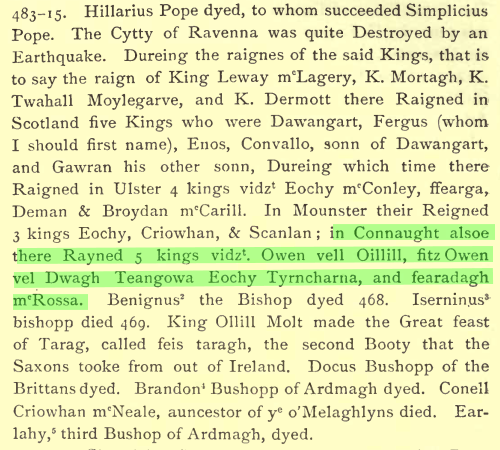
Eógan Bél, Ailill [inda Banna] son of Eógan Bél, Dau Tengae Umae, Eóchád Tírmchárnae, and Feradach macc Rossa - a descendant of Ailill Molt like Eógan Bél and Ailill inda Banna, but from a cousin line. Those three were Uí Fiachroí Foltsnáthaig, putatively all from Cera, while Dau Tengae Umae and Eóchád Tírmchárnae were Uí Briúin from Mag Seóla. Feradach macc Rossa apparently reigned for a year or less, which is why he is skipped in some records.
