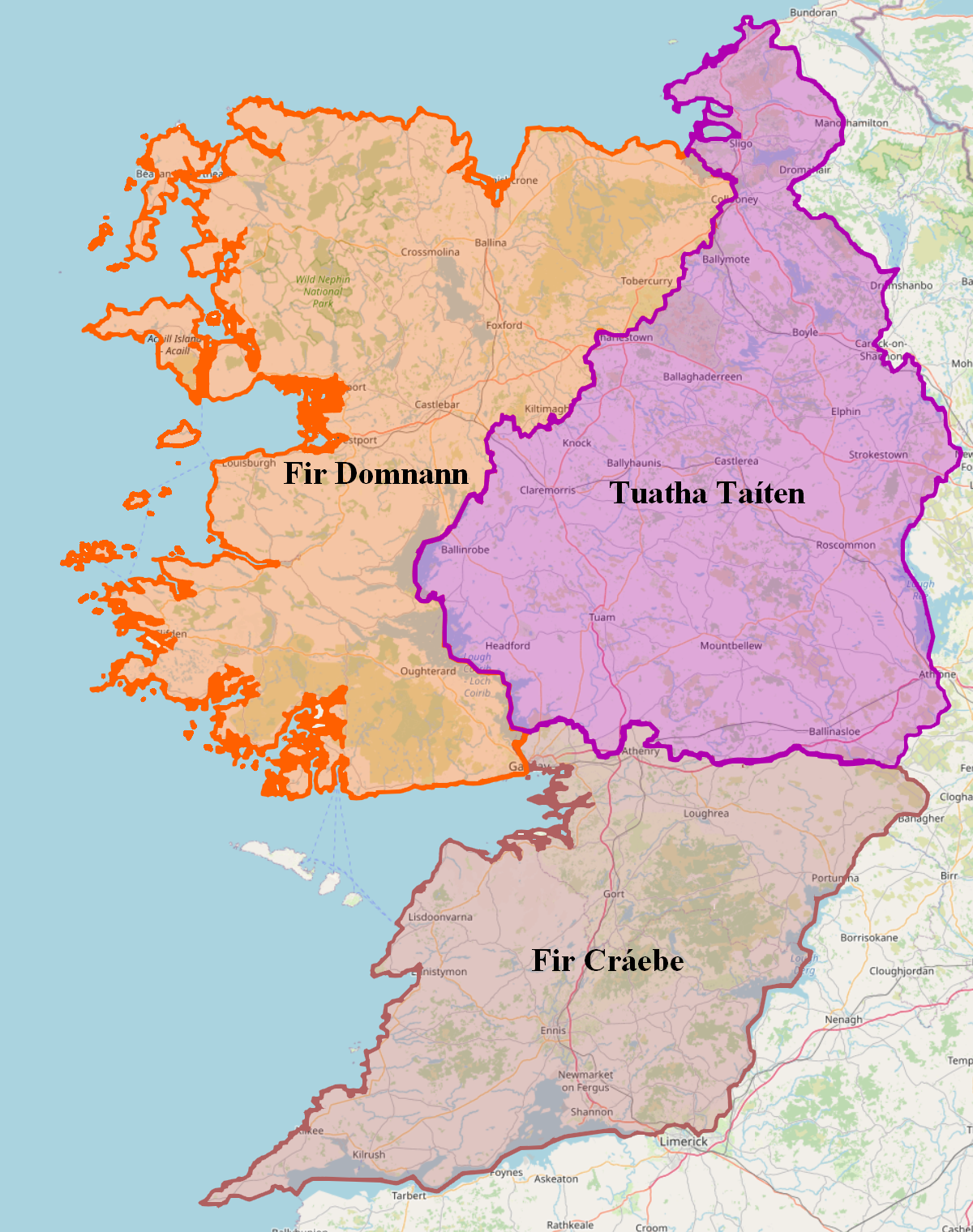
- Fir Domnann
- Túatha Taíten
- Fir Cráebe
Edmund Hogan's Onomasticon Goedelicum has the following entries:
In Dubaltach Mac Fir Bisig's Hy-Fiachrach we are told:11140
connachta np. LL 148, SG (ed. O’Grady) 50; Connachta, ap., LU 98b (seldom Connachtu, as AU i 480, ii 44 and Marianus Scottus); gp., Connacht, Arm. 18ab; the dp., Connachtaib; Connacht, and the people of C. Connachtarum regio, VC (ed Reeves), 157; extent is covered by the ecclesiastical province of Tuam (al. di. Tuam, Achonry, Clonfert, Elphin, Galway and Kilmacduagh, Killala), and the c. Leitrim; al. Cóiced Meidbe, AU iii 58, MartD xxxiv; they held fr. Limerick to r. Drobaís, betw. Sligo and the Erne, Ogygia 172, MartD xxxiv. , AClon. 15 in Cathal Crobderg’s time, ext. fr. Ess Ruad to Luimnech, fr. Uisnech Mide to Inis Bó Finne, fr. Loch Éirne to Loch Deirgdeirc, Kilkenny J ii 346; ó Suca co Drobaís & ó iarthar Thíre Amalgada co Breifne Uí Ragallaig, Betha Aeda Ruaid, 236; of old consisted of its present extent, plus Thomond and N Breifne (or c. Cavan), O’Flaherty, West Connacht, 125; the Teora Connachta, i.e. the Fir Domnann, the Fir Craíbe and the Tuatha Taíten, Lec 343, AU i 414. In Connacht are:– Ard Niad, Lec 32, AFM i 40; Áth Aird na Riad, AU iii 308; Achad Conaire i Luignib Connacht, MartO. 130, MartG 152; the r. Bre, al. Breib; Bréchmag i Cera, MartO. 90; Balla i Cera, MartD 90; Breifne, MartO. 143, MartG 170; Cell Bí, MartD xxxix; Cell Luaithrenn i Corann, MartD 148; Cera, MartO. 181; Liber Hymnorum 63, Cúil Drephni *Cúl Dreimne*, Druim Cliab, Sligech, are in it, MartD 166; Drumlane in c. Cavan, AFM ii 876; Daire Echdroma i Maig Mucraime, MartD 120; Duiblinn Fraích; Inis Bó Finne i cConmaicnib Mara i n-iarthar Connacht, MartG 152, MartO, 130; Inis Mac nÉrnín for Loch Cé i cC., MartG 182; Mag Eo na Saxan, MartO. 181; Mag Slécht in it, RC xvii 174; Mag Luirg in it, MartG 214; Mag Mucraime i n-iarthar Connacht, MartG 92, MartO. 84; ATig. RC xvii 174, ext. into c. Cavan, occisi sunt a Maig Slécht i crich Connacht; Ros Commáin in it, MartO. 184; Scrín, fd. by Colum Cille, in it, MartD 150; also Tech Baíth, MartG 234
25991
teora connachta ap; AU i 272, 320, LL 14, BB 64a; gp., rí Teóra Connacht, AFM ii 612, AU i 400; al. Fir Chraíbe, Donndaig and Tuatha Taíten, H. 1. 18, ii 726; Uí Briúin, Uí Muireadaig and Uí Fiachrach, Lec 175, 570; al. Gamanraige Irruis, Fir Craíbe and Tuatha Taíden, AU i 260
2352
áth na ríg Áth na Ríogh, in c. Galway; Athenry, ford where Aidne, Uí Maine, and Uí Briúin Seola meet, AFM iii 336, v 1280, !?Cl. 12, O’Flaherty, West Connacht, 85; .i. Vadum Regum, Ogygia 16; Áth na Ríogh Hy Maine, 6; mentioned in AConn 13a* = ACT (ed. Freeman), 1266.18, 1249.9, 1249.10, 1316.5, 1322.9, 1375.14, 1473.22*, ALC-ndx; maidm Átha na Ríg, AU ii 310; Adneri, Sweetman CDI an. 1244; Athnery, Achnerwi, Theiner, AD 1289, pp. 144–5; Grace’s Annals (ed Butler) 72; + Mac Feorais of, ALC ii 50+
4814
brethfne uí ruairc *breifne uí ruairc* Ragallach, son of Uatu, was k. of Tuatha Taíden (in Connacht) and of Breithfne Uí Ruairc as far as Cliabán Modairn, Keating, H. 5. 32, 160b; **a bad spelling of Breifne; v. Breifne, Breifne Uí Ruairc supra*
16288
fidach 2 fr. F. to Limerick was a third part of Connacht; fr. Fidach to Temair Broga Niad another third, Keating, H. 5. 32, 121b
16616
fir na craibhe 2 *fir na craíbe* a tribe of Sliab Furri; they and Gamanraige and Tuatha Taíden were called Fir Ólnécmacht, Ogygia 175; Eochu Feidlech divided Connacht into 3 parts; he gave to Fidach mac Féig F. na C., fr. Fidach to Limerick, Keating, H. 5. 32, 121b, 137a; *Gamanraige is a vox nihili; not a people* Ó hUiginn, ‘The Gamanradh’, Celtica 27 (2013) 79–94*
16618
fir ólnegmacht *ólnégmacht* the Gamanraige *Gamanraige is a vox nihili; not a people*, Fir Craíbe and Tuatha Taíden of Connacht, Ogygia 175, Windisch, TBC, 637; Olnécmacht, Cóir Anmann, § 77
21073
mag sainb and Tír Tuatha Taíden fr. Fidaci regia (Ráith Fidaig or Dún Fidaig?) to Temair Broga Niad in Leinster, Ogygia 269; fr. Fidioch *Fidach* to Temair Bruga Niad, Keating, H. 5. 32, 137a, 121b; seems betw. Cruachu and Athlone, and in Uí Maine, RC xxi 152, Cath Finntrága (ed. Meyer), p. 14; al. Mag nAí, YBL 649, Stowe D ii 2, 42b, Cormac's Glossary 41; but Sanb got Moysainue, now called Meath, AClon. 42
22509
ólnécmacht Olnécmacht .i. Connacht, LU 51a, Leabhar Breac, 25b, Cóir Anmann, 404, 324, Misc Celt Soc 24, Lec 221, MacFirbis, Genealogies, 50, AFM vi 1960, LL 331b; Cóiced O., LU 51a, YBL 899, Cath RR, 16, Bodl. Dinn 20; Crích O., SG (ed. O’Grady) 61; fir O., Irische Texte i 108, MacFirbis, Genealogies, 50; al. Cóiged Connacht, ext. fr. Luimnech to Ess Ruaid, and fr. Uisnech to Insi Bó, BB 207a; al. the Damnonii, early inhabitants of Connacht, i.e. Tuatha Taíden, Fir Craíbe, the people of Sliab Furri, Ogygia 269, 360; *Dumnonii, Domnainn*
24260
sentuatha taíden Senthuatha Taíden and Mag Sainb, betw. Fidach and Temair Broga Niad, in Connacht, Keating, H. 5. 32, 121b, 137a
26782
trí sloinnte dux na T. S, AU i 269; seems in Luigne or Leyny, c. Sligo; or Teora Connachta, al. the Gamanraige of Erris, the Fir Craíbe, and the Tuatha Taíden, Hennessy
28214
ui maini *uí maine* MartO, Nepotes Maine, Arm. 14ab; v. their genealogy, *O’D, Hy Many, passim; CGH 171–3 = LL 338g41* !?Sr. 79a; v. Map of Uí Maine in O’D., Hy Many; al. di. of Clonfert, MacF. Bishops (ed. Kelly); al. Trian Uachtarach (?), Hy Maine, 62; ancient Uí M. comprised b. Ballymoe, b. Ballintober South, b. Athlone and b. Moycarn in c. Roscommon ; b. Ballymoe, b. Tiaquin, b. Killian, b. Kilconnell, b. Clonmacnowen, b. Longford, b. Leitrim, b. Loughrea, and parts of b. Dunkellin and b. Athenry in c. Galway, part of b. Tulla Upper, c. Clare; and the p. of Lusmagh, in King’s c., Hy Many; v. Lec 349, BR (ed. O’D), Top. Poems, VT, ed. Stokes; AFM-ndx, ALC-ndx, CS-ndx, MartO,MartD, MartT (ed Kelly); *CGSH §§21.1, 662.9*; Mag Rath (ed. O’Donovan), FrIrAnn, Colgan AASS, Codex Salman., AASS i, BLis 45a; *Eochaid Fer Dá Giall for Tír Maine & for Sentuathaib Connacht & for Tuathaibh Taíden ... ó Dubglais Charadh co Gréin, ZCP xiv 216 (Echtra Conaill Gulban); O’Rahilly, EIHM 97–8, 479 (subject peoples: Túatha Taíden, Sogain, Dál nDruithne, Cattraige, Gabraige); CDI ii 34 §223, 35 §§224–6, 228, 78 §478, 132 §823, 143 §878; Paul Russell, ‘Nósa Ua Maine: the customs of the Uí Mhaine’, in Thomas Charles-Edwards Morfydd E. Owen, & Paul Russell (ed), The Welsh king and his court (Cardiff 2000) 527–51*
9523
clann simióin all the Gailéoin and Fir Domnann, LL 8, BB 17a
13669
domnaind *domnainn* cf. *Domnainn, Inber Domnann, Cathair Domnann, Irrus Domnann, Mag Domnann* Galion and Domnand, al. Laigin, as said in Táin bó Cualnge, LL 311a; np. Domnaind, YBL 117; dp.Domnannchaib, Lec 286b; the Fir Domnann; Domnandchoib, AFM i 28; a tribe of Fir Bolgs, usually called Damnonii, situated in Leinster, AClon. 28; *Margaret Dobbs, ‘The Domnaind’, JRSAI 46 (1916) 168–74; Dumnonii < *Dubnoni¯ı, EIHM (O’Rahilly) 95; v. Inber Domnann. Irros Domnann &c.*
16566
fir domnand *fir domnann, domnainn* Fer Diad of this stock, LL 81a, 87a, 127a, BB 46a; one of the three Connachta, Lec 343; Balla, Cera, are in it, BLis 41a; in NW of c. Mayo; in Crích Ólnécmacht, Lec 445; *Domnainn <Dumnonii, O’Rahilly, EIHM, 31; Margaret Dobbs, ‘The Domnaind’, JRSAI 46 (1916) 168–74*
16554
fir craíbe *fir chraíbe* in Connacht, MacFirbis, Genealogies, 59; one of the three parts of Connacht, Bruiden Da Coca 158, Lec 343, H. 1. 18, ii 711; ext. fr. Fidaci regia (Dún Fidaig?) to Limerick, Ogygia 269; fr. Fidioch to Limerick was Fír na Craebe, Fidach’s portion of Connacht, Keating, H. 5. 32, 137a
In Hubert Thomas Knox's The History of the County of Mayo we are told:However this may have been, we read that in the life-time of Niall of the Nine Hostages, Brian, his brother of the half blood, became King of Connaught, and his second eldest brother of the half blood, Fiachra, the ancestor of the O'Dowds and of all the Hy-Fiachrach tribes, became chief of the district extending from Carn Fearadhaigh, near Limerick, to Magh Mucroimhe, near Athenry. But dissensions soon arose between Brian and his brother Fiachra, and the result was that a battle was fought between them, in which the latter was defeated, captured, and delivered as a hostage into the hands of his half brother, Niall of the Nine Hostages. After this, however, Dathi, the son of Fiachra, a very warlike youth, waged war on his uncle Brian, and challenged him to a pitched battle, at a place called Damh-chluain, situated not far from Knockmaa hill, near Tuam, in the now county of Galway. In this battle, in which Dathi was assisted by Crimthann, son of Enna Cennselach, King of Leinster, Brian and his forces were routed, and pursued from the field of battle to Tulcha Domhnaill, where he was overtaken and slain by Crimthann, son of Enna Cennselach. The body of Brian was buried at the place where he fell, but after a long lapse of years St. Beo Aedh, or Aidits vivax, of Roscam, near Galway, removed his bones from that place, and buried them at Roscam; and the writer of the tract on the battle of Damh-cluain, preserved in the Book of Ballymote, adds, “the burial-place of Brian is to be seen there at this day.”
And later:Eochaidh Allat was King of the Gamanry, over the kingdom of Irrusdomnonn, comprising Clann Umoir tribes north of Aidhne, in the kingdom of the Hy Briuin Seola, and the lands afterwards of the Conmaicne in the county of Galway, all the counties of Mayo and Sligo, with the lands of the Gregry and Calry in the counties of Roscommon and Leitrim, according to the bounds given, from the River of Galway to the rivers Duff and Drowse. But we must believe that most of the minor clans gave but slight allegiance to the Gamanry in the period now opening, as so great a kingdom would have always predominated in Connaught if its tribes had acted together. The bounds are likely to have been handed down by very ancient tradition, and I should take it to have been really the county of Mayo and the countries of the Calry at this time.
Tinni, son of Curaidh, was King of the Tuatha Taiden, whose kingdom comprised the Plain of Sanb, not identified, and the lands of the Tuatha Taiden, from the Palace of Fidach towards Tara. It seems to represent what was afterwards the great kingdom of Hy Many in its largest extent, and may have included the country afterwards called the Three Tuatha and most of Magh Ai.
Knox expounds on this in great detail in his article “The Early Tribes of Connaught”:7. The Olnegmacht
Keating and O'Flaherty agree in the division of Connaught into three great kingdoms which did not extend east of the Shannon.The Fir Craibe, Tuatha Taiden, and Gamanraige are the Olnegmacht. Cruachan was the possession of their chief king.
- From Limerick to the Palace of Fidach, or Fidach, under the Fir Craibe or Fir na Craibe.
- From the Palace of Fidach, or Fidach, eastwards towards Temair an Broga Nia in Leinster {i.e. Tara), under a clan of the Tuatha Taiden.
- From the River of Galway to DufF and Drowes, the kingdom of Irrusdomnann, under the Gamanraige.
The Fir Craibe are the chief clan of the Clann Umoir, who occupied nearly all their kingdom and a considerable part of Irrusdomnann.
The group of tribes comprised by the term Tuatha Taiden is not definitely stated, but O'Flaherty says that they were of the septs of Sliabh Furri, which is in the parish of Killeroran. From O'Flaherty's list of supporters of Maine I infer that their kingdom was almost exactly that of the Hy Maine in its greatest traditional extent up to Sliabh Badhghna. The Palace of Fidach, being a bound for them and for the Fir Craibe, should be somewhere near the border of the ancient Aidhne.
The Gamanry were the reigning clan of Connaught when this Olnegmacht period opens. They built Rath Eochaidh, afterwards called Cruachan, which I suspect to have become a general name for a royal fort. It seems to have taken its name from Eochaidh Allat, King of the Gamanry of Irrusdomnann and King of Connaught, who was killed by Meave's husband Tinni. It is not necessary to suppose that this was the first occupation of that neighbourhood, only that the great fort was attributed to him. The Releg seems to be much older.
Their kingdom of Irrusdomnann comprised the Clan Umoir tribes north of Galway and all the counties of Mayo and Sligo and North Leitrim, the countries of the Gregry and Calry. It may have included Roscommon nearly up to Cruachan. Ailill Find was living in his fort in Crich Cairbre in the north of the district of the Kerry, when Fergus went to attack him. Fergus reached the Dun immediately after passing over Ath Feni. Ath Fen was in Kerry territory, and I incline to think that it was a ford of the river Lung, and that Ailech Mor of the Kerry, close to Castlemore Costello, is the place meant. It answers the description. The proper country of the Gamanry themselves seems to have been much the same as that of the Hy Fiachrach, whom I take to be their descendants. But this is vague and uncertain.
Knox, like so many before him, fell prey to the misinformation that Dua Tengae Umae died in the Battle of Segais in 500 AD. As demonstrated in The Early Kings of Connacht article, this was not the case and Knox's quibble with the early Uí Briúin genealogies is unwarranted. Further, Y-DNA has completely demolished his attempts to break up the Dál Cuinn as being descendants of the various early tribes of the region, but his research is still interesting. And he raises an interesting point:The Hy Fiachrach of the Moy also furnish a traditional connexion with the kingdom of Irrusdomnonn. The proper kingdom of the O'Dowdas was supposed to extend to Duff and Drowse. The Calry did certainly extend so far. Yet, as far back as we can go, the descendants of Fiachra, son of Eochy Moyvane, never had anything to do with Carbury: it was always in the possession of the Ulster kings, or a subject of dispute between them and the kings of Connaught. The tradition can only have arisen by taking over the tradition of the kingdom of Irrusdomnonn, for the Hy Fiachrach never got beyond Tireragh, unless the O'Fiachrachs of St. Patrick's time (who were in the peninsula of Coolerra) were of that race, of which there is no evidence. The Hy Fiachrach seem to be a transformation of Gamanry and Clan Morna, like that of the Hy Many, into Milesians.
...
Muredach and his son, Eochy Moy vane, are in quiet possession of the kingdom when the historical period opens. We then come on the Ui Briuin and Ui Fiachrach instead of the races of Fiach and Morna, and the old Tuatha Taiden are Milesian Ui Maine. In the fourth century Thomond is taken from Connaught and annexed to Munster, being the greater part of the Fircraibe Kingdom.
The distribution of territory among the sons of Eochy Moyvane is significant. The kingdom of the Tuatha Taiden remains intact; the Gregry, the Kerry, and the Conniaicne with their own sub-kings are under the King of Connachta; only the territories of the Fircraibe and of Irrusdomnonn are divided.
Brian Orbsen, King of Connaught, is the head of the Connachta branch of the Fircraibe race, as I understand these legends. Whether the Hy Briuin of Seola and Umall derive from him or not is doubtful. They probably did not, for they appear late in the annals, and seem to be but a transformation of the local tribes into Milesians. The early Hy Briuin pedigree is suspicious in the fifth century. Duach Galach and Duach Tenguma are two well-authenticated kings of Connaught; Eogan Sreim seems also fairly authentic, and to have come in after Ailill Molt; but the pedigrees give Muredach Mal and Fergus between Eogan and Duach Tenguma, and there is not time for those two generations. I suspect them to have come into it in the process of working the kings of Seola and of Brefne into the genealogy. As this Hy Briuin genealogy errs by excess, so the pedigree of the Hy Fiachrach of the Moy errs by omitting several generations in the fifth and sixth centuries. The pedigree of the Hy Fiachrach of Aidne is least objectionable as regards the number of generations.
Fiachra originally got the territory in the south from Carn Feradaig to Mag Mucrime, the Kingdom of the Fircraibe, with a part of the county of Limerick which in the Attacottic List is occupied by the Tuath Ua Cathbarr and Tuath Ua Corra, who also held the southwestern part of Thomond.
The kingdom of Irrusdomnonn is not mentioned as being divided among the sons of Eochy. The parts of it held by Clan Umoir, whom I suppose to have remained, as there is nothing to account for their disappearance, and no other occupants are mentioned until the descendants of Brian appear, are found under the Hy Briuin. The rest of the kingdom seems to have come to the possession of Dathi, son of Fiachra. Dathi's descendants certainly had Carra and Tirawley. Why the descendants of that Fiachra, who could not hold his own kingdom in Thomond, should dispossess the Clan Morna itself, the ruling family of Irrusdomnoun, does not appear. It seems to me that the men of Aidne are the true descendants of that Fiachra, and that another body of Hy Fiachrach of the north has been worked into their genealogy. This great transfer of land from Connaught to Munster is attributed to a conquest by Lugaid Meann or to one by Conall Eachluath, as an eric for the death of Crimthann, son of Fidach, in the time of Muredach Tirech, or in that of Fiachra. The Tuath Ua Cathbarr and Ua Corra drop out of sight, and the Dalcais appear. The traditions seem to represent the rise of the Ua Cathbarr and Ua Corra section, who at last confined the Clann Umoir kings of the race of Fiac to Aidne, where they survived as Hy Fiachrach.
ARE the Túath Dé Danann and the Fir Domnann one and the same? Apparently domnann possibly derived from damnand. This is interesting because I surmise the myths and legends of the Túath Dé Danann are distortions of the arrival of the proto Dál Cuinn to the northwest of Ireland as chronicled in the Laud 610 genealogies. I further postulate this MAY have been at Umall because Brión's son Conall had the epithet Oirbsen, which MAY mean "the old homestead"; and Conall Oirbsen was the progenitor of the O’Malley Clan of Umall. This is pure speculation, not fact, but the details do seem to lend credence to the surmise.The Cruithne of Leinster, and the Tuatha de Danann, and the Firgaileoin appeared to be the same race. The Danonians are a branch from the Firgaileoin; as Firgaileoin are certainly Firbolg, and apparently Domnonian, the Danonians are also really Donmonian in origin. This agrees with the alleged common descent from Nemed.
What we are told of the territories of the original Teóra Connachta is that Fir Domnann stretched from the River Galway in the south to the Rivers Duff and Drowse in the north. However, from Knox's observation, the Fir Domnann territory likely did not include the Barony of Carbury; so that has been assigned to the Tuatha Taíten as the the northernmost extent of their territory. We know that Fir Cráebe was bounded by the River Shannon on the south and east. It's northern limit at Fidach's Palace was most likely near to Athenry where the later Aidne, Uí Maini, and Uí Briúin Seóla territories met. Tuatha Taíten was north of Fidach's Palace and bounded on the east by the River Shannon and on the west by Fir Domnann. As noted above, the northernmost limit of their territory has been assigned as the Rivers Duff and Drowse.
The old boundaries of the baronies were used for the most part. Otherwise, in a few cases natural features such as rivers were used; and in a couple of cases with no other choice, eyeball approximations were made. This map may not be 100% accurate, but it hopefully provides a general idea of the division of territory among the original Teóra Connachta.