
Link between Uí Briúin Seóla, the Uí Fiachrach Aidne, and the Uí Maini
-
BuckeyeMike
- Dos Senchada
- Posts: 55
- Joined: Sat, 2021-Feb-06 4:56 pm
Link between Uí Briúin Seóla, the Uí Fiachrach Aidne, and the Uí Maini
I've been sorted from the herd once again; FTA42553 under BY20593. The search continues for a link to Uí Briúin Seóla, the Uí Fiachrach Aidne, and the Uí Maini should one exist. I'm currently searching in the Mayo/Roscommon area. I have found records for Rowley's, McDermott's and McCormick's (2 of my closest matches) in the Swinford area of Northern County Mayo and Tumna, County Roscommon. It appears the Rowley name disappeared from County Galway before Griffith's Valuation, no "Rowell's" and 4 "Rowland's" are listed there. The suggested convergence of the Uí Briúin Seóla, the Uí Fiachrach Aidne, and the Uí Maini seems to be very plausible.
Micheál Ó Rothláin
-
Webmaster

- Site Admin
- Posts: 1587
- Joined: Wed, 2019-Jun-26 2:47 pm
Re: Link between Uí Briúin Seóla, the Uí Fiachrach Aidne, and the Uí Maini
Mike,
Yes, that is your unique clade based on your BigY 700 test result analysis on The Big Tree. Based on the data we have so far, you are the only known man in this clade. Hopefully that will change with more men testing. You can see your closest surname matches on the DCG Cladogram.
As you said, that includes a Mac Diarmata and a Mac Cormaic, as well as a Dyer (Ó Dubuidir?). The other 2 men's ancestral surname is unknown, unfortunately. I will make one more suggestion as to families to look at and that is the Cland Maíl Ruanada Mac Diarmata and Mac Dondcháda. They are supposed to be R1b-A260-, along with the recent Ó Conchobair Dond gentleman; but we have not seen any real results from these families EXCEPT under R1b-FGC5939, like yourself. Due to this, you may want to check records for the Barony of Boyle in northern Co. Roscommon, which is what the old kingdom of Moylurg became.
As a caution, don't get wrapped up with the Co. Sligo Ó Rothláin family, who are not supposed to be related at all.
Best wishes on the research, and please continue to post any new findings. Thanks!
Yes, that is your unique clade based on your BigY 700 test result analysis on The Big Tree. Based on the data we have so far, you are the only known man in this clade. Hopefully that will change with more men testing. You can see your closest surname matches on the DCG Cladogram.
As you said, that includes a Mac Diarmata and a Mac Cormaic, as well as a Dyer (Ó Dubuidir?). The other 2 men's ancestral surname is unknown, unfortunately. I will make one more suggestion as to families to look at and that is the Cland Maíl Ruanada Mac Diarmata and Mac Dondcháda. They are supposed to be R1b-A260-, along with the recent Ó Conchobair Dond gentleman; but we have not seen any real results from these families EXCEPT under R1b-FGC5939, like yourself. Due to this, you may want to check records for the Barony of Boyle in northern Co. Roscommon, which is what the old kingdom of Moylurg became.
As a caution, don't get wrapped up with the Co. Sligo Ó Rothláin family, who are not supposed to be related at all.
Best wishes on the research, and please continue to post any new findings. Thanks!

-
BuckeyeMike
- Dos Senchada
- Posts: 55
- Joined: Sat, 2021-Feb-06 4:56 pm
Re: Link between Uí Briúin Seóla, the Uí Fiachrach Aidne, and the Uí Maini
Thank you for the hints, I will be adding Dyer to my list of common geographical names. I haven't looked for a connection with the Coolcarney group, although I do wonder if those Ó Rothláin's may have emigrated alongside Mac Diarmata, Mac Cormaic, as well as the Dyer (Ó Dubuidir) southward; maybe after Auliffe O'Rothlain, Chief of Calry of Coolcarney, was slain by O'Moran in 1208?
Right now I'm still focusing on that Uí Briúin Seóla, Uí Fiachrach Aidne, and Uí Maini "triangle".
I did find an interesting surname change, although it's not likely connected to me; "Clotworthy Rowley, 1st Baron Langford (31 October 1763 – 13 September 1825), known as Hon. Clotworthy Taylor until 1796 and as Hon. Clotworthy Rowley from 1796 to 1800, was an Irish peer.
Langford was the fourth son of Thomas Taylor, 1st Earl of Bective, and his wife Jane Rowley, daughter of Hercules Langford Rowley and his wife Elizabeth Rowley, 1st Viscountess Langford (a title which became extinct in 1796). Thomas Taylour, 1st Marquess of Headfort, Hercules Taylour and General Robert Taylour were his elder brothers. He succeeded to the Rowley estates in 1796 and assumed the same year by Royal licence the surname of Rowley in lieu of Taylor. Rowley represented Trim in the Irish House of Commons from 1791 to 1795. Subsequently, he sat for Meath until 1800, when the Langford title was revived and Taylor was raised to the Peerage of Ireland as Baron Langford, of Summerhill in the County of Meath." (Wikipedia).
Another commentary from Debrett's Peerage pg. 612 "The noble family of Rowley is of Saxon origin, and were seated at Carmichan, co. Chester, in the reign of Edward II., in the person of Randolfe de Rowley. This branch of the family settled in Ireland' in the reign of James I." https://archive.org/details/debrettspee ... ew=theater.
Langford's brother Thomas Taylor was 1st Marquess of Headfort, which is in County Galway, unless the place name has changed.
Now, I've only to untangle this confusion.
Right now I'm still focusing on that Uí Briúin Seóla, Uí Fiachrach Aidne, and Uí Maini "triangle".
I did find an interesting surname change, although it's not likely connected to me; "Clotworthy Rowley, 1st Baron Langford (31 October 1763 – 13 September 1825), known as Hon. Clotworthy Taylor until 1796 and as Hon. Clotworthy Rowley from 1796 to 1800, was an Irish peer.
Langford was the fourth son of Thomas Taylor, 1st Earl of Bective, and his wife Jane Rowley, daughter of Hercules Langford Rowley and his wife Elizabeth Rowley, 1st Viscountess Langford (a title which became extinct in 1796). Thomas Taylour, 1st Marquess of Headfort, Hercules Taylour and General Robert Taylour were his elder brothers. He succeeded to the Rowley estates in 1796 and assumed the same year by Royal licence the surname of Rowley in lieu of Taylor. Rowley represented Trim in the Irish House of Commons from 1791 to 1795. Subsequently, he sat for Meath until 1800, when the Langford title was revived and Taylor was raised to the Peerage of Ireland as Baron Langford, of Summerhill in the County of Meath." (Wikipedia).
Another commentary from Debrett's Peerage pg. 612 "The noble family of Rowley is of Saxon origin, and were seated at Carmichan, co. Chester, in the reign of Edward II., in the person of Randolfe de Rowley. This branch of the family settled in Ireland' in the reign of James I." https://archive.org/details/debrettspee ... ew=theater.
Langford's brother Thomas Taylor was 1st Marquess of Headfort, which is in County Galway, unless the place name has changed.
Now, I've only to untangle this confusion.
Micheál Ó Rothláin
-
BuckeyeMike
- Dos Senchada
- Posts: 55
- Joined: Sat, 2021-Feb-06 4:56 pm
Re: Link between Uí Briúin Seóla, the Uí Fiachrach Aidne, and the Uí Maini
Rowley Scenarios: I have no idea if this is anywhere near correct. Most of this is cut-and-paste so I can guarantee a ton of typo's.
Thus far, I have no Y-111 matches at FTDNA. I used a listing of my top 60 Y-67 matches and compiled as many of their complete STR's as I could find and combined them with a random sample from the Sons of Aodh Project, which included O'Reilly's, Murray's, and Dowd's. The result was a chart of 40 FTDNA STR results. I then set up a spreadsheet to extrapolate them out to find GD's beyond my Y-67 matches. This resulted in 13 Y-111 matches between GD12 and GD19. I added in 2 Donohoe matches that I couldn't find complete STR's but are my 2 closest Y-67 matches. I then used the TiP calculator to narrow down to the top 10 who are at least 78% probable at 12 generations, and 100% at 24 generations. Only 2 of those are not Uí Briúin Seóla Vassals: Murphy (Uí Fiachrach, Uí Fiachrach Aidhne) and O'Rielly (Uí Briúin Bréifne, Uí Rogallaig) Using 30 years per generation, I believe this could get a common ancestor between 360 and 720 years ago, or since @ 1300 a.d.
From "The Genealogies, Tribes, and Customs of Hy-Fiachrach, commonly called O'Dowda's Country" @1650
pgs 407-408: "The Hereditary Proprietors of Tir Fhiachrach down here.
The estate of O'Morain, i.e. Ard na Riagh, and his chieftainship the district thence to Tuaim da Odhar. O'Brogain of Breachmhagh.
There were four chiefs over Cuil Chearnadha, which extends from Beul Atha na n-Idheadh to the road of Breachmhagh*, namely, O'Fionain, O'Rothlain, O'h-Iornain (or O'Tuathalain), and O'Cuinn. O'h-Eana of Imleach Loisge; O'Gealagain of Cill Iochtair, i. e. Grainseach; O'Breslen of Cill Fhaindle, or Cill Ainnle."
*Breachmhagh is about a mile and a half north from the little town of Foxford, in the barony of Gallen, and county of Mayo. Foxford is 7 miles from Swinford, Co Mayo. From Swinford to Charlestown on the Mayo/Sigo border is 6.5 miles, and to the Roscommon border is 11 miles. For future convenience, I will use Swinford as a "base" location. Since this appears to be a different "O'Rothlain" than the one in Sligo, I'll focus here. By the time of Griffith's Survey, one of the largest concentrations of Rowley's, 9 seperate families, live in a 3 mile radius of Swinford, completely surrounded by Donohoe's and McDermott's. County Roscommon is dominated by McDermott's and Donohoe's, along with many McCormick's. There are only 2 Rowley references near Carrick-on-the-Shannon. Across the river in Co Leitrim, 'Mr. William Rowley' was an absentee landowner [Statistical Survey of the County Leitrim; by James McParlan;1802] and Josias Rowley was a member of the landed gentry holding most of the baronies of Leitrim and Mohill. The Donohoe's, McDermott's and McCormick's are in the surrounding areas; Patrick and Thomas McLoughlin rented land from Josias. This Josias is probably a member of the Rowley's of Mount Cambell who's lineage is well documented, largely in Northern Ireland and England, and does not appear to connect to me. I have found no Rowley's in Co Gallway.
The Ui Briuin Seola/Ui Fiachrach Aidna/Ui Maine/Ui Briuin Ai conjunction is generally within a 35 mile radius circle centered near Taum, Co Galway, which also encompasses Swinford in Mayo.
The matching families predicted to be Ui Briuin Seola Vassels (Dyer, McCormick, McDermott, Donohoe, McLoughlin) and Ui Fiachrach Aidhne (Murphy (Murray?)) all have historical records together in this area for the past 1500 years.
The FTDNA BY20593 branch consists of Desertspring (?), Mac Diarmata (McDermott), Mac Cormaic (McCormick), Ó Dubuidir? (Dyer), Samson (?), and Ó Rothláin? (Rowley). A YDNA SNP map (A6925) also covers this area, Swinford in the center of one cluster, with an overlap of 2 clusters to the east between Swinford and Roscommon.
The McDermott and the McDonough tribes came from the Murray's ["The history of Ireland from the earliest period to the English invasion" by Keating, Geoffrey, 1570?-1644?; O'Mahony, John, 1816-1877:
pg 482: "Muredach Maeil-lethan, i.e. Muredach of the Broad Head. He was son of Fergus, son of Raghallach, son of Uada. It was from him that the Sil Muireadhaigh [Shleel Murray*), (i.e. Seed of Muredach) consisting of the O'Connors (of Connaught). the Mac Dermots, Mac Donoughs. O'Beirnes, O'Flanagans, Mageraghties. O'Finnaghties, took their tribe-name. He was otherwise called Muredach of Magh Aei, in Roscommon. He died in the year 700, in the seventh year of Loingsech.]
From "History of Ireland" pg 732: "The 0'Reillys, as above stated, were descended from the same ancestor as the O'Rourkes, namely Aedh Finn, or Hugh the Fair, king of Connaught, in the beginning of the seventh century- They took the name O Raighilligh or 0'Raghallaigh. pronounced O'Roilligh, and rendered into O Reilly, from Raghallach, one of their celebrated chiefs, in the tenth century. The O Reillys also took the tribe name of Muiuter Maolmordha, or the people of Maelmordha, from Maelmorda, another of their celebrated chiefs. This name Maelmorda, or Mulmora, latinised Milesius and anglicised Miles, was a favorite name with the O Reillys, and was borne by many of their chiefs.
The principality of Brefney O Reilly comprised originally the greater part of the present county of Cavan, the boundary between it and Brefney O Rourke being, as already stated, the river at Ballyconnell, and being separated from Fermanagh, or Mac Guires country, by the Ballyconnell mountains."
These are likely the Uí Briúin Bréifne, Uí Rogallaig who show up in Co Meath in the 1850's. I believe this rules out the Uí Rogallaig as a significant source of Rowley DNA. Interestingly, pg 236 references "Rothlan": EOCAIDH APTHACH, ARD-RIGH.
A. M. 3301 [[cir 1900BC]]. Eocaidh Apthach, son of Finn, son of Olild, son of Flann Ruadh, son of Rothlan, son of Martin, son of Sithkind, son of Riaghlan, son of Eocaidh Brec, son of Lugaidh, son of Ith, son of Breogan, was monarch of Ireland for one year.
There's still a lot more to dig into, but I think this might help verify that the BY20593 group is a mixture of the Ui Briuin Seola/Ui Fiachrach Aidna/Ui Maine/Ui Briuin Ai which would reinforce the idea they were indeed "vassals" of the various tribes.
All suggestions moving forward will be greatly appreciated!
Thus far, I have no Y-111 matches at FTDNA. I used a listing of my top 60 Y-67 matches and compiled as many of their complete STR's as I could find and combined them with a random sample from the Sons of Aodh Project, which included O'Reilly's, Murray's, and Dowd's. The result was a chart of 40 FTDNA STR results. I then set up a spreadsheet to extrapolate them out to find GD's beyond my Y-67 matches. This resulted in 13 Y-111 matches between GD12 and GD19. I added in 2 Donohoe matches that I couldn't find complete STR's but are my 2 closest Y-67 matches. I then used the TiP calculator to narrow down to the top 10 who are at least 78% probable at 12 generations, and 100% at 24 generations. Only 2 of those are not Uí Briúin Seóla Vassals: Murphy (Uí Fiachrach, Uí Fiachrach Aidhne) and O'Rielly (Uí Briúin Bréifne, Uí Rogallaig) Using 30 years per generation, I believe this could get a common ancestor between 360 and 720 years ago, or since @ 1300 a.d.
From "The Genealogies, Tribes, and Customs of Hy-Fiachrach, commonly called O'Dowda's Country" @1650
pgs 407-408: "The Hereditary Proprietors of Tir Fhiachrach down here.
The estate of O'Morain, i.e. Ard na Riagh, and his chieftainship the district thence to Tuaim da Odhar. O'Brogain of Breachmhagh.
There were four chiefs over Cuil Chearnadha, which extends from Beul Atha na n-Idheadh to the road of Breachmhagh*, namely, O'Fionain, O'Rothlain, O'h-Iornain (or O'Tuathalain), and O'Cuinn. O'h-Eana of Imleach Loisge; O'Gealagain of Cill Iochtair, i. e. Grainseach; O'Breslen of Cill Fhaindle, or Cill Ainnle."
*Breachmhagh is about a mile and a half north from the little town of Foxford, in the barony of Gallen, and county of Mayo. Foxford is 7 miles from Swinford, Co Mayo. From Swinford to Charlestown on the Mayo/Sigo border is 6.5 miles, and to the Roscommon border is 11 miles. For future convenience, I will use Swinford as a "base" location. Since this appears to be a different "O'Rothlain" than the one in Sligo, I'll focus here. By the time of Griffith's Survey, one of the largest concentrations of Rowley's, 9 seperate families, live in a 3 mile radius of Swinford, completely surrounded by Donohoe's and McDermott's. County Roscommon is dominated by McDermott's and Donohoe's, along with many McCormick's. There are only 2 Rowley references near Carrick-on-the-Shannon. Across the river in Co Leitrim, 'Mr. William Rowley' was an absentee landowner [Statistical Survey of the County Leitrim; by James McParlan;1802] and Josias Rowley was a member of the landed gentry holding most of the baronies of Leitrim and Mohill. The Donohoe's, McDermott's and McCormick's are in the surrounding areas; Patrick and Thomas McLoughlin rented land from Josias. This Josias is probably a member of the Rowley's of Mount Cambell who's lineage is well documented, largely in Northern Ireland and England, and does not appear to connect to me. I have found no Rowley's in Co Gallway.
The Ui Briuin Seola/Ui Fiachrach Aidna/Ui Maine/Ui Briuin Ai conjunction is generally within a 35 mile radius circle centered near Taum, Co Galway, which also encompasses Swinford in Mayo.
The matching families predicted to be Ui Briuin Seola Vassels (Dyer, McCormick, McDermott, Donohoe, McLoughlin) and Ui Fiachrach Aidhne (Murphy (Murray?)) all have historical records together in this area for the past 1500 years.
The FTDNA BY20593 branch consists of Desertspring (?), Mac Diarmata (McDermott), Mac Cormaic (McCormick), Ó Dubuidir? (Dyer), Samson (?), and Ó Rothláin? (Rowley). A YDNA SNP map (A6925) also covers this area, Swinford in the center of one cluster, with an overlap of 2 clusters to the east between Swinford and Roscommon.
The McDermott and the McDonough tribes came from the Murray's ["The history of Ireland from the earliest period to the English invasion" by Keating, Geoffrey, 1570?-1644?; O'Mahony, John, 1816-1877:
pg 482: "Muredach Maeil-lethan, i.e. Muredach of the Broad Head. He was son of Fergus, son of Raghallach, son of Uada. It was from him that the Sil Muireadhaigh [Shleel Murray*), (i.e. Seed of Muredach) consisting of the O'Connors (of Connaught). the Mac Dermots, Mac Donoughs. O'Beirnes, O'Flanagans, Mageraghties. O'Finnaghties, took their tribe-name. He was otherwise called Muredach of Magh Aei, in Roscommon. He died in the year 700, in the seventh year of Loingsech.]
From "History of Ireland" pg 732: "The 0'Reillys, as above stated, were descended from the same ancestor as the O'Rourkes, namely Aedh Finn, or Hugh the Fair, king of Connaught, in the beginning of the seventh century- They took the name O Raighilligh or 0'Raghallaigh. pronounced O'Roilligh, and rendered into O Reilly, from Raghallach, one of their celebrated chiefs, in the tenth century. The O Reillys also took the tribe name of Muiuter Maolmordha, or the people of Maelmordha, from Maelmorda, another of their celebrated chiefs. This name Maelmorda, or Mulmora, latinised Milesius and anglicised Miles, was a favorite name with the O Reillys, and was borne by many of their chiefs.
The principality of Brefney O Reilly comprised originally the greater part of the present county of Cavan, the boundary between it and Brefney O Rourke being, as already stated, the river at Ballyconnell, and being separated from Fermanagh, or Mac Guires country, by the Ballyconnell mountains."
These are likely the Uí Briúin Bréifne, Uí Rogallaig who show up in Co Meath in the 1850's. I believe this rules out the Uí Rogallaig as a significant source of Rowley DNA. Interestingly, pg 236 references "Rothlan": EOCAIDH APTHACH, ARD-RIGH.
A. M. 3301 [[cir 1900BC]]. Eocaidh Apthach, son of Finn, son of Olild, son of Flann Ruadh, son of Rothlan, son of Martin, son of Sithkind, son of Riaghlan, son of Eocaidh Brec, son of Lugaidh, son of Ith, son of Breogan, was monarch of Ireland for one year.
There's still a lot more to dig into, but I think this might help verify that the BY20593 group is a mixture of the Ui Briuin Seola/Ui Fiachrach Aidna/Ui Maine/Ui Briuin Ai which would reinforce the idea they were indeed "vassals" of the various tribes.
All suggestions moving forward will be greatly appreciated!
Micheál Ó Rothláin
-
Webmaster
- Site Admin
- Posts: 1587
- Joined: Wed, 2019-Jun-26 2:47 pm
Re: Link between Uí Briúin Seóla, the Uí Fiachrach Aidne, and the Uí Maini
Mike,
Great research!
One thing I must caution you about is using STR data for matching. For R1b-M222+ men such as we are it is completely useless! See the article about STR Convergence, which is very true especially for R1b-DF104+ men. The only valid matching is via position on the Y-Haplotree based on SNPs. If men are in the same terminal clade/haplogroup, then STR data can be used to get better granularity, but not before SNP testing has confirmed the same terminal clade.
We are looking into the R1b-A6925+ Mac Diarmata and Mac Dondcháda men to see if they could possibly be the Cland Maíl Ruanada. But if they are, then the genealogies have a BIG oopsie, because it would be impossible for them to be a branch of the Síl Muiredaig Ó Conchobair, because of the Y-DNA.
This could affect you because the Cland Maíl Ruanada territories were close to the eastern and southern boundaries of Coolcarney. The old genealogies indicate the proprietors of Coolcarney were Calraige, not Dál Cuinn. But I found this recently:
This then extends to Coolcarney. Are the O’Rothláin, O’Cuind, O’hIarnáin, and O’Findáin the original Calraige inhabitants, or the subsequent people who appropriated the territory? And IF the Cland Maíl Ruanada has a busted genealogy, it is not a big leap to surmise their northwestern neighbors, the Calraige of Coolcarney, might have a similar issue. Hopefully more data will help clear this up in the near future.
Great research!
One thing I must caution you about is using STR data for matching. For R1b-M222+ men such as we are it is completely useless! See the article about STR Convergence, which is very true especially for R1b-DF104+ men. The only valid matching is via position on the Y-Haplotree based on SNPs. If men are in the same terminal clade/haplogroup, then STR data can be used to get better granularity, but not before SNP testing has confirmed the same terminal clade.
We are looking into the R1b-A6925+ Mac Diarmata and Mac Dondcháda men to see if they could possibly be the Cland Maíl Ruanada. But if they are, then the genealogies have a BIG oopsie, because it would be impossible for them to be a branch of the Síl Muiredaig Ó Conchobair, because of the Y-DNA.
This could affect you because the Cland Maíl Ruanada territories were close to the eastern and southern boundaries of Coolcarney. The old genealogies indicate the proprietors of Coolcarney were Calraige, not Dál Cuinn. But I found this recently:
But the Calraidhe of Magh h-Eileag are referenced in other sources such as Hy-Fiachrach as being Uí Fiachrach, Uí Amalgada. The O’Maíl Finda, O’Gaibthecháin, and O’Flaind are given as Uí Amalgada who are descendants of Óengus Find son of Amalgaid son of Fiachrae Foltsnáthach. So now that calls into question whether those family surnames are referring to the original Calraige inhabitants, or instead to the subsequent people who appropriated the territory.The Calraidhe of Muirisc in Tir-Ua-n-Amhalghadha are of the race of the son of Cael, son of Lughaidh Cal, and this sept is the same as Calraidhe of Magh h-Eileag: O’Mailfhina is its hereditary chieftain. They all became extinct except a few, and the Ui-Gaibhtheachain and the Ui Floinn took possession of the land, so that they are the most powerful therein, and these are also of the race of Aenghus, son of Amhalghaidh. Cuil-Cearnadha is called Calraidhe Cuile from its being in the corner or angle of Fith-Gathlaidh; and, if the learned say truly, it is to it the appellation of Calraidhe Innse-Nisc should be given. These are its hereditary tribes, namely, O’Rothlain its chieftain, and Ua Cuinn, Ua Iarnain, and Ua Finain.
[ http://publish.ucc.ie/celt/document/T105009 ]
This then extends to Coolcarney. Are the O’Rothláin, O’Cuind, O’hIarnáin, and O’Findáin the original Calraige inhabitants, or the subsequent people who appropriated the territory? And IF the Cland Maíl Ruanada has a busted genealogy, it is not a big leap to surmise their northwestern neighbors, the Calraige of Coolcarney, might have a similar issue. Hopefully more data will help clear this up in the near future.
-
BuckeyeMike
- Dos Senchada
- Posts: 55
- Joined: Sat, 2021-Feb-06 4:56 pm
Re: Link between Uí Briúin Seóla, the Uí Fiachrach Aidne, and the Uí Maini
I did have my doubts about STR's, but still used them to narrow down the search. I could have saved some brain matter if only I would have started with the 17 A6925 SNP matches in the Cladogram! I ended up with the same 6 under BY20593 in my top 10 (I couldn't find Desertspring)...the hard way: Dyer GD 12, McCormick GD 14, Samson GD 15, McDermott GD 17. McDonagh I did have to use STR's since he only tested to 37. Live and learn.
By my awkward sort (SNP then STR) I get:
1. Ó Dubuidir? (Dyer FTDNA-MK65894) 12@111+3@67 =15 (just to break ties later)
2. Mac Cormaic (McCormick FTDNA-B432078) 14+4=18
2. Ó Murchada? (Murphy FTDNA-208769) 14+4=18
2.* Ó Maíl Brigde? (Reid FTDNA-IN25527) 13+5=18
3. Mac Diarmata (McDermott FTDNA-246499) 17+4=21
4. Mac Dondchád (McDonagh FTDNA 452991) GD 7 @ 37
I can see the dilemma with the genealogies, based on my limited knowledge of the DNA it looks like Mac Diarmata and Mac Dondchád should be something else; but VERY close.
If you don't mind I'm going to think out loud here. You can turn off the volume at any time.
We have 2 sources for Ó Rothláin as "one of four chiefs over Cuil Chearnadha (Coolcarney), which extends from Beul Atha na n-Idheadh to the road of Breachmhagh, in the barony of Gallen, and county of Mayo, 5 miles from the southern border of Sligo." The Uí Fiachrach Muaide territory at its widest reach included the baronies of Erris and Tirawley in Co. Mayo, and the barony of Tireragh in Co. Sligo. Breachmhagh is on the border of Tirawley and Callen. This is the same geography as Coolcarney, which is within the Barony of Gallen stretching across both County Mayo, and County Sligo*. These locations seem to be too far north to be Uí Briúin Seóla or Uí Fiachrach Aidhne. All of this would be Uí Fiachrach Muaide territory, presumably making everyone Uí Fiachrach Muaide genetically? Maybe?
*(Atlas and Cyclopedia of Ireland; P.W. Joyce, 1905? https://archive.org/details/atlascyclop ... ew=theater)
As you mentioned, Cland Maíl Ruanada territories were close to the eastern and southern boundaries of Coolcarney, which is within the Barony of Gallen stretching across both County Mayo, and County Sligo, the same geographic location. It was unique in that it was a separate principality of the Uí Fiachrach from the rest of the Barony of Gallen. (The Irish Archaeological Society).
Is it possible all of us are Cland Maíl Ruanada, or neighbors? Hmmmm...
When I try to map this out, it looks like all the references take place inside a 15 mile radius of current Attymass, Co Mayo. On the Ordinance map of Mayo, Coolcarney comprised the parishes of Kilgarvan and Attymass. The parish of Crossmolina in the barony of Tirawley mentioned below is also inside this circle, 10 miles NW. Both Attymass and Crossmolina are mentioned often.
-’The Calraidhe of Magh h-Eileag are referenced in other sources such as Hy-Fiachrach as being Uí Fiachrach, Uí Amalgada.’ Is the Uí Amalgada branch the one that became extinct, replaced by their cousins, Uí Fiachrach Muaide or even Maíl Ruanada?
-Cálraighe Mag nEileag – situated on the north-west corner of Lough Conn, County Mayo (also in the same 15 mile circle)
-Cálraighe Mag Muirisc – at the mouth of the river Moy (in the circle).
-Donnchadh Mor had four sons, namely, Brian Dearg O'Dubhda (Dowd), lord of Tireragh, Tirawley, and Erris, who, according to the Annals of the Four Masters, was killed on the road while on his (@30 mile) pilgrimage to the abbey of Boyle. This also places O'Duhda in the same area.
I Found this, but I won't swear to it's validity; I can't verify the identity of the guy who wrote this, if it's the authors interpretation of “Genealogy of Corca Laidhe”, or scholarly fact:
"The Calraidhe of Muirisc in Tir-Ua-n-Amhalghadha are of the race of the son of Cael, son of 44i Lughaidh Cal, and this sept is the same as Calraidhe of Magh h-Eileag:
[94 Calraidhe of Magh h-Eleag, a sept, giving name to a territory nearly coextensive with the parish of Crossmolina in the barony of Tirawley and County of Mayo. (See Genealogies, &c. of Ui-Fiachrach, p. 238, note f, and the map prefixed to that work.)]
O'Mailfhina is its hereditary chieftain.
*[95 O'Mailfhina, now Mullany. There is an obvious defect in the text here, which should be as follows: ‘The Calraidhe of this district became extinct, and O'Mailfhina of the race of Aenghus, son of Amhalghaidh, of the sept of the Ui-Fiachrach, became the hereditary chieftain. The family of O'Mailfhina also became extinct, except a few, and the Ui-Gaibhtheachain and the Ui-Floinn, who are also of the race of Aenghus, son of Amhalghaidh, took possession of the land, and are now the most powerful therein.’ The little town of Crossmolina, Cros-Ui- Mhailfhina, in Tirawley, took its name from this family.]
They all became extinct except a few, and the Ui-Gaibhtheachain
[96 Ui-Gaibhtheachain, now Gaughan, a name still common in this district. (See Ui-Fiachrach, pp. 13, 238.]
and the Ui Floinn
[97 The Ui-Floinn, i. e. the family of the O'Flynns. The head of the O'Flynns was seated at Oireamh, now Errew in the parish of Crossmolina, where he was airchinneach of the church of St. Tighearnan. This family possessed a very curious relic called Mias Tighearnain, i.e. St.Tighearnan's dish. (See Ui-Fiachrach, p. 239, note i.)]
took possession of the land, so that they are the most powerful therein, and these are also of the race of Aenghus, son of Amhalghaidh. Cuil-Cearnadha
[98 Cuil-Cearnadha. (See notes 74, 79 supra.) 74 Calraidhe-Innse-Nisc. This was another name for Calraidhe of Cuil-Cearnadha. See note 98 infra, page 31. 79 Calraidhe of Cuil-Cearnadha, a sept seated in the territory of Coolcarney, which comprises the parishes of Attymass and Kilgarvan, in the barony of Gallen, County of Mayo. This tribe opposed the preaching of St. Patrick. (See Genealogies &c. of Ui-Fiachrach, p. 471) They (the Calraidhe) were dispossessed at an early period by the Ui-Fiachrach.]
is called Calraidhe Cuile from its being in the corner or angle of Fith-Gathlaidh;
[99 Fidh-Gathlaidh, i. e. Gateley's forest, a large forest in the territory of Gaileanga, now the barony of Gallen in the County of Mayo. (See Annals of the Four Masters at the year 1225)]
and, if the learned say truly, it is to it the appellation of Calraidhe Innse-Nisc
[100 Calraidhe-Innse-Nisc. This was another name for Calraidhe of Cuil-Cearnadha. (See note 98 infra, page ???)]
should be given. These are its hereditary tribes, namely, O'Rothlain
[101 its chieftain, O'Rothlain. This name is still extant in this district, but anglicized Rowley. (See Annals of the Four Masters at the year 1208, and Ui-Fiachrach, p. 246, note h.)]
and Ua Cuinn,
[102 Ua Cuinn, now Quin??.]
Ua Iarnain,
[103 Ua h-Iarnain, now obsolete]
and Ua Finain.
[104 Ua Finain, now O'Finan. Dr. O'Finan, formerly Roman Catholic Bishop of Killala was of this family and a native of this very territory]
-"The O’Leary’s One Thousand years Ago, and the origins of the Parish Of Uibh Laoghaire"; by Peter O'Leary (https://irelandxo.com/ireland-xo/messag ... tribe-5-10)
If this is correct and there is an error, the 'Calraidhe of Muirisc' of Cuil-Cearnadha were dispossessed at an early period by the 'Uí Fiachrach, Uí Amalgada' (O'Mailfhina). O'Mailfhina also became extinct except for O'Gaibhtheachain and the O'Floinn (also Uí Amalgada). The hereditary tribes were O'Rothlain, Ua Cuinn, Ua h-Iarnain, and Ua Finain, who would also be Uí Fiachrach ?; but wasn't Amalgada the brother of Nathí, uncle of Fiachnae? (https://en.wikipedia.org/wiki/U%C3%AD_Fiachrach)
Eochaid Mugmedon>Brion Fiachrae Ailill>Nathí>Fiachnae>(Uí Fiachrach Muaidhe). That makes O'Rothlain, Ua Cuinn, Ua h-Iarnain, and Ua Finain the ones who took over the territory of Coolcarney; they are inaccurately implied as Uí Fiachrach, Uí Amalgada because of the flawed genealogy between Amalgada and Nathí; should be Uí Fiachrach Muaidhe. This matches the Mac Fhirbhisigh reference to 'O'Rothlain ready; the holiday party' in Coolcarney after they take over?
Then again, I’m probably barking up the wrong tree...literally.
By my awkward sort (SNP then STR) I get:
1. Ó Dubuidir? (Dyer FTDNA-MK65894) 12@111+3@67 =15 (just to break ties later)
2. Mac Cormaic (McCormick FTDNA-B432078) 14+4=18
2. Ó Murchada? (Murphy FTDNA-208769) 14+4=18
2.* Ó Maíl Brigde? (Reid FTDNA-IN25527) 13+5=18
3. Mac Diarmata (McDermott FTDNA-246499) 17+4=21
4. Mac Dondchád (McDonagh FTDNA 452991) GD 7 @ 37
I can see the dilemma with the genealogies, based on my limited knowledge of the DNA it looks like Mac Diarmata and Mac Dondchád should be something else; but VERY close.
If you don't mind I'm going to think out loud here. You can turn off the volume at any time.
We have 2 sources for Ó Rothláin as "one of four chiefs over Cuil Chearnadha (Coolcarney), which extends from Beul Atha na n-Idheadh to the road of Breachmhagh, in the barony of Gallen, and county of Mayo, 5 miles from the southern border of Sligo." The Uí Fiachrach Muaide territory at its widest reach included the baronies of Erris and Tirawley in Co. Mayo, and the barony of Tireragh in Co. Sligo. Breachmhagh is on the border of Tirawley and Callen. This is the same geography as Coolcarney, which is within the Barony of Gallen stretching across both County Mayo, and County Sligo*. These locations seem to be too far north to be Uí Briúin Seóla or Uí Fiachrach Aidhne. All of this would be Uí Fiachrach Muaide territory, presumably making everyone Uí Fiachrach Muaide genetically? Maybe?
*(Atlas and Cyclopedia of Ireland; P.W. Joyce, 1905? https://archive.org/details/atlascyclop ... ew=theater)
As you mentioned, Cland Maíl Ruanada territories were close to the eastern and southern boundaries of Coolcarney, which is within the Barony of Gallen stretching across both County Mayo, and County Sligo, the same geographic location. It was unique in that it was a separate principality of the Uí Fiachrach from the rest of the Barony of Gallen. (The Irish Archaeological Society).
Is it possible all of us are Cland Maíl Ruanada, or neighbors? Hmmmm...
When I try to map this out, it looks like all the references take place inside a 15 mile radius of current Attymass, Co Mayo. On the Ordinance map of Mayo, Coolcarney comprised the parishes of Kilgarvan and Attymass. The parish of Crossmolina in the barony of Tirawley mentioned below is also inside this circle, 10 miles NW. Both Attymass and Crossmolina are mentioned often.
-’The Calraidhe of Magh h-Eileag are referenced in other sources such as Hy-Fiachrach as being Uí Fiachrach, Uí Amalgada.’ Is the Uí Amalgada branch the one that became extinct, replaced by their cousins, Uí Fiachrach Muaide or even Maíl Ruanada?
-Cálraighe Mag nEileag – situated on the north-west corner of Lough Conn, County Mayo (also in the same 15 mile circle)
-Cálraighe Mag Muirisc – at the mouth of the river Moy (in the circle).
-Donnchadh Mor had four sons, namely, Brian Dearg O'Dubhda (Dowd), lord of Tireragh, Tirawley, and Erris, who, according to the Annals of the Four Masters, was killed on the road while on his (@30 mile) pilgrimage to the abbey of Boyle. This also places O'Duhda in the same area.
I Found this, but I won't swear to it's validity; I can't verify the identity of the guy who wrote this, if it's the authors interpretation of “Genealogy of Corca Laidhe”, or scholarly fact:
"The Calraidhe of Muirisc in Tir-Ua-n-Amhalghadha are of the race of the son of Cael, son of 44i Lughaidh Cal, and this sept is the same as Calraidhe of Magh h-Eileag:
[94 Calraidhe of Magh h-Eleag, a sept, giving name to a territory nearly coextensive with the parish of Crossmolina in the barony of Tirawley and County of Mayo. (See Genealogies, &c. of Ui-Fiachrach, p. 238, note f, and the map prefixed to that work.)]
O'Mailfhina is its hereditary chieftain.
*[95 O'Mailfhina, now Mullany. There is an obvious defect in the text here, which should be as follows: ‘The Calraidhe of this district became extinct, and O'Mailfhina of the race of Aenghus, son of Amhalghaidh, of the sept of the Ui-Fiachrach, became the hereditary chieftain. The family of O'Mailfhina also became extinct, except a few, and the Ui-Gaibhtheachain and the Ui-Floinn, who are also of the race of Aenghus, son of Amhalghaidh, took possession of the land, and are now the most powerful therein.’ The little town of Crossmolina, Cros-Ui- Mhailfhina, in Tirawley, took its name from this family.]
They all became extinct except a few, and the Ui-Gaibhtheachain
[96 Ui-Gaibhtheachain, now Gaughan, a name still common in this district. (See Ui-Fiachrach, pp. 13, 238.]
and the Ui Floinn
[97 The Ui-Floinn, i. e. the family of the O'Flynns. The head of the O'Flynns was seated at Oireamh, now Errew in the parish of Crossmolina, where he was airchinneach of the church of St. Tighearnan. This family possessed a very curious relic called Mias Tighearnain, i.e. St.Tighearnan's dish. (See Ui-Fiachrach, p. 239, note i.)]
took possession of the land, so that they are the most powerful therein, and these are also of the race of Aenghus, son of Amhalghaidh. Cuil-Cearnadha
[98 Cuil-Cearnadha. (See notes 74, 79 supra.) 74 Calraidhe-Innse-Nisc. This was another name for Calraidhe of Cuil-Cearnadha. See note 98 infra, page 31. 79 Calraidhe of Cuil-Cearnadha, a sept seated in the territory of Coolcarney, which comprises the parishes of Attymass and Kilgarvan, in the barony of Gallen, County of Mayo. This tribe opposed the preaching of St. Patrick. (See Genealogies &c. of Ui-Fiachrach, p. 471) They (the Calraidhe) were dispossessed at an early period by the Ui-Fiachrach.]
is called Calraidhe Cuile from its being in the corner or angle of Fith-Gathlaidh;
[99 Fidh-Gathlaidh, i. e. Gateley's forest, a large forest in the territory of Gaileanga, now the barony of Gallen in the County of Mayo. (See Annals of the Four Masters at the year 1225)]
and, if the learned say truly, it is to it the appellation of Calraidhe Innse-Nisc
[100 Calraidhe-Innse-Nisc. This was another name for Calraidhe of Cuil-Cearnadha. (See note 98 infra, page ???)]
should be given. These are its hereditary tribes, namely, O'Rothlain
[101 its chieftain, O'Rothlain. This name is still extant in this district, but anglicized Rowley. (See Annals of the Four Masters at the year 1208, and Ui-Fiachrach, p. 246, note h.)]
and Ua Cuinn,
[102 Ua Cuinn, now Quin??.]
Ua Iarnain,
[103 Ua h-Iarnain, now obsolete]
and Ua Finain.
[104 Ua Finain, now O'Finan. Dr. O'Finan, formerly Roman Catholic Bishop of Killala was of this family and a native of this very territory]
-"The O’Leary’s One Thousand years Ago, and the origins of the Parish Of Uibh Laoghaire"; by Peter O'Leary (https://irelandxo.com/ireland-xo/messag ... tribe-5-10)
If this is correct and there is an error, the 'Calraidhe of Muirisc' of Cuil-Cearnadha were dispossessed at an early period by the 'Uí Fiachrach, Uí Amalgada' (O'Mailfhina). O'Mailfhina also became extinct except for O'Gaibhtheachain and the O'Floinn (also Uí Amalgada). The hereditary tribes were O'Rothlain, Ua Cuinn, Ua h-Iarnain, and Ua Finain, who would also be Uí Fiachrach ?; but wasn't Amalgada the brother of Nathí, uncle of Fiachnae? (https://en.wikipedia.org/wiki/U%C3%AD_Fiachrach)
Eochaid Mugmedon>Brion Fiachrae Ailill>Nathí>Fiachnae>(Uí Fiachrach Muaidhe). That makes O'Rothlain, Ua Cuinn, Ua h-Iarnain, and Ua Finain the ones who took over the territory of Coolcarney; they are inaccurately implied as Uí Fiachrach, Uí Amalgada because of the flawed genealogy between Amalgada and Nathí; should be Uí Fiachrach Muaidhe. This matches the Mac Fhirbhisigh reference to 'O'Rothlain ready; the holiday party' in Coolcarney after they take over?
Then again, I’m probably barking up the wrong tree...literally.
Micheál Ó Rothláin
-
Webmaster
- Site Admin
- Posts: 1587
- Joined: Wed, 2019-Jun-26 2:47 pm
Re: Link between Uí Briúin Seóla, the Uí Fiachrach Aidne, and the Uí Maini
Mike,
Here is a map I compiled from Irish Townlands, which is a very good resource.
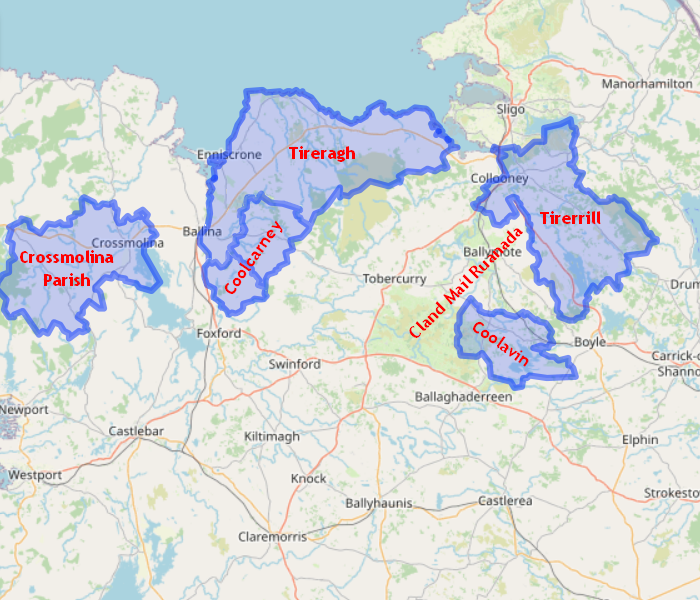
For the most likely southwestern boundary of Tir Fiachrach, please see my post Two Ambiguous Territorial Boundary Points Resolved, which basically indicates that Tir Fiachrach actually did correspond fairly well to modern Tireragh despite John O’Donovan's bemused speculations. And make no mistake, John O’Donovan's work in the mid 1800s was outstanding, but he was not perfect.
Also, as you can see, the Cland Maíl Ruanada were fairly far north, but so were the Uí Fiachrach Muaide and Uí Amalgada. IMO, this was probably part of the earliest territories of the Dál Cuinn, while Co. Galway to the south was probably some of the latest. How far west from Coolavin and Tirerrill the Cland Maíl Ruanada territory extended I am not sure.
And to be clear, the Uí Amalgada are almost certainly Uí Fiachrach, just not descended from Feradach Daithe, but rather his brother Amalgaid. And yes, the Uí Fiachrach Muaide apparently seized territory from the Uí Amalgada in Tirawley, but did not drive them to extinction. The large Loughney cluster under R1b-BY35727 proves that conclusively to me.
BTW, the Muirisc in the Calraidhe of Muirisc probably refers to the Barony of Murrisk, not the small territory on the northern coast of Tireragh.
Here is a map I compiled from Irish Townlands, which is a very good resource.
For the most likely southwestern boundary of Tir Fiachrach, please see my post Two Ambiguous Territorial Boundary Points Resolved, which basically indicates that Tir Fiachrach actually did correspond fairly well to modern Tireragh despite John O’Donovan's bemused speculations. And make no mistake, John O’Donovan's work in the mid 1800s was outstanding, but he was not perfect.
Also, as you can see, the Cland Maíl Ruanada were fairly far north, but so were the Uí Fiachrach Muaide and Uí Amalgada. IMO, this was probably part of the earliest territories of the Dál Cuinn, while Co. Galway to the south was probably some of the latest. How far west from Coolavin and Tirerrill the Cland Maíl Ruanada territory extended I am not sure.
And to be clear, the Uí Amalgada are almost certainly Uí Fiachrach, just not descended from Feradach Daithe, but rather his brother Amalgaid. And yes, the Uí Fiachrach Muaide apparently seized territory from the Uí Amalgada in Tirawley, but did not drive them to extinction. The large Loughney cluster under R1b-BY35727 proves that conclusively to me.
BTW, the Muirisc in the Calraidhe of Muirisc probably refers to the Barony of Murrisk, not the small territory on the northern coast of Tireragh.
Finally, yes, it is a mess as to which families were actually Calraige and which were Dál Cuinn who had seized the Calraige territories. The Y-DNA may lead us down unexpected avenues; but it will always be the indisputable truth no matter what the records may show.The plain of Muirisc, daughter of Liogan, that is, the plain called after Muirisc, the daughter of Liogan, for some account of whom see Dinnsenchus, Lib. Lecan, fol. 247. It is the name of a narrow piece of level land stretching from the foot of Croaghpatrick, in the county of Mayo, to the margin of Clew Bay. From the monastery of Muirisc in this place the barony of Murresk, anciently called Upper Umhall, was named in 1585.
[ Hy-Fiachrach, pp. 4-5 ]
Muiresch Aigle, now Murresk, an abbey at the foot of Cruachan Aigle, now Croaghpatrick, about four miles from Westport. The name Muirisc was originally applied to the level district lying between the mountain and the sea. There is another Muirisc in the barony of Tireragh, but this is not the one here referred to.
[ Hy-Fiachrach, p. 471 ]
-
BuckeyeMike
- Dos Senchada
- Posts: 55
- Joined: Sat, 2021-Feb-06 4:56 pm
Re: Link between Uí Briúin Seóla, the Uí Fiachrach Aidne, and the Uí Maini
Outstanding David!
I was happy to find Foxford on a map and draw a circle. Now I feel like a 6 year old with a crayon trying to keep up with DaVinci! Your post 'Two Ambiguous Territorial Boundary Points Resolved', is brilliant. I read it twice, and will do so again soon, along with the posts from 2019/2020 to educate myself before I bore you with my scribbling.
I’m still working on tracing then O’Rothlain/Rowley name through time, your amazing research will be a huge help!
Any suggestions you may have would be greatly appreciated. Thanks for letting me take up some of your time.
I was happy to find Foxford on a map and draw a circle. Now I feel like a 6 year old with a crayon trying to keep up with DaVinci! Your post 'Two Ambiguous Territorial Boundary Points Resolved', is brilliant. I read it twice, and will do so again soon, along with the posts from 2019/2020 to educate myself before I bore you with my scribbling.
I’m still working on tracing then O’Rothlain/Rowley name through time, your amazing research will be a huge help!
Any suggestions you may have would be greatly appreciated. Thanks for letting me take up some of your time.
Micheál Ó Rothláin
-
Webmaster
- Site Admin
- Posts: 1587
- Joined: Wed, 2019-Jun-26 2:47 pm
Re: Link between Uí Briúin Seóla, the Uí Fiachrach Aidne, and the Uí Maini
Mike,
It is my pleasure! Thanks for the compliments.
This is a journey of discovery we are all on together. Joining later than others may mean a little extra catch-up work is needed, but no one is an expert by any stretch of the imagination. Hopefully, working together we will eventually arrive at the truth, or as close as we can with the facts we uncover.
And one thing I want to make abundantly clear is that John O’Donovan is my hero for Irish history. I wish I had his knowledge of Old Irish and Irish geography. The one advantage I have over him is the lack of expectation bias. Because my own knowledge is so deficient, I don't have the automatic expectations that kick in when you are knowledgeable about a subject. That is the only reason I twigged to the probable name changes on those boundary points.
It is my pleasure! Thanks for the compliments.
This is a journey of discovery we are all on together. Joining later than others may mean a little extra catch-up work is needed, but no one is an expert by any stretch of the imagination. Hopefully, working together we will eventually arrive at the truth, or as close as we can with the facts we uncover.
And one thing I want to make abundantly clear is that John O’Donovan is my hero for Irish history. I wish I had his knowledge of Old Irish and Irish geography. The one advantage I have over him is the lack of expectation bias. Because my own knowledge is so deficient, I don't have the automatic expectations that kick in when you are knowledgeable about a subject. That is the only reason I twigged to the probable name changes on those boundary points.