Page 1 of 6

The Uí Maini Puzzle

Posted: Sun, 2022-Feb-20 11:20 pm
by Webmaster
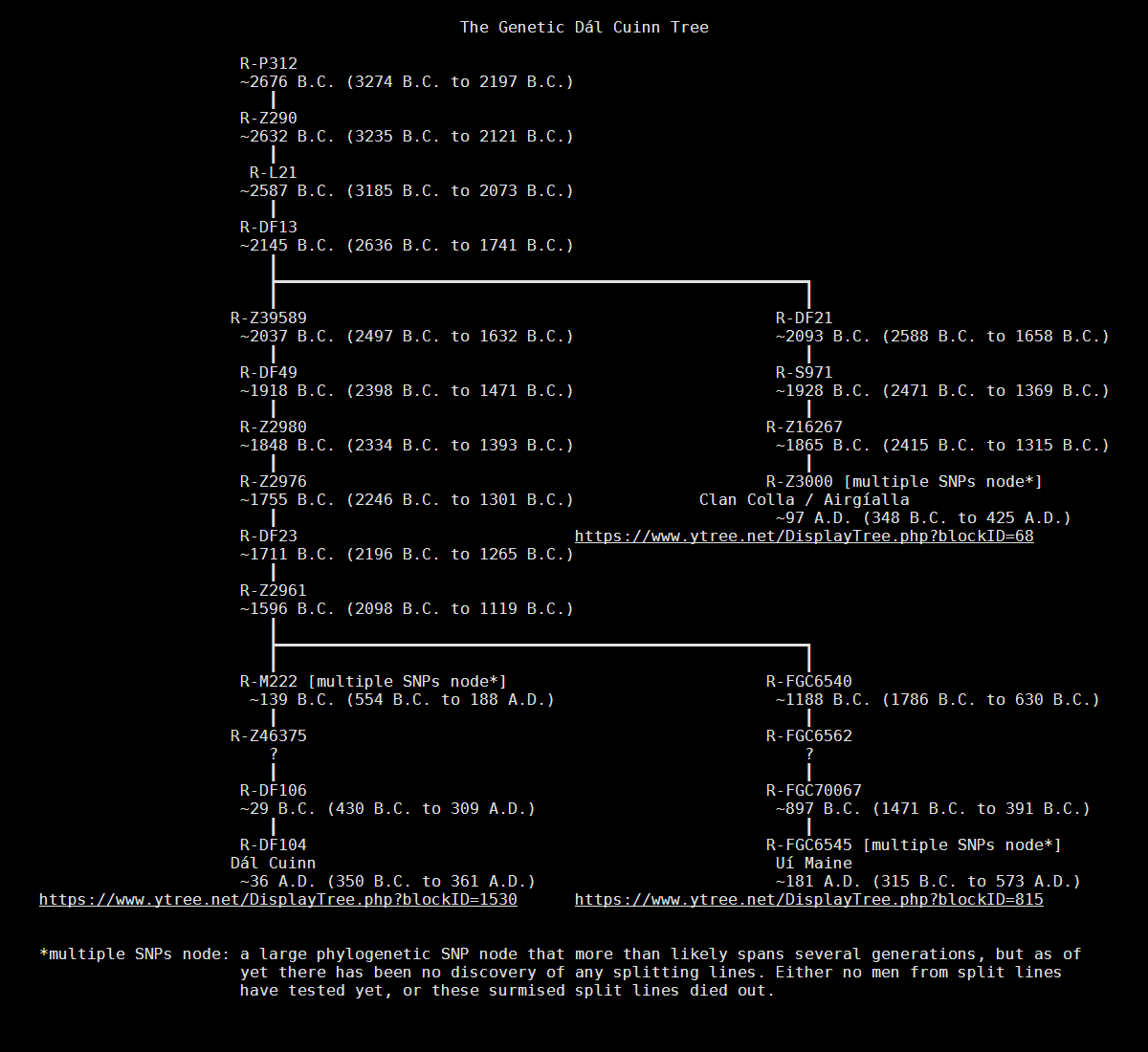
Although the Uí Maini were attached to the Dál Cuinn, typically through one of the Three Collas, the Y-DNA data has shown this to be completely wrong.
Image

Of the traditional Uí Maini families, only the leading two have show up under R1b-FGC6540, the O’Kelly and the O’Madden. The Airgíalla McTraynor family also appears to be showing up here; but that is all. So where are all the other Uí Maini families?

The Y-DNA seems to be revealing that the Uí Maini were not a dynastic group like the Dál Cuinn, but rather a federation of people. These are the preliminary hypotheses for the other constituent members of the federation.
  1. The Uí Fiachroí Find were actually R1b-A1206 Uí Fiachroí Aidne, primarily the Cenél Áeda inda hEchtge. We are seeing a growing O’Naughton presence here with ties back to the correct family; as well as other surnames such as O’Fahy and O’Flanagan.
  2. The O'Mullally were actually R1b-DF85 Uí Néill, Cenél Conaill as were the "Uí Fiachroí" Mac Fir Bisig. Both of these families are showing up under the R1b-FGC71316 subclade with men who have the right geographical and family history connections.
  3. Other Uí Maini surnames appear to be showing up under the R1b-FGC5939 Uí Briúin subclade. The initial surnames in this subclade were those of the Uí Briúin Seóla vassal families enumerated in the Muinter Murcháda Tract. However, as this subclade has grown, other interesting surnames have begun showing up. In particular, Cland Maíl Rúanada surnames such as McDermott and McDonough have appeared. Additional surnames such as O’Rowley and O’Flanagan have also appeared. Research into the annals has raised the question as to whether these are the remnants of the Uí Crimthainn of Cruffon.
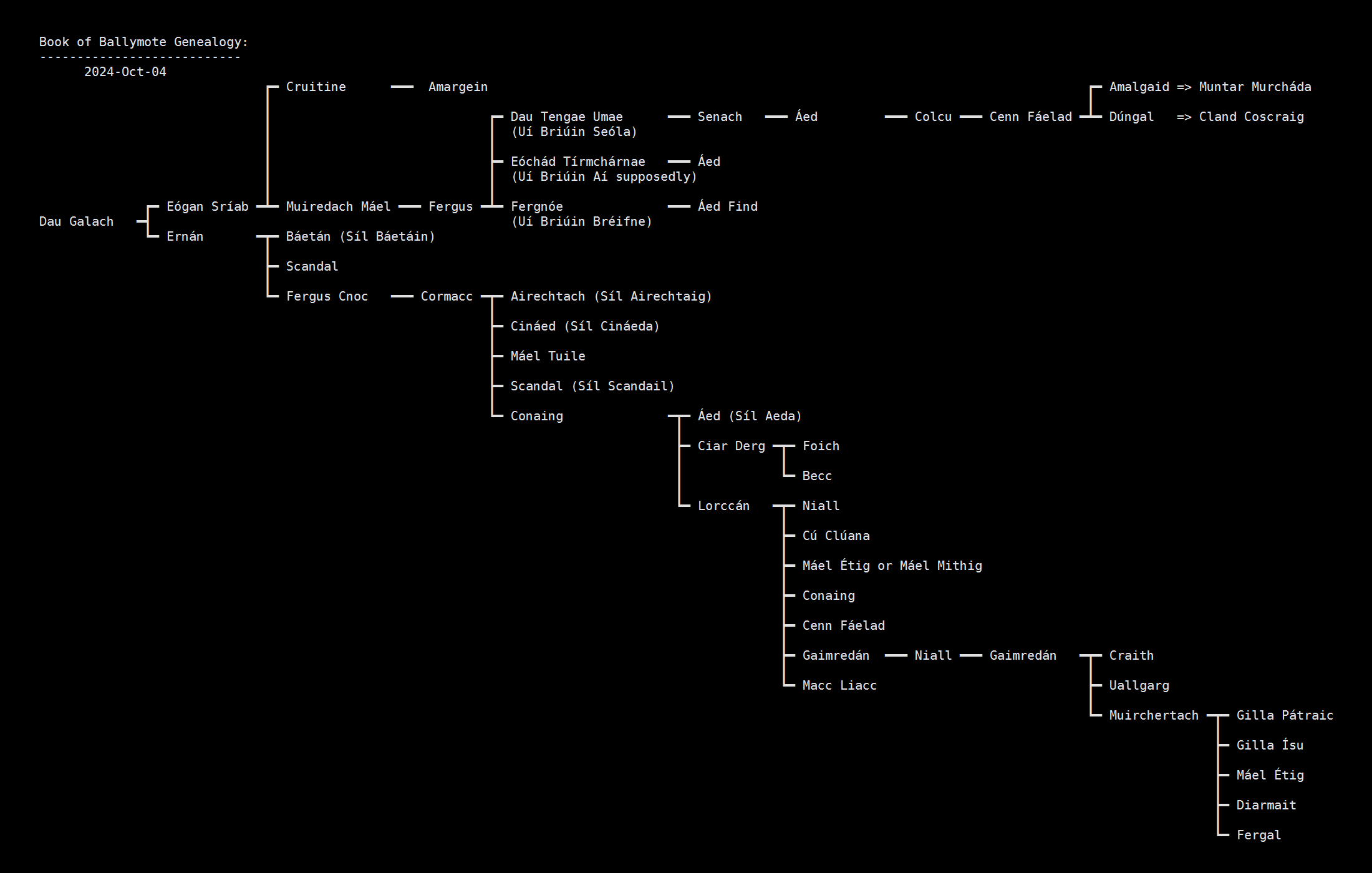
  4. Further research has led to the speculation that R1b-FGC5939 MAY be the true descendants of Eóchád Tírmchárna. The split at R1b-Y166841 for the Uí Briúin Aí and R1b-A260 for the Uí Briúin Seóla and the Uí Briúin Bréifne has destroyed the traditional genealogy of the 3 sons of Fergus. There is an outlying genealogy that states that Muiredach Máel had TWO sons: Fergus and Cathal. This genealogy does not state the Uí Briúin Aí descend from Cathal, but the descendants of Cathal would account for the Uí Briúin Aí, while the descendants of Fergus would account for the Uí Briúin Seóla and the Uí Briúin Bréifne. Further, IF R1b-FGC5939 is the clade for the descendants of Eóchád Tírmchárna, it would explain some of the seemingly anomalous entries in the annals for some of their early actions in the Mag Seóla area. This would also explain the animosity between the Uí Briúin Aí and the Uí Briúin Seóla.
There is much research to be done, but the possibilities being opened up by the Y-DNA are quite intriguing.

Re: The Uí Maini Puzzle

Posted: Wed, 2022-Feb-23 5:44 am
by Muireagain
First question is: are the O’Maddens related to the O'Kellys? For the originator of the O'Kelly (Ceallach) is not an ancestor of the of the O'Madden:

From O'Clery pedigrees:
[Ui Maine]
(col. c). GENELACH H. MHADADHAIN
1676. Murchadh, Cathal, Domhnall, Fearadach, Bresal, Calbhach clann Eoghain m Murchada m Cathail m Madadhain moir.
1677. Murchadh, Eogan, Seaan, Cathal : clann Murcaidh m Eoghain m Murchaidh m Eoghain m Murchuidh m Cathail m Madadhain mhoir m Diermada m Madadhain remair m Gadra m Dunadaigh m Diermada m Aeda m Oilella m Dunadhaigh m Gadra m Loingsigh m Dunadhaigb m Cobthaig m Maile duin m Dungaile m Anmchadha (col. d) m Eoghain buac m Corpmaic m Cairpre cruim. m Feradaigh m Luighdheach m, Dallain m Bresail m Maine moir m Echach fir da ghiall m Dornnaill. m Iomchadhae m Colla fo critb.

Hence an O'Madden would not fall under the O'Kelly haplogroup. Additionally, the BY82177+ Maddens post-date the adoption of the surname O'Kelly, for the O'Kelly lines spilt at BY3437 (which is above BY82177.) The Madden testees from co. Galway, per the FTDNA website, are Z253 and so are closer relatives to the Dal gCas than they are to O'Kelly of Ui Maine.

Another problem is that the only parallel branch the O'Kellys, predate the adoption of the O'Kelly dynastic surname, are the Trainors. Who are a family associated with Oriel and not the lands of the Ui Maine. So maybe the O'Kellys have Airgíalla origins, however they have no discernable relatives in lands of the Ui Maine prior to the adoption of the O'Kelly surname in the 11th century. (I suspect foul play by Brian Boru against the origin Ui Maine line.)

So that leaves the question about the BY198 population common to the Ui Maine lands. The pedigrees that have been associated with some of them, and claiming that they Ui Maine, have no correlation in regard to their halpogroups.

All I know is that the area called Cruffon, and associated with some of the BY198 families, is named for a Crimthainn Cael. He appears in the life of Saint Ciarán of Clonmacnoise, as having a house at Rathcroghan (if memory serves me) and hence suggesting that he was a king of the people associated with the Ui Briuin tribes (A259) and probably their close relatives BY198. Additional, elsewhere it is recalled that he was the first king to kill a Christian woman. So, basically there is a large territory stretching across east Galway and southern Roscommon called Tir Crimthainn, yet its origins is shrouded in mystery. Suggesting that this area might have undergone a rewriting of history. Hence to understand it I think it would be best to pursue the oldest records on the area and people. I know that are least one early saint had a Ui Maine pedigree, I wonder what else could be found?

Bernard.

Re: The Uí Maini Puzzle

Posted: Wed, 2022-Feb-23 8:33 am
by Webmaster
At this point in time I have NO confidence in any of the Uí Maini genealogies prior to ~1100 AD. They just don't track. Re the R1b-BY82177 O’Madden, they may be O’Kelly SCEs, but they are the only O’Madden I have seen.

Re R1b-BY198 and the other direct subclades of R1b-A18726 except R1b-A259, I personally have no doubt whatsoever they are the descendants of Ernán, Dau Galach's second son, whose genealogies are carried for quite a way in the Book Of Ballymote and then abruptly dropped.

Image

Re Cruffon, I will make a longer post later showing what the annals do say about it, which has some extremely interesting tidbits and clearly indicates the confusion the old annalists generated by calling a people by the original inhabitants's territorial name, even if the then current inhabitants had no relationship to the original inhabitants.

Re: The Uí Maini Puzzle

Posted: Wed, 2022-Feb-23 8:55 am
by Webmaster
The synopsis of the following annals entries is that the definition of the Uí Maini seems to change over time and that the Uí Crimthainn (Cruffon) were almost certainly Uí Briúin.

756 AD
AT756.6The battle of Belach Cró gained by Crimthann over the Delbna of Uí Maine, wherein Finn son of Arb, king of the Delbna, fell by Tipraite Finn, and a slaughter of the Delbna including him. And hence are the place-names Lochán Belaig Cró and Tipra Finn.https://celt.ucc.ie/published/T100002A.html#p256
AFM751.10The battle of Bealach Cro was gained by Crimhthann over the Dealbhna of Ui Maine, in which was slain Finn, son of Arbh, Lord of Dealbhna, at Tibra Finn, and the Dealbhna were slaughtered about him. From this are named Lochan Bealaigh Cro, and Tibra Finn. The Ui Maine were contending with them for the cantred between the Suca the River Suck and the Sinainn the River Shannon, for this was called the cantred of Dealbhna. Of this was said:

The battle of the speckled hosts of Bealach Cro,
pitiable the journey of the Dealbhna to it.
Crimhthann the warlike brought destruction
on the fierce Dealbhna Nuadhat.

Finn, son of Arbh, chief king of Dealbhna,
was wounded with large spears,
Of the fierce battle was he chief,
until he fell at Tibra Finn.
https://celt.ucc.ie/published/T100005A.html#p355
Note: These annals entries give rise to some plausible speculation that Uí Crimthainn (Cruffon) was founded at this point in time and consisted of the entirety of the Delbna Nuadat territory. Further, it causes some interesting questions to arise as to exactly who the Uí Maini were until ~1048 AD; after which point it is apparent that the non Dál Cuinn Ó Cellaig had assumed the ascendancy.

757 AD
Kilmore Monastery #2https://en.wikipedia.org/wiki/List_of_m ... _Roscommon
AU757.3The burning of Cell Mór Dithraib by the Uí Chremthainn.https://celt.ucc.ie/published/T100001A.html#p211
AT757.3The burning of Cell Mór Dithrib the great church of the desert = Kilmore by the Uí Crimthainn.https://celt.ucc.ie/published/T100002A.html#p257
AFM752.4Cill Mor Dithraibh was burned by the Ui Crumthainn.https://celt.ucc.ie/published/T100005A.html#p355
879 AD
AU879.8Mael Caere, chief of Uí Chremthainn, was killed.https://celt.ucc.ie/published/T100001A.html#p337
AFM876.8and Maelcaere, lord of Ui Cremthainn, died.https://celt.ucc.ie/published/T100005A.html#p523
Note: It is unclear as to which Uí Crimthainn these annals entries refer to.

1028 AD
AU1029.3Brian ua Conchobuir, heir designate of Connacht, was killed by his own people.https://celt.ucc.ie/published/T100001A.html#p467
AT1027.10Brian son of Cathal Ó Conchobhair, crown prince of Connacht, was killed by Maelseachnaill Ó Maelruanaidh, king of Crimthann.https://celt.ucc.ie/published/T100002A.html#p368
AI1028.6Brian Ua Conchobuir, royal heir of Connachta, dies.https://celt.ucc.ie/published/T100004.html#p197
AFM1029.3Brian Ua Conchobhair, royal heir of Connaught, was slain by Maelseachlainn, son of Maelruanaidh, lord of Crumhthann.https://celt.ucc.ie/published/T100005B.html#p817
CS1028.5Brian son of Cathal ua Conchobuir, heir designate of Connacht, was killed by Mael Sechnaill ua Maílruanaidh.https://celt.ucc.ie/published/T100016.html#p227
1030 AD
AFM1030.8An eclipse of the sun on the day before the Calends of September.https://celt.ucc.ie/published/T100005B.html#p819
AT1030.4Roscommon and Elphin and the whole of Magh nAí were laid waste.https://celt.ucc.ie/published/T100002A.html#p370
CS1030.4Ros Comáin and Ailfinn and all Mag Aí were violated.https://celt.ucc.ie/published/T100016.html#p229
Note: Although there is nothing written explicitly connecting this event with the slaying of Tadc inda Eich Gil Ó Conchobair below, it is easy to surmise the 2 events are somehow connected.
AU1030.5Tadc ua Conchobuir, king of Connacht, and In Got, king of Mide, were killed.https://celt.ucc.ie/published/T100001A.html#p467
AU1030.12Tadc son of Cathal son of Conchobor was killed by Mael Sechnaill ua Maíl Ruanaid, king of Cremthann.https://celt.ucc.ie/published/T100001A.html#p469
AT1030.10Tadhg son of Cathal son of Conchobhar, king of Connacht, was killed by Ó Maelruanaidh, king of Crumthann, and by the Clan Coscraidh including Ecsaide Ó Cathluain.https://celt.ucc.ie/published/T100002A.html#p370
AT1030.12Domhnall the Stammerer, king of Meath, was treacherously killed by his own soldier, Cú Cairn Ó Cobhthaigh.https://celt.ucc.ie/published/T100002A.html#p371
AI1030.5Tadc Ua Conchobuir, king of Connachta, was slain by the Connachta.https://celt.ucc.ie/published/T100004.html#p197
AI1030.6Domnall Got, king of Mide, was killed.https://celt.ucc.ie/published/T100004.html#p197
AFM1030.12*Tadhg of the White Steed Ua Conchobhair, King of Connaught, was slain by the Gott, i. e. Maelseachlainn, grandson of Maelruanaidh, lord of Meath and Cremthainne.https://celt.ucc.ie/published/T100005B.html#p819
AFM1030.20Domhnall Gott, King of Meath, was treacherously slain by Cucaratt Ua Cobhthaigh, one of his own soldiers.https://celt.ucc.ie/published/T100005B.html#p821
AB1030.K7Tadg mac Cathail meic Concubair interfectus est o Maelsecnaill u Mailruanaid ríg Crumthaind.https://celt.ucc.ie/published/G100012.html#p329
CS1030.9Tadc son of Cathal son of Conchobor, king of Connacht, was killed by Mael Sechnaill ua Maílruanaidh, king of Crimthann, and by Clann Coscraidh with Escaidi ua Catluain.https://celt.ucc.ie/published/T100016.html#p229
CS1030.10Domnall Got, king of Mide, was killed treacherously by Cúcaird ua Maílchallann, his own mercenary.https://celt.ucc.ie/published/T100016.html#p229
*Note: AFM1030.12 appears to be a garbled entry that the other entries clear up and expound upon. That is, the slaying of Domnall Got ríg Mide and the slaying of Tadc inda Eich Gil Ó Conchobair were 2 separate and independent events that AFM1030.12 egregiously conflated.

1036 AD
AT1036.2Maolseachlainn Ó Maolruanaidh, king of Cremthann, was killed by Aodh Ó Conchobhair in revenge for Tadhg son of Cathal, and Brian.https://celt.ucc.ie/published/T100002A.html#p375
AI1036.3Mael Sechnaill son of Cormac, royal heir of Uí Briúin, was slain.https://celt.ucc.ie/published/T100004.html#p203
AFM1036.5Maeleachlainn, lord of Creamthaiune, was slain by Aedh Ua Conchobhair, in revenge of Tadhg of the White Steed, and of Brian.https://celt.ucc.ie/published/T100005B.html#p831
CS1036.2Mael Sechnaill ua Maelruanaidh king of Cremthann was killed by Aed ua Conchobuir in revenge for Tadc and Brian.https://celt.ucc.ie/published/T100016.html#p233
Note: AI1036.3 provides a crucial link between the Uí Crimthainn (Cruffon) and the Uí Briúin. It is not as definitive as could be wished for since it does not explicitly say Cormac is the son of Máel Rúanada, but the combination of all these annals entries STRONGLY points to a genealogy of Máel Sechnaill son of Cormac son of Máel Rúanada.

1048 AD
AT1048.13Then came the crown prince of Uí Maine, and Ó Maolruanaidh and Ó Flannacán and the cleric Ó Taidhg and Mac Buadacháin, crown prince of Delbna, and he routed them and killed them all.https://celt.ucc.ie/published/T100002A.html#p389
AFM1048.17A predatory excursion was made by the royal heirs or chieftains of Ui-Maine into Dealbhna where the royal chieftains were all slain, namely, Ua Maelruanaidh, Ua Flannagain, the Cleireach Ua Taidhg, and Mac Buadhachain, royal heir of Dealbhna.https://celt.ucc.ie/published/T100005B.html#p855
Note: These annals entries strongly appear to be related to the Delbna Nuadat territory, not the Delbna bEthra territory. The annals entries for the year 756 AD point to the STRONG likelihood that Uí Crimthainn (Cruffon) was comprised of the entirety of the Delbna Nuadat territory at this time in 1048 AD.

The following annals entries are particularly puzzling since Dub Daingen/Dub Dóengus is recorded as the great grandson of Máel Rúanada, the putative ancestor of the Mac Diarmata, and thus Uí Briúin, NOT Uí Maini. So again, it raises the question of exactly who the Uí Maini were at any given point in time; hearkening back to whether a reference to a people was by their tribal name or territorial name.

1034 AD
AT1034.5Dubh Daingean [Dub Dóengus], son of Donnchadh, of the Uí Maine, that is, the king of Connacht, was slain by his own people, namely Sitric Ó F[gap: extent: 1 word]. [From 1037 AD entries, probably Sitric Ó Flannacáin.]
AU1034.4Dub Daingen, king of Connacht, was killed by his own people.
AI1034.2Dub Daingen was slain by the Uí Maine.
AFM1034.5Dubhdaingean, lord of Connaught, was slain by the Connaughtmen themselves.
CS1034.4Dubdaingen i.e. the son of Donnchad king of Connacht, was killed by his own people i.e. by the Uí Maine i.e. by Sitric ua F.

Re: The Uí Maini Puzzle

Posted: Wed, 2022-Feb-23 2:47 pm
by BuckeyeMike
My attempt to trace the Ui Maini genealogies through the various subclades given by David (above) has led me to the same conclusion as David; they became a loose knit confederation, unlike the gradual separation of the Ui Briuin who fought each other as much as they did other clans :D . My main focus has been the clans in Delbna Nudat. I have condensed some dialog to provide opportunities to discuss smaller sections in detail to help correct my mistakes.

Table #1 (see attached) is designed to provide comparisons between various genealogies. The ages of each individual are calculated on my rough heuristic of 27 years/generation; 54 y/mutation. These are used solely as ‘placeholders’ for SNP’s of the surmised parallel ancestry of FGC5939.
https://docs.google.com/spreadsheets/d/ ... 1351723324

I begin with 2 suppositions:
1. The Ui Maine are not genetically connected to the Three Collas.
2. The genealogy of Colla Fochrith → Imchad → Domnall → Eochaid → Maine (Ui Maine) from Rawlinson and others compared to a genealogy of “Úi Maine of Connacht” provided by Dennis Walsh differ specifically at Imchad.
3. Having found no specific genealogy for Imchad, including the excellent the work at Peters Pioneers (http://www.peterspioneers.com), it can be implied Colla is not the son of Eachach Doimlen (if Eachach was even real).
4. Using Bart Jaski’s chart #72 for Ui Maine and eliminating Colla Fochrith and Imchad, Domnall is left as the progenitor of Ui Maine and the 3rd great grandson of Conn Cétchathach.

This particular Dal Cuinn Ui Maine group branches out @ 500AD (Luighdech mac Dallan)
(Side note: I dislike coincidences. The likelihood of Eochaid Muigmadon and Eochaid Fir da Giall
living within 2 generations when Ui Maine and Ui Briuin diverge is intriguing, but not implausible.)

This data can then be placed in Table #2 to identify the two Ui Maine in Connacht families often mentioned in the annals; Cenel Cairpre Crom and Clann Cremthainn. I am most interested in Clann Cremthainn based on the surmise this particular group is likely the source of the name of the territory of Ui Maine after the southern Ui Briuin clans began to force them north east. (AT756.6 Crimthann defeats Delbna of Ui Maine implies a territory, not a clan.)

I arbitrarily chose Fergus as my anchor for A260 (@450AD). Accordingly, the next mutation, FGC5939, would occur @504AD. As seen above, this is the nearly the same time as the Ui Maine DNA could have diverged.

The annals also give a clue as to the division of the Ui Briuin.
Up until @ 650AD, kings were only called ‘Ui Briuin’. Afterward they are specified as:
- Ui Briuin Seola (Cenn Faelad – 682)
- Uí Briúin Sil Cellaig (Cellach mac Rogallaig – 705)
- Ui Briuin Breifne (Brion Fergna)
- Ui Briuin Ai Síl Muiredaig (Muiredach Muillethan – 702)

My current working theory. We now have 4 Ui Briuin clans and the Connacht Ui Maine genetically connected as Dal Cuinn as late as @280AD under DF108.
• 290AD brothers Muiredach Tírech and Domnaill are progenitors of Ui Briuin and Ui Maine respectively. [edited]
• 500AD the Ui Maine split with brothers Feradaigh and Cremthainn Cael. Part of the Ui Maine confederation settles in Delbna Nudat.
• 650AD, Cenn Faelad (Ui Briuin Seola) begin forcing the other Ui Briuin out of Magh Seola toward Delbna Nudat.
• 700AD the Ui Briuin Ai force Sil Cellach further into Delbna Nudat.
• 750AD Ui Briuin Sil Cellach defeat the Ui Maine in Delbna, possibly conscripting them as vassals.

Please feel free to comment, I look forward to any advice that will correct my many wayward thoughts.
There are still hundreds of dots left that may not connect until more DNA data is gathered.

https://docs.google.com/spreadsheets/d/ ... 1351723324

Re: The Uí Maini Puzzle

Posted: Wed, 2022-Feb-23 8:48 pm
by Webmaster
Mike,

My primary comment is that you are still using the Eóchád Doimlén genealogy for the Uí Maini; but that is who was used to tie The Three Collas to the Dál Cuinn, which connection has been totally broken by the Y-DNA. The Peter's Pioneers website you reference explains that in great detail. So the very existence of Eóchád Doimlén becomes very questionable.

Further, you are hitting on the very subject I am intrigued by: exactly what did the appellation Uí Maini really mean? If it was referring to the lineage that lead to the O’Kelly, then again, that has been shattered by the Y-DNA.

Let me also introduce this twist from the Book Of Ballymote:
123. Fiacha sraiftine atiad a mc. .i. Muiredach tirech a quo in rigraidh & Domnall sen O Maine Chonnacht & Ferghus & Eochu & Feradhach a quo .H. Crimthannan.
This says the Uí Maini of Connacht descend from Domnall son of Fiachu Sraibtine, who would be the putative nephew of Eóchád Doimlén. Interestingly, it also says Feradach was the progenitor of the Uí Crimthainn; but WHICH Uí Crimthainn is unclear, as there is more than one recorded Uí Crimthainn.

But all of these connections for the O’Kelly Uí Maini do not fit the Y-DNA at all. The Three Collas/Airgíalla split off from the Dál Cuinn line centuries before there even was a Conn Cétchathach. The same is true with the O’Kelly and McTraynor line. That leaves the other "Uí Maini" families who do seem to be showing as Dál Cuinn; either Uí Fiachroí Aidne or Uí Briúin, with the Uí Néill, Cenél Conaill O’Mullally exception.

So again, what exactly does the appellation Uí Maini mean? It certainly cannot mean the fictitious monolithic dynastic family depicted in the Hy-Many genealogies. The Uí Fiachroí Find being Uí Fiachroí Aidne for the most part is not too surprising. Even John O’Duggan in his topographical poem seems to allude to this:
O'Maoilmuaidh over Clann-Taidhg; and O'Floinn over Clann-Maoilruain; O'Rothlain over Caille Fothaidh; Mac-Sgaithghil over Corco-Mogha; and O'Braoin over Loch Gealgosa; O'Maille over the two Umhalls; O'Talcharain over Conmaicne-Cuile; and O'Cadhla over Conmaicne-mara; MacConroi over Gnomor; and O hAdhnaidh over Gnobeg; MacAodha over Clann-Coscraigh; O'Flaithbheartaigh over Muintir Murchadha; O'hEidhin, and MacGiollacheallaigh, and the O'Cleirighs, over Ui-Fiachrach Finn; and O'Duibhghiolla over Cinel Cinnghamhna; and MacFiachra over Oga Beathra; and O'Cathain over Cinel-Sedna; and O'Maghna over Caenraighe; and O'Seachnasaigh and O'Cathail, two chiefs of Cinel Aedha.
[ p. 47, under the heading THE PART RELATING TO BREIFNE. ]
That statement about the Uí Fiachroí Find is interesting; although it ties them to the Cenél Guaire, while the Y-DNA points to the Cenél Áeda inda hEchtge, which makes more sense geographically. And in a quick aside, despite John O’Donovan's supposition that the O’Rothlain and O’Braoin families mentioned above referred to the Coolcarney family in the first instance and some unknown Co. Sligo family in the second, all the evidence points to these families being in Cruffon, which fits with your Y-DNA, Mike, as we have discussed previously.

So it all still comes down to the fact that the Uí Maini genealogies for the most part appear to be inventions, not facts. Then if Uí Maini refers to a territory, who were the original inhabitants? The O’Kelly appear to be a transplant from Airgíalla with their McTraynor genetic connection, and all the other families appear to be Dál Cuinn so far; although as Bernard pointed out, the Síl Anmchada O’Madden may have a Dál gCais heritage. So we have a big mess with no easy solution to hand, which means a lot more research is required. But the one thing that is quite clear is that the Uí Maini were NOT a monolithic dynastic family as has been depicted for centuries. This is unlike the Dál Cuinn, who apart from a few egregious discrepancies, do follow their genealogies as evidenced by the Y-DNA.

Re: The Uí Maini Puzzle

Posted: Wed, 2022-Feb-23 10:01 pm
by BuckeyeMike
Thank you David, I stand corrected.
I did not make clear that I believe the correct genealogy would be that of Walsh on Table #1 and commented: "Domnall is left as the progenitor of Ui Maine and the 3rd great grandson of Conn Cétchathach." which matches Book Of Ballymote: "...Uí Maini of Connacht descend from Domnall son of Fiachu Sraibtine", who would be the putative nephew of Eóchád Doimlén.
Forgetting to correct that on Table #2 was definitely an oversite since corrected. The working theory comment will be changed as well.

I think it is very plausible the Ui Maine became a loose fit confederation. IF this particular Ui Maine origin through Domnall mac Fiachu Sraibtine is correct, there is another Ui Maine group in the confederacy to account for the O’Kelly. I have not studied the O'Kelly genealogy. References such as AFM751.10 "Crimhthann over the Dealbhna of Ui Máine" seem to imply Ui Maine as a territory.

Re: The Uí Maini Puzzle

Posted: Thu, 2022-Feb-24 12:37 am
by Webmaster
Mike,

The split of the O’Kelly line from the Dál Cuinn line probably occurred ~2500 BC or thereabouts. So none of those genealogies you are looking at connecting to Conn Cétchathach, fl. ~125 AD, have any semblance of reality. And most of the Dál Cuinn families who were in the Uí Maini confederation probably did not exist until well after 500 AD, the split after Fergus for the Uí Briúin. So again, I dismiss ALL the Uí Maini genealogies prior to ~1100 AD or so. I think they are either badly confused or downright fictitious. I do NOT think the same is true for the Dál Cuinn in general, although there are a few egregious discrepancies.

There is no branching between Conn Cétchathach, who was probably born after R1b-DF104 and Eóchád Muigmedón, who was probably the last mutation in the R1b-DF105 phylogenetic node. Even if Conn Cétchathach had or was DF104+, the only branch parallel to R1b-DF105 is R1b-FT14462 and that must have occurred soon after Conn Cétchathach and NO Uí Maini surnames seem to be appearing there. So if Domnall son of Fiachu Sraibtine really did exist, he certainly does not have living descendants who have tested; which implies he certainly did NOT produce a significant dynastic family such as the Uí Maini.

So again, we are left with a big mess to try to clean up.

Re: The Uí Maini Puzzle

Posted: Fri, 2022-Feb-25 6:59 pm
by BuckeyeMike
The ancient genealogies for the Ui Maine are unquestionably a mess and grafting quite common. However, sometimes a given genealogy will fit the DNA evidence and annalistic references, ie. the Book Of Ballymote which says the Uí Maini of Connacht descend from Domnall son of Fiachu Sraibtine; these should be given due consideration of their accuracy even with the pitfalls of 1500 years.

The Uí Maini of Connacht family in the confederation also has a Clann Cellag who are possibly conflated with the other O’Kelly families referenced below.
Cellaig → Finachta → Oililla → Indrachtaig → Dluthaig → Fichellaig →(Bart adds Flann here) → Dicolla → Eogain Find → Cormaic  → Cairbri Cruim → +4 → Maine Mor.

“The split of the O’Kelly line from the Dál Cuinn line probably occurred ~2500 BC or thereabouts. So none of those genealogies you are looking at connecting to Conn Cétchathach, fl. ~125 AD, have any semblance of reality. “
As I understand, there were at least two O’Kelly lines; the Clan Colla Kelly (Z3000) who “appear to be a transplant from Airgíalla with their McTraynor genetic connection”
and; the Hy Maine Kelly (R-FGC6540) who split Z2961 @ 1600BC. The existence of Ui Maine surnames not included in either of these groups suggests a third Ui Maine, not necessarily O’Kelly. This third family group is Ui Maine of Connacht.

“There is no branching between Conn Cétchathach, who was probably born after R1b-DF104 and Eóchád Muigmedón, who was probably the last mutation in the R1b-DF105 phylogenetic node.”
My table is nearly the same: Conn Cétchathach (DF104), Eóchád Muigmedón (DF109)

“...and most of the Dál Cuinn families who were in the Uí Maine confederation probably did not exist until well after 500 AD, the split after Fergus for the Uí Briúin.”
I believe the Uí Maine of Connacht split occurred the generation or two before Fergus @ 400AD-450AD.

“Even if Conn Cétchathach had or was DF104+, the only branch parallel to R1b-DF105 is R1b-FT14462 and that must have occurred soon after Conn Cétchathach and NO Uí Maini surnames seem to be appearing there.”
There are no Ui Maine surnames under FT14462, but there are Dal Cuinn Ui Maine Aedacain men that are DF198 under DF105.

“So if Domnall son of Fiachu Sraibtine really did exist, he certainly does not have living descendants who have tested.”
All the evidence points to the Dal Cuinn Ui Maine Mac Aodhagain of Connacht.

“...which implies he certainly did NOT produce a significant dynastic family such as the Uí Maini.”
Absolutely. As discussed before, the Ui Maine were a confederation of families and not a dynastic family similar to the Ui Briuin.

“I personally have no doubt whatsoever they are the descendants of Ernán, Dau Galach's second son.”
If Ernan is progenitor of BY198 there is no connection to Cairpre Crom 4 generations later. We have the Ui Maine surname Keegan on the Cladogram under FT94609, tracing back through Cairpre Crom Ui Maine (presumably FT94357)
(Cairpre Crom (FT94357) → Feradaigh → Luighdech (FT94609) → Dallan → Bresail (BY198) → Maine Mor).

There is absolutely no doubt the Ui Maine are not Colla and “...fail to match the Airghialla DF21. Nor does the alleged descent of the DF49 Ui Maine fit in.”
http://www.peterspioneers.com/colla.htm

To be clear, my interpretation of mutations is not precise, but placing parallel SNP’s side by side (BY198 & A259) under Dau Galach (A18726):
IF:
Parallel → A259 (Eogan Srem) & (cousins?) BY198 (Maine Mor/Bresail) under A18726 Daui Galach

AND:
- Chart #72 ‘Ui Maine’ is correct for Maine Mor/Bresal removing
 the erroneous grafting of Colla/Imchad;

- The Walsh 'Ui Maine of Connacht’ genealogy is correct matching chart #72
- Dal Cuinn Ui Maine Mac Aedacain genealogy matches the Ui Maine Keegan, chart #72, and 'Ui Maine of Connacht’ genealogy
- The Book Of Ballymote: Uí Maine of Connacht descend from Domnall son of Fiachu Sraibtine
which matches the corrected Chart #72 and the Ui Maine of Connacht

THEN:

This Ui Maine family, of the Ui Maine confederation in Connacht, ARE Dal Cuinn.

Re: The Uí Maini Puzzle

Posted: Fri, 2022-Feb-25 10:46 pm
by Webmaster
Mike,

To be clear, when I say Uí Maini, I mean a monolithic dynastic group who descended from a common male progenitor, just like the Dál Cuinn. This is what all the Uí Maini genealogies claim. But all the Y-DNA evidence says this is completely wrong.
  1. There was only ONE Uí Maini O’Kelly family and they are R1b-R-FGC6540+. Period. I have spoken extensively with their project leader previously and their genealogies are rock solid back to the late medieval period. And NONE of the other Uí Maini families are appearing here. So that breaks ALL of the Uí Maini genealogies right there.
  2. The work at Peter's Pioneers shows the genealogy back to one of The Three Collas is also genetically impossible. So that eliminates all the Uí Maini genealogies that trace back there. The only shred of truth from those records is the genetic connection of the McTraynor family from Airgíalla with the Uí Maini O’Kelly family in Connacht. The leaves open the possibility that the O’Kelly progenitor migrated from Airgíalla to Connacht, but he was NOT a descendant of The Three Collas.
  3. The split at R1b-DF105 where we see all the different Connachta dynastic groups appearing, the Uí Briúin, the Uí Fiachroí, and the Uí Néill, means that this split occurred after or with Eóchád Muigmedón who came AFTER Domnall son of Fiachu Sraibtine, so any descendants of Domnall would have to have either branched off before or split the R1b-DF105 phylogenetic node, for which we see no evidence so far. So none of Domnall's descendants could be R1b-A259+ or R1b-BY198+ or R1b-FGC23742+. That eliminates any possibility of him being the progenitor of any kind of dynastic group such as the Uí Maini.
  4. You mention the R1b-BY198+ Mac Áeducáin, but they are no different than the R1b-A1206+ Ó Nechtain, Ó Flannacáin, and Ó Fáthaig, the R1b-DF85+ Ó Maíl Álaig, etc. These are disparate familial groups after the split at R1b-DF105.
So yes, the Uí Maini as a confederation appears to have existed, but the Uí Maini as a dynastic group never did, with all the evidence available to us currently. This is very clear from the Y-DNA record. So ALL of the Uí Maini genealogies that try to connect all the above disparate families to a common progenitor are completely fictitious. There never was an Uí Maini dynasty, but there apparently was an Uí Maini confederation.

This is why I discount all the Uí Maini genealogies prior to ~1100 AD as fictitious, but after this it is clear in the annals that the O’Kelly family had become the Uí Maini confederation chieftain. So it appears that fictitious genealogies were written to join all these disparate families into a common dynastic group. That did happen, sadly, but not to the the extent that 20th Century AD historians tried to make out.