The mysterious Uí Briúin na Sionna
Posted: Wed, 2024-Jan-24 6:21 pm
Geography brought me into taking a look at the Ui Briuin na Sionna after my recent research is pointing to a possible association of A5902>FT130287 with Clann Uadach of the Sil Muireadhach, which could be a reason for my clade ending up in Tir Maine. David told me (If I remember this correctly), that the Clann Uadach's original territory was on the Roscommon-side of the Shannon not far from the Doon of Drumsna (Leitrim), which could have been the site of some intermingling between Breifne kin-groups and Sil Muireadhach as they wouldve been practically amongst eachother for 3 centuries before Clann Uadach was positioned by Ó Conchubhair in Tir Maine to exert his authority over the Ui Maine. Looking at the history of the area, I found that the greater part of this area "between Elphin and Jamestown" was "Tir Briuin na Sionna", and part of the Three Tuathas, where Ó Manacháin (of Ui Briuin na Sionna) was chief until pushed out by Ó Birn in 1249. Both of these surnames are still heavily represented in Roscommon/Leitrim however no O'Monaghans show up in any A259+ downstreams, or even A18726 for that matter (unless they have emerged as the Mannions in TBT10109 who have an ancestor with the well-defined Cland Fergaile Ó hAllmuráins). And only one O'Beirn shows up under A10528 "Maicne Ernain" with O'Malleys. The rest of the Byrn/Burn are in A887 which occurred in 1200 among the Muintir Maelmordha in western Cavan. There are Bryans among another of the Breifne Ui Raghaillaigh clades that could also be O'Beirnes. Could all of these groups be more recent NPEs? or is there something largely fictitious about where the Ui Briuin na Sionna came from?
Both Ó Manacháin and Ó Birn are given Ui Briuin genealogies. It's said that the O'Beirns were Sil Muireadhach who "ousted" O'Monaghans, who were "na Sionna" although I can't confirm that. So it would seem that the Ui Briuin na Sionna may have come under Sil Muireadhach control in the 13th c or earlier and became vassals of O Conchubhair. Could the Clann Uadach prior to their placement in Tir Maine been performing the same duties for O Conchubhair among the Ui Briuin na Sionna at an earlier date?
H. Maenachan of Clann Ona mc. Aenghusa in the Book of Ballymote
H. Maenachan is one of the families said to descend from Ona m. Aenghusa m. Earca derg m. Briain m. Echach mugmedoin
Genelach hI Bern from An Leabhar Donn
Domnall ocus Uilliam Dondchad & Tadcc Cairpri & Feradach Dunadach & Rosa & In Gilla Dub clann Mailechlainn m. Briain m. Taidc m. Dondchada m. Domnaill m. Gillacrist m. Imair m. Gillacrist m. Mathgamna m. Gillacomain m. Imair m. Gillananaem m. Domnaill m. Gillacrist m. Conconnacht m. Muircertaig m. Ciaba Gorma m. Muircertaig m. Birnn m. Cinaetha m. Ubain m. Uatach m. Aeda bailb m. Indrachtaig m. Muiredaig Muillethain
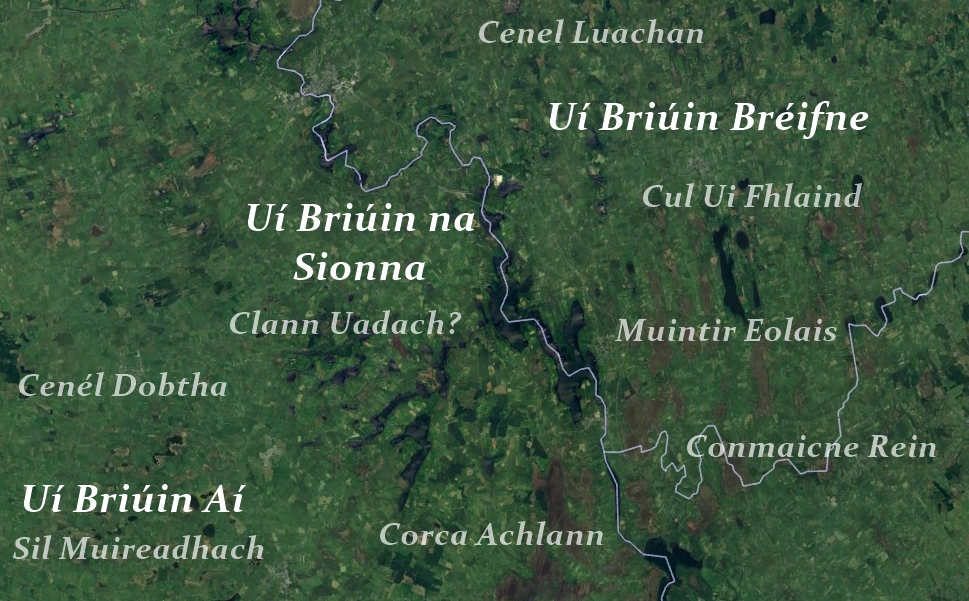
There are certainly enough historical references to define the Ui Briuin na Sionna and their territories (at the very least the parishes of Aughrim, Kilmore, & Clooncraff in Co. Roscommon), but history only records two families ever associated with them, and possibly a third, the Mac Aodh. The Mac Aodh are associated with Aughrim, Co. Roscommon which was Eochraim-mic-Aodh, in Tir Briuin na Sionna, however they don't seem to be Ui Briuin either unless I just haven't come across any Ui Briuin McHughs.
AFM 866.
Flann, the son of Conaing, lord of all Bregia, was killed in the battle of Killoneery by Monaghan, lord of Hy-Briuin na Sionna, on which occasion a bard sung: "'How great was Monaghan's sway, How great his glory on that clay, When he cut off proud Conaing's head, And bore it off in triumph as it bled I In his red right hand, &c.,"
AFM 1145.
The Hy-Briuin (Breifne), with the party of Connacians, made an attack on the fleets of the Sil-Murray, and of the Tuathas, on which occasion Morogh O'Mulrenin, chief of the Clan-Conor, and Donogh O'Monaghan, lord of Hy-Briuin na Sionna, were slain
AFM 1159.
Murray O'Monaghan, lord of Hy-Briuin, of the Shannon, was killed at the battle of Ardee, which was fought between Roderic O'Conor and Maurice MacLoughlin, Monarch of Ireland.
"1196.
Iodhnaighe, or Ignatius O'Monaghan, Lord of Hy-Briuin, of the Shannon, died.
"1218. The English of Meath made an eruption into Hy-Briuin na Sionna, but were repulsed and defeated by the Hy-Briuins.
"1232.
The church of Kilmore, in Hy-Briuin na Sionna, was consecrated by Donogh O'Conor, Bp. of Elphin.
"1249.
Teige O'Monaghan, lord of Hy-Briuin na Sionna, died on the 16th of June, and was interred at Kilmore na Sionna.
AFM 1251.
The rain fell in such torrents in Hy-Briuin na Sionna that a large boat might sail through the Baile of Kilmore na Sionna.
"1342.
Hugh, the son of Felim O'Conor, and Donogh O'Beirne, chief of Tir-Briuin na Sionna, drove Torlogh O'Conor into the church of Elphin, when he went thither to obtain pledges for the reparation of the prey which O'Beirne's people had carried away from Rubert Burke."
"1398.
A party of the MacDermots proceeded to Aughrim Mae Aodh, in Tir-Briuin na Sionna.
" 1415.
Tomaltach, the son of Teige O'Beirne, was slain in a nocturnal aggression by Farrell, the son of Dermot MacRannal, at Cluain Sithe (Cloonshee, Clooncraff p.), in Baile Eile, in the house of Mac-an-Donnanaigh (now Denneny), where, also the daughter of Loughlin O'Hanley was burned.
" 1451.
The three sons of Melaghlin O'Beirne-Teige, William Lind Donogh-were slain at Cluain Creamha (Clooncraff) by the descendants of Melaghlin MacRannall and Donnell, the son of Brian O'Beirne.
The O'Beirne are first mentioned in 1342, well into the timeframe of A887. There are also scattered O'Brians among A260+ downstreams that could also be O'Beirne. Could the Ui Briuin na Sionna be a conglomeration of unrelated people like the Ui Maine? Or at least a scattering of Ui Briuin clades from all three major Ui Briuin kindreds? Did their geographic positioning between much two much more powerful families turn them into a genetic melting pot? It would somewhat explain why 3 of the Cenel Brenaind kin-groups of Breifne not only have no association with Breifne, but seem to have surname "footprints" in Machaire Connacht & Ui Maine.
Both Ó Manacháin and Ó Birn are given Ui Briuin genealogies. It's said that the O'Beirns were Sil Muireadhach who "ousted" O'Monaghans, who were "na Sionna" although I can't confirm that. So it would seem that the Ui Briuin na Sionna may have come under Sil Muireadhach control in the 13th c or earlier and became vassals of O Conchubhair. Could the Clann Uadach prior to their placement in Tir Maine been performing the same duties for O Conchubhair among the Ui Briuin na Sionna at an earlier date?
H. Maenachan of Clann Ona mc. Aenghusa in the Book of Ballymote
H. Maenachan is one of the families said to descend from Ona m. Aenghusa m. Earca derg m. Briain m. Echach mugmedoin
Genelach hI Bern from An Leabhar Donn
Domnall ocus Uilliam Dondchad & Tadcc Cairpri & Feradach Dunadach & Rosa & In Gilla Dub clann Mailechlainn m. Briain m. Taidc m. Dondchada m. Domnaill m. Gillacrist m. Imair m. Gillacrist m. Mathgamna m. Gillacomain m. Imair m. Gillananaem m. Domnaill m. Gillacrist m. Conconnacht m. Muircertaig m. Ciaba Gorma m. Muircertaig m. Birnn m. Cinaetha m. Ubain m. Uatach m. Aeda bailb m. Indrachtaig m. Muiredaig Muillethain
There are certainly enough historical references to define the Ui Briuin na Sionna and their territories (at the very least the parishes of Aughrim, Kilmore, & Clooncraff in Co. Roscommon), but history only records two families ever associated with them, and possibly a third, the Mac Aodh. The Mac Aodh are associated with Aughrim, Co. Roscommon which was Eochraim-mic-Aodh, in Tir Briuin na Sionna, however they don't seem to be Ui Briuin either unless I just haven't come across any Ui Briuin McHughs.
AFM 866.
Flann, the son of Conaing, lord of all Bregia, was killed in the battle of Killoneery by Monaghan, lord of Hy-Briuin na Sionna, on which occasion a bard sung: "'How great was Monaghan's sway, How great his glory on that clay, When he cut off proud Conaing's head, And bore it off in triumph as it bled I In his red right hand, &c.,"
AFM 1145.
The Hy-Briuin (Breifne), with the party of Connacians, made an attack on the fleets of the Sil-Murray, and of the Tuathas, on which occasion Morogh O'Mulrenin, chief of the Clan-Conor, and Donogh O'Monaghan, lord of Hy-Briuin na Sionna, were slain
AFM 1159.
Murray O'Monaghan, lord of Hy-Briuin, of the Shannon, was killed at the battle of Ardee, which was fought between Roderic O'Conor and Maurice MacLoughlin, Monarch of Ireland.
"1196.
Iodhnaighe, or Ignatius O'Monaghan, Lord of Hy-Briuin, of the Shannon, died.
"1218. The English of Meath made an eruption into Hy-Briuin na Sionna, but were repulsed and defeated by the Hy-Briuins.
"1232.
The church of Kilmore, in Hy-Briuin na Sionna, was consecrated by Donogh O'Conor, Bp. of Elphin.
"1249.
Teige O'Monaghan, lord of Hy-Briuin na Sionna, died on the 16th of June, and was interred at Kilmore na Sionna.
AFM 1251.
The rain fell in such torrents in Hy-Briuin na Sionna that a large boat might sail through the Baile of Kilmore na Sionna.
"1342.
Hugh, the son of Felim O'Conor, and Donogh O'Beirne, chief of Tir-Briuin na Sionna, drove Torlogh O'Conor into the church of Elphin, when he went thither to obtain pledges for the reparation of the prey which O'Beirne's people had carried away from Rubert Burke."
"1398.
A party of the MacDermots proceeded to Aughrim Mae Aodh, in Tir-Briuin na Sionna.
" 1415.
Tomaltach, the son of Teige O'Beirne, was slain in a nocturnal aggression by Farrell, the son of Dermot MacRannal, at Cluain Sithe (Cloonshee, Clooncraff p.), in Baile Eile, in the house of Mac-an-Donnanaigh (now Denneny), where, also the daughter of Loughlin O'Hanley was burned.
" 1451.
The three sons of Melaghlin O'Beirne-Teige, William Lind Donogh-were slain at Cluain Creamha (Clooncraff) by the descendants of Melaghlin MacRannall and Donnell, the son of Brian O'Beirne.
The O'Beirne are first mentioned in 1342, well into the timeframe of A887. There are also scattered O'Brians among A260+ downstreams that could also be O'Beirne. Could the Ui Briuin na Sionna be a conglomeration of unrelated people like the Ui Maine? Or at least a scattering of Ui Briuin clades from all three major Ui Briuin kindreds? Did their geographic positioning between much two much more powerful families turn them into a genetic melting pot? It would somewhat explain why 3 of the Cenel Brenaind kin-groups of Breifne not only have no association with Breifne, but seem to have surname "footprints" in Machaire Connacht & Ui Maine.
 So wedged between two Ui Briuin groups were an Ui Broin, the amount of strange coincidences in all this is wild. That is fascinating about the Ui Ailella going that far east, I wonder if there are Sil Muireadhach surnames popping up among them. That map is excellent, I remember you telling me you were using townlands.ie? what tools are you using to outline townlands?