Page 2 of 2

Re: Latest in the Ua Guaire/Ui Coileáin saga

Posted: Mon, 2025-Jun-02 3:26 pm
by Webmaster
Chris,

Wow! Thanks!

Re: Latest in the Ua Guaire/Ui Coileáin saga

Posted: Thu, 2025-Jun-26 3:00 pm
by ChrisMcLain132906
No problem, David! I did come across something odd on a hunch:
Although Ballymote mentions other sons of Dubhdacrioch but doesn't say there were kin groups descended of them, specifically "Dobran" and "Maelbeannachta", I looked into where some variants of these names were if they did exist.

Ó Maoilbheannachta: devotee of the blessing (?) Both Mulvanerty & Mulvaughnaty variants fell out of use. This family is entirely "Blessing", "Blessin", "Blesson" and exists solely within the confines of Breifne, specifically Cloone p., Co. Leitrim.

Ó Dobhrain : A rare connacht surname; "Doveran"/"Duveran" is almost non-existent except for a Clare brehon family that coincidentally anglicized this way. Dobhar meant both otter or "water animal" and also was an adjective for dark, gloomy, unclean. Could be a diminutive of either. However, "Doran" is a Leinster name and appears in fiants with my Ui Guaire in Offaly.

Ó Deoráin, deoraí, wanderer, exile and by extension, a pilgrim. A noted brehon family of Laois and one of the "Seven Septs" there; IF & SGG.

So this certainly piqued my interest not only for the meaning but because it was another brehon family. The Clare family were brehons and said to be from "Dubhdabhoireainn" (Dark one of the two burrens) that changed to O Dabhoireann. I'll have to peruse the bigtree to see of there are any testers from these groups. It may be another case of a name with multiple meanings that were misconstrued in different locales.

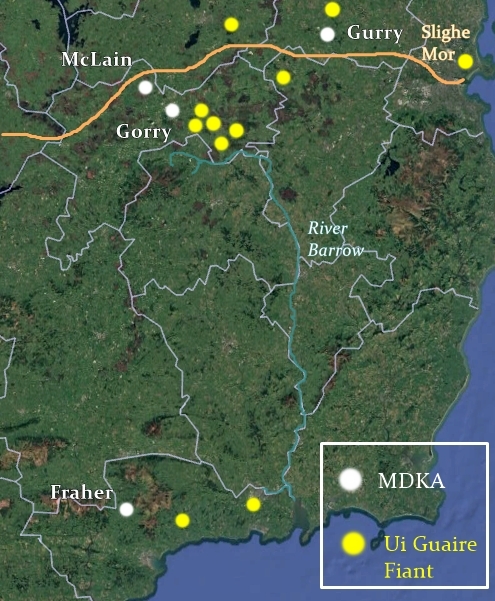
I also may have both disproven my Ui Cuilinn theory but also consolidated a location of at least one settlement in Leinster by trying to establish (via geography and migration routes) the potential for Mr. Fraher's connection to the greater kin-group, which may be the River Barrow...
Image
This is every O/Mac Guaire fiant except for one in Limerick. Looks like someone at some point took a trip down the Barrow and settled. Which if true would mean mine and Fraher's ancestors (c.990-1060) would be an Ui Guaire.
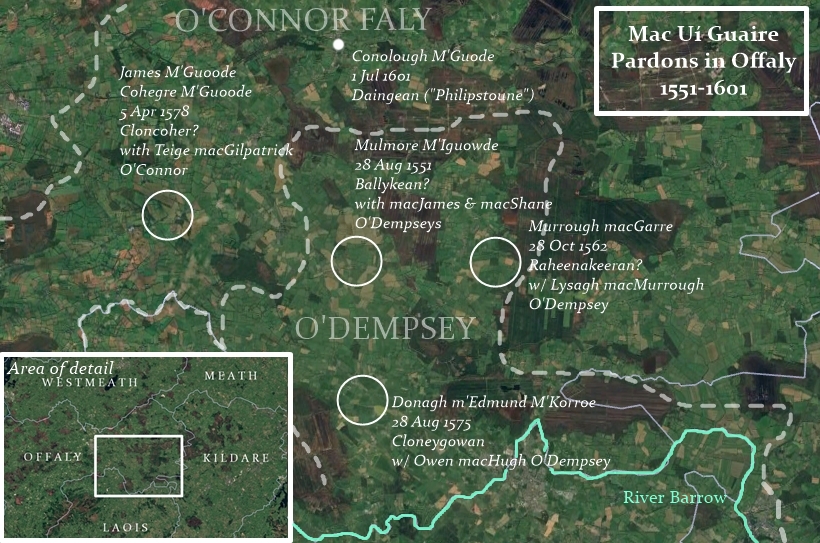
I've been working recently on narrowing down locations in these earlier closer fiants via the locations of the gentry that were named and the common denominator here again seems to point to Clann Maoilughra (O Diomasach), who also controlled Geashill 1337-1540 where the "James M'Guoode" and "Cohegre M'Guoode" were pardoned.
Image

Mac Ui Guaire (if this isn't just a mis-transcription) would indicate for certain this family was from somewhere else. How long people would have used this prefix before it faded into just "Mac" is unknown. Perhaps all the records we see of alternate "mac" prefixes in surnames that are confirmed Ui are really from Mac Ui, in an attempt to differentiate themselves as an independent branch.
O'Dempsey's bards also used this prefix (Mac Ui Crosain), Crosain being a synonym for a satirist or reviler, originally from O'Mordha in Laois.

Re: Latest in the Ua Guaire/Ui Coileáin saga

Posted: Thu, 2025-Jun-26 4:19 pm
by Webmaster
Chris,

So "M'Guoode" is a corruption of Mac Guaire, which Rev. Woulfe only gives as a Scottish surname?

Also of interest is that deorad is related to deóra which in turn could also be teóra, so that Teóra Connachta MIGHT not mean the Three Connachta, but the Foreign Connachta.

Re: Latest in the Ua Guaire/Ui Coileáin saga

Posted: Sat, 2025-Jun-28 6:22 pm
by ChrisMcLain132906
Wow, now would "Foreign Connachta" be referring to the "more recent" entry of Conn's ancestors into Ireland compared to the other big celt migrations that were already there? That's fascinating.

There is a Mac Guaire "Maquarrie" family in Scotland, specifically Ulva in the western isles. It appears that there were probably at least two Ó Guaire families in Leinster, one being mine in the Offaly area with a branch in Waterford and likely another with S. Leinster origins.

I didn't realize until very recently that the "r" was rolled: https://www.teanglann.ie/en/fuaim/guaire which gave the impression "Goo-eh-deh", "Gwah-deh", etc. It's clear from all the odd spellings in the fiants, the english writer was unsure of what was even being said here.

Woulfe gives for Ó Guaire: "Wexford-Waterford, Midlands; Originally from midlands" while MacLysaght says "The original clan was located somewhere between Offaly and Meath". What appears to be a mac-alias, seems to have developed by the prefix Mac Ui by this family. The earliest fiant in 1551 is "Mulmore M'Iguowde" (Máelmuire Mac Uí Guaire). If I compare the other family in the area that I know did this (Mac Ui Crosain) they are "Macicrosan" in the Kildare rental into the earlier decades of the Fiants and by c1580 "M'Crossan". So it seems very probable that many surnames that Woulfe and MacLysaght confirm as Ó-prefixed probably had "Son of the descendant of" branches that in modern times we mistake for just an alternate Mac-prefix, as their Mac Ui generations were not recorded.
This would also explain something I found a while back that I thought was a transcription error:
F.Eliz.2682; Thady M'Y Leyne of Balymakernagh, Co. Waterford. One of John of Desmond's men. 5 May 1576
Mac Uí Laighin?

I figure there was at least another O/Mac Guaire family in Leinster for a few reaons. Not only the frequency of the given name in Leinster in the 8th to 11th centuries that probably spawned a family, but I have two Kilkenny "Gorey" men who are S7898, although I'm not sure of those SNP origins or if they're even NPEs or not. In modern times there was a large Gorey family around Thomastown but this is not supported by any Fiants. And as much as I've been trying to see if I could place the Ua Guaire who was tigherna Ui Cuilinn (AFM1032) and slain by Ui Cennsalaig king Diarmat mac Mael-na-mBo, as potentially in Offaly, the Ui Cennsalaig had a Clann Guaire (confirmed in Rawlinson B502) and ruled several Ui Cuilinn kin groups in the region. This could probably be Diarmat mac Mael-na-mBo exercising authority on an insubordinate sub-chief in his rise to taking the Leinster kingship from the Ui Dunlainge in the coming decade. There are three Ui Cennsalaig kings in the 9th century with "mac Guaire" patronymics so the likelihood that this developed as a surname here is very good, and that the "Wexford Gorrys" that Woulfe identifies are not one & the same as the Midlands-Waterford Gorrys, and were probably the Clann Guaire of Ui Cennsalaig. Potentially the Kilkenny Goreys are not either of these families, and could even be anglo-norman de Gaor, (Gore>Gorey?), however I haven't delved too much into it, but the Gore surname cluster is roughly in Kilkenny/Central Leinster.
Re: Latest in the Ua Guaire/Ui Coileáin saga

Posted: Sun, 2025-Jun-29 12:18 am
by Webmaster
Chris,

Please see my recent post The Original Teóra Connachta. This time frame was right before Eóchád Muigmedón. What is confusing is that supposedly Fiachróe Foltsnáthaig was originally given the Fir Cráebe territory, yet his descendants wound up with a lot of the northern portion of the Fir Domnann territory.

It is not unreasonable that Ailill was given the Tuatha Taíten territory based on what his descendant's territory was by the time of St. Patrick.

So that leaves the original Fir Domnann territory possibly being given to Brión. I speculate that the proto Dál Cuinn originally did land in what became the Fir Domnann territory, according to the Laud 610 description of their arrival. Further, the similarity of Túatha Dé Danann and Fir Domnann leads to speculation about them being the same people by different names. I have said several times I think the myths and legends of the Túatha Dé Danann are distortions of the arrival of the proto Dál Cuinn.

Finally, it also makes one wonder if Niall Noígíallach was not given any territory, or at least not in Connacht, which is why his sons carved out territory in Ulaid and Mide. Nothing is really clear at this point, but it all does engender speculation.

Re: Latest in the Ua Guaire/Ui Coileáin saga

Posted: Wed, 2025-Jul-02 9:14 am
by pdonelan
Fascinating discussion.
I was born and raised in Gorey (Irish: Guaire), County Wexford. When growing up I was given two explanations for the origin/meaning of Gorey/Guaire. The first was "place of goats", and the second was "place of sand". No one ever mentioned or knew that Guaire was a person's name.
Back in the 1980s I investigated the origins of the Tristan and Isolde story. During this investigation I became aware that there were three Ui Cennsalaig kings in the 9th century who were sons of Guaire. I mentioned this to several local historians, suggesting that Gorey/Guaire might have got its name from this Guaire, but they showed no interest in my suggestion.

Re: Latest in the Ua Guaire/Ui Coileáin saga

Posted: Thu, 2025-Jul-03 1:25 pm
by ChrisMcLain132906
I definitely wondered that myself when I first saw the location name. It's probably one of those "coincidental" things they were not able to prove or disprove and they unfortunately rule out pronunciations that they have less records of, and I think there's more cases of that. There is a "Graystown" in Co. Tipperary and in the 16th century it was "Gwerriestown". This is clearly (to me), a Baile Guaire or Baile Ui Guaire. In Laois, a Knockardagur which in the 17th c. was "Knockardogurry" and presently was determined to be Cnoc Ard Ui gCorra. However this is a west Connacht name and doesn't seem to have any evidence placing it in the midlands prior to modern times. This place is probably more correctly Cnoc Ard Ui Guaire. Shrule, Co. Laois near the Kildare and Carlow borders was originally Sruthair Guaire (probably named for an abbot at the ecclesiastic site there).

Logainm.ie says for Gorey town in Wexford that there was an older townland name of "Ramstown". The English-Irish dictionary gives an alternate word pronouced like Guaire, that is Guaireach meaning bristly-haired, which may have led local people to making this connection.

Not only did I come across those three mac Guaire kings and a "Clann Guaire" in Ui Cennsalag, but a very informative website author and researcher for traceyclann.com indentifies who the Guaire may be.
The Life of St. Comgall of Bangor states that Cormac mac Diarmata offered his castle at Ard Crema (Artramon) to saint Comgall. According to the Life of Munnu (or Fintan) of Taghmon, Co. Wexford, he dwelt for twelve years with the Uí Bairrche at Ard Chrema (Aird, Arid, Arit, Ayrd, Crama, Crema, Cremha “height of the wild garlic”) alongside the sea. They were plundered by Guaire Mac Eoghan of Síl Máeluidir, who was seeking the kingship of Uí Cheinnselaigh. St. Munna, when Guaire refused to return their goods, prophesised his death by beheading by his enemies. Smyth (1982) locates this on the north side of the Slaney, to the west of Castlebridge, Co. Wexford, perhaps Artramon.

Variants of the name Guaire appear upwards of a dozen times in the lineages of Leinster families listed in Rawlinson B502. Going through the annals, there were abbots of the name in Glendalough, Slievemargy, Clonfad, and what seems like an abbot or bishop of Kildare in AFM962, Cairbre Ua Guaire. However in Connacht there were several Ua Guaire who were abbots of Tuam Greine, who may be connected to Guaire mac Aidhne, king of the Ui Fiacrach, who I have to assume had a descendant branch who carried his namesake.

"Guaire/Guairi" definitely seems to occur at a higher frequency in Leinster c. 8th-11th centuries and there are probably several families and locational names that may have been deemed to have other meanings.

Re: Latest in the Ua Guaire/Ui Coileáin saga

Posted: Thu, 2025-Jul-17 2:45 pm
by tamcevoy
Chris there are a group of Holly, Hawley, Halleys showing under Z255-The surname Holly in Ireland has roots in both Gaelic and English origins. It can be an Anglicized form of the Gaelic name Mac Cuilinn, where cuileann translates to "holly."