I did have my doubts about STR's, but still used them to narrow down the search. I could have saved some brain matter if only I would have started with the 17 A6925 SNP matches in the Cladogram! I ended up with the same 6 under BY20593 in my top 10 (I couldn't find Desertspring)...the hard way: Dyer GD 12, McCormick GD 14, Samson GD 15, McDermott GD 17. McDonagh I did have to use STR's since he only tested to 37. Live and learn.
By my awkward sort (SNP then STR) I get:
1. Ó Dubuidir? (Dyer FTDNA-MK65894) 12@111+3@67 =15 (just to break ties later)
2. Mac Cormaic (McCormick FTDNA-B432078) 14+4=18
2. Ó Murchada? (Murphy FTDNA-208769) 14+4=18
2.* Ó Maíl Brigde? (Reid FTDNA-IN25527) 13+5=18
3. Mac Diarmata (McDermott FTDNA-246499) 17+4=21
4. Mac Dondchád (McDonagh FTDNA 452991) GD 7 @ 37
I can see the dilemma with the genealogies, based on my limited knowledge of the DNA it looks like Mac Diarmata and Mac Dondchád should be something else; but VERY close.
If you don't mind I'm going to think out loud here. You can turn off the volume at any time.

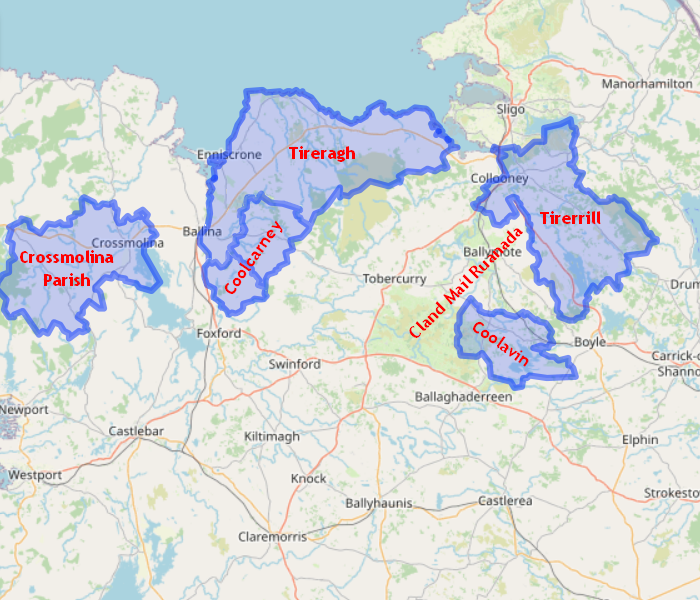
We have 2 sources for Ó Rothláin as "one of four chiefs over Cuil Chearnadha (Coolcarney), which extends from Beul Atha na n-Idheadh to the road of Breachmhagh, in the barony of Gallen, and county of Mayo, 5 miles from the southern border of Sligo." The Uí Fiachrach Muaide territory at its widest reach included the baronies of Erris and Tirawley in Co. Mayo, and the barony of Tireragh in Co. Sligo. Breachmhagh is on the border of Tirawley and Callen. This is the same geography as Coolcarney, which is within the Barony of Gallen stretching across both County Mayo, and County Sligo*. These locations seem to be too far north to be Uí Briúin Seóla or Uí Fiachrach Aidhne. All of this would be Uí Fiachrach Muaide territory, presumably making everyone Uí Fiachrach Muaide genetically? Maybe?
*(Atlas and Cyclopedia of Ireland; P.W. Joyce, 1905?
https://archive.org/details/atlascyclop ... ew=theater)
As you mentioned, Cland Maíl Ruanada territories were close to the eastern and southern boundaries of Coolcarney, which is within the Barony of Gallen stretching across both County Mayo, and County Sligo, the same geographic location. It was unique in that it was a separate principality of the Uí Fiachrach from the rest of the Barony of Gallen. (The Irish Archaeological Society).
Is it possible all of us are Cland Maíl Ruanada, or neighbors? Hmmmm...
When I try to map this out, it looks like all the references take place inside a 15 mile radius of current Attymass, Co Mayo. On the Ordinance map of Mayo, Coolcarney comprised the parishes of Kilgarvan and Attymass. The parish of Crossmolina in the barony of Tirawley mentioned below is also inside this circle, 10 miles NW. Both Attymass and Crossmolina are mentioned often.
-’The Calraidhe of Magh h-Eileag are referenced in other sources such as Hy-Fiachrach as being Uí Fiachrach, Uí Amalgada.’ Is the Uí Amalgada branch the one that became extinct, replaced by their cousins, Uí Fiachrach Muaide or even Maíl Ruanada?
-Cálraighe Mag nEileag – situated on the north-west corner of Lough Conn, County Mayo (also in the same 15 mile circle)
-Cálraighe Mag Muirisc – at the mouth of the river Moy (in the circle).
-Donnchadh Mor had four sons, namely, Brian Dearg O'Dubhda (Dowd), lord of Tireragh, Tirawley, and Erris, who, according to the Annals of the Four Masters, was killed on the road while on his (@30 mile) pilgrimage to the abbey of Boyle. This also places O'Duhda in the same area.
I Found this, but I won't swear to it's validity; I can't verify the identity of the guy who wrote this, if it's the authors interpretation of “Genealogy of Corca Laidhe”, or scholarly fact:
"
The Calraidhe of Muirisc in Tir-Ua-n-Amhalghadha are of the race of the son of Cael, son of 44i Lughaidh Cal, and this sept is the same as Calraidhe of Magh h-Eileag:
[94 Calraidhe of Magh h-Eleag, a sept, giving name to a territory nearly coextensive with the parish of Crossmolina in the barony of Tirawley and County of Mayo. (See Genealogies, &c. of Ui-Fiachrach, p. 238, note f, and the map prefixed to that work.)]
O'Mailfhina is its hereditary chieftain.
*[95 O'Mailfhina, now Mullany.
There is an obvious defect in the text here, which should be as follows:
‘The Calraidhe of this district became extinct, and O'Mailfhina of the race of Aenghus, son of Amhalghaidh, of the sept of the Ui-Fiachrach, became the hereditary chieftain. The family of O'Mailfhina also became extinct, except a few, and the Ui-Gaibhtheachain and the Ui-Floinn, who are also of the race of Aenghus, son of Amhalghaidh, took possession of the land, and are now the most powerful therein.’ The little town of Crossmolina, Cros-Ui- Mhailfhina, in Tirawley, took its name from this family.]
They all became extinct except a few, and the Ui-Gaibhtheachain
[96 Ui-Gaibhtheachain, now Gaughan, a name still common in this district. (See Ui-Fiachrach, pp. 13, 238.]
and the Ui Floinn
[97 The Ui-Floinn, i. e. the family of the O'Flynns. The head of the O'Flynns was seated at Oireamh, now Errew in the parish of Crossmolina, where he was airchinneach of the church of St. Tighearnan. This family possessed a very curious relic called Mias Tighearnain, i.e. St.Tighearnan's dish. (See Ui-Fiachrach, p. 239, note i.)]
took possession of the land, so that they are the most powerful therein, and these are also of the race of Aenghus, son of Amhalghaidh. Cuil-Cearnadha
[98 Cuil-Cearnadha. (See notes 74, 79 supra.) 74 Calraidhe-Innse-Nisc. This was another name for Calraidhe of Cuil-Cearnadha. See note 98 infra, page 31. 79 Calraidhe of Cuil-Cearnadha, a sept seated in the territory of Coolcarney, which comprises the parishes of Attymass and Kilgarvan, in the barony of Gallen, County of Mayo. This tribe opposed the preaching of St. Patrick. (See Genealogies &c. of Ui-Fiachrach, p. 471) They (
the Calraidhe) were dispossessed at an early period by the Ui-Fiachrach.]
is called Calraidhe Cuile from its being in the corner or angle of Fith-Gathlaidh;
[99 Fidh-Gathlaidh, i. e. Gateley's forest, a large forest in the territory of Gaileanga, now the barony of Gallen in the County of Mayo. (See Annals of the Four Masters at the year 1225)]
and, if the learned say truly, it is to it the appellation of Calraidhe Innse-Nisc
[100 Calraidhe-Innse-Nisc. This was another name for Calraidhe of Cuil-Cearnadha. (See note 98 infra, page ???)]
should be given. These are its hereditary tribes, namely, O'Rothlain
[101 its chieftain, O'Rothlain. This name is still extant in this district, but anglicized Rowley. (See Annals of the Four Masters at the year 1208, and Ui-Fiachrach, p. 246, note h.)]
and Ua Cuinn,
[102 Ua Cuinn, now Quin??.]
Ua Iarnain,
[103 Ua h-Iarnain, now obsolete]
and Ua Finain.
[104 Ua Finain, now O'Finan. Dr. O'Finan, formerly Roman Catholic Bishop of Killala was of this family and a native of this very territory]
-"The O’Leary’s One Thousand years Ago, and the origins of the Parish Of Uibh Laoghaire"; by Peter O'Leary (https://irelandxo.com/ireland-xo/messag ... tribe-5-10)
If this is correct and there is an error, the '
Calraidhe of Muirisc' of Cuil-Cearnadha were dispossessed at an early period by the 'Uí Fiachrach, Uí Amalgada' (O'Mailfhina). O'Mailfhina also became extinct except for O'Gaibhtheachain and the O'Floinn (also Uí Amalgada). The hereditary tribes were O'Rothlain, Ua Cuinn, Ua h-Iarnain, and Ua Finain, who would also be Uí Fiachrach ?; but wasn't Amalgada the brother of Nathí, uncle of Fiachnae? (
https://en.wikipedia.org/wiki/U%C3%AD_Fiachrach)
Eochaid Mugmedon>Brion Fiachrae Ailill>Nathí>Fiachnae>(Uí Fiachrach Muaidhe). That makes O'Rothlain, Ua Cuinn, Ua h-Iarnain, and Ua Finain the ones who took over the territory of Coolcarney; they are inaccurately implied as Uí Fiachrach, Uí Amalgada because of the flawed genealogy between Amalgada and Nathí; should be Uí Fiachrach Muaidhe. This matches the Mac Fhirbhisigh reference to 'O'Rothlain ready; the holiday party' in Coolcarney after they take over?
Then again, I’m probably barking up the wrong tree...literally.